Electromagnetic interference is the silent killer of electronic systems. It doesn't blow up your circuit board or melt connectors, but it makes digital signals unreliable enough that processors misread data. By the time you identify the root cause, you've typically burned through multiple testing rounds and significant schedule time.
Aluminum 6061 is the preferred material for EMI shielding enclosures due to its electrical conductivity, machinability for complex geometries with tight seams, lightweight properties for portable electronics, and cost-effectiveness that doesn't require separate business case justification.
The critical engineering aspect of EMI shielding enclosures lies in seam design and joint treatment. An EMI enclosure's effectiveness depends on its worst gap - a 0.5mm seam gap can leak enough RF energy to reduce shielding effectiveness by 20-30dB. This necessitates precisely machined mating surfaces (better than 0.05mm flatness over seam length) and consistent, well-prepared mounting surfaces for EMI gaskets or conductive finger stock.
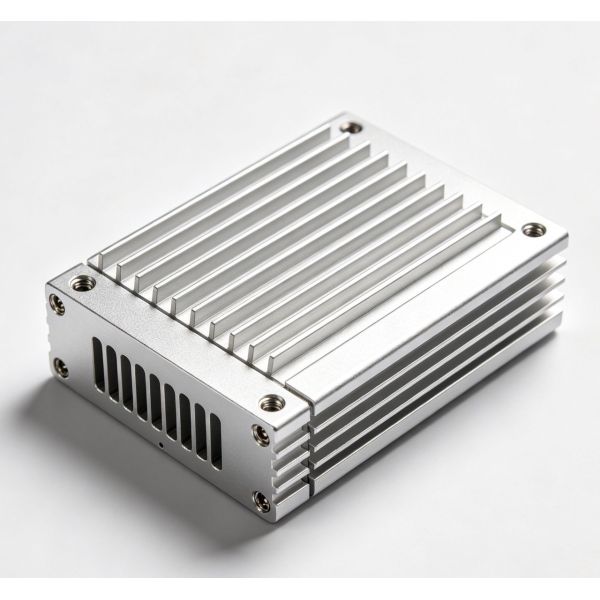
We machine EMI enclosures from solid 6061 billets using 3-axis and 5-axis milling. Machining from solid provides precise wall thickness control, eliminates draft angles and parting lines, and enables integration of internal features like heatsink fins, mounting bosses, and cable gland recesses directly into enclosure walls.
Frequently Asked Questions
Q: Why machine from solid billet instead of die casting?
A: For prototypes and volumes under 500 pieces, machining from solid eliminates the $10,000-50,000 tooling investment of die casting. You also get better dimensional accuracy (no draft angles, no shrink), no porosity (which can create EMI leakage paths), and the ability to change the design between units without new tooling. Above 1000 pieces, die casting becomes more cost-effective - but machining is faster to start and more flexible to change.
Q: Does anodizing affect the EMI shielding performance?
A: Yes, and it depends on the type. Type II (conventional) anodize creates a thin aluminum oxide layer that is electrically insulating - it can reduce shielding effectiveness at high frequencies. Chromate conversion coating (which is conductive) is the better choice for maximum shielding. If hard anodize (Type III) is required for wear resistance, we can strip the anodize from the mating/seam surfaces or apply conductive gaskets to maintain the electrical path.
Q: Can you provide EMC test data for the enclosures?
A: We don't have an anechoic chamber in-house, but we coordinate with third-party EMC testing labs to verify shielding effectiveness on your enclosure design. The test report provides shielding effectiveness data across your frequency range of interest. We've worked with customers to achieve 80-100dB shielding on machined aluminum enclosures.
Q: What's the minimum wall thickness you can achieve?
A: 1.0mm is achievable on small enclosures (<100mm). For enclosures larger than 200mm, we recommend 1.5mm minimum for structural rigidity and to maintain flatness on seam surfaces during assembly. The final wall thickness depends on your shielding requirements, enclosure size, and mounting method.
Q: Can you integrate PCB standoffs and mounting features?
A: Absolutely. CNC machining allows us to machine PCB mounting bosses, threaded inserts, alignment pins, cable gland pockets, and ventilation slots directly into the enclosure walls. This is one of the main advantages of machining from solid - every feature is built into one piece.