Marine Steel Plate Eye Plate for Rope Terminal & Shackle Connections | JIS F 3410-1999 Type C
Product Overview
The JIS F 3410 Type C steel plate eye plate is a welded shipboard connection fitting used for fixing rope terminals, shackles, pulleys, and similar attachment points to ship structures. It provides a compact eye connection where the external load must be transferred through the eye plate, weld legs, and supporting deck or structural member.
This Type C page covers nominal sizes 0.5 to 10 with permissible loads from 4.9 to 98 kN. Unlike a bollard or chock, this product is not a free-standing mooring post or rope guide; it is a welded eye connection point. Selection should be checked together with load direction, shackle fit, weld leg, base structure reinforcement, material grade, surface treatment, inspection requirement, and class approval scope when applicable.
Quick Specifications
Main Technical Parameters
| Nominal size |
Permissible load KN |
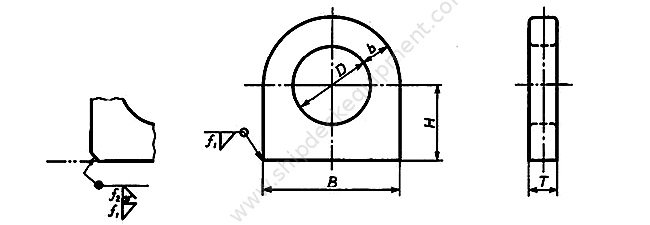
b | B | D | H | T | Welding leg f1 |
f2 | weight |
| 0.5 | 4.9 | 13 | 52 | 26 | 26 | 13 | 4 | - | 0.19 |
| 1 | 9.8 | 15 | 68 | 38 | 38 | 15 | 6 | - | 0.39 |
| 2 | 19.6 | 19 | 86 | 48 | 48 | 19 | 9 | - | 0.78 |
| 3 | 29.4 | 24 | 108 | 60 | 60 | 22 | 11 | - | 1.42 |
| 5 | 49 | 32 | 144 | 80 | 80 | 32 | 13 | - | 3.68 |
| 7.5 | 73.5 | 36 | 162 | 90 | 90 | 36 | 8 | 12 | 5.24 |
| 10 | 98 | 42 | 189 | 105 | 105 | 42 | 9 | 14 | 8.32 |
Selection & Inquiry Guide
Step 1: Confirm JIS F 3410 Type C and nominal size 0.5 / 1 / 2 / 3 / 5 / 7.5 / 10 according to permissible load and vessel drawing.
Step 2: Confirm the actual use: rope terminal fixing, shackle connection, pulley fixing, mooring accessory connection, or other shipboard attachment point.
Step 3: Confirm load direction, connection hardware, minimum shackle requirement if applicable, and whether the application is non-lifting, cargo-related, or subject to special approval.
Step 4: Confirm installation structure: deck, bulkhead, bracket, foundation plate, available welding length, weld leg, local reinforcement, and shipyard weld inspection requirement.
Step 5: Confirm material and finish: SS400 / mild steel / SM400 equivalent / stainless steel option, Sa 2.5 blasting, shop primer, final paint system, or special corrosion protection.
Step 6: Confirm inspection and certificate scope before quotation: material certificate, maker certificate, class certificate, witness inspection, magnetic particle / dye penetrant test, FEA report, or pull test if required.
Step 7: Provide quantity, delivery destination, required delivery time, installation drawing, load sketch, and product photos if this is a replacement project.
Structure
Steel plate eye body | Central eye opening | Smooth contact surface | Welded edge / base area | Welding legs f1 / f2 | Marking area | Blasted and shop-primed surface
Welding, Load Direction & Engineering Advantages
Custom Attributes
How It Works
Rope terminal or shackle is connected to the eye opening → Load is introduced into the Type C eye plate → Force transfers through the steel plate body and welding legs → Supporting ship structure and reinforcement carry the load → Inspection and final coating are completed according to project requirement
Applications
Ship mooring accessory connection | Rope terminal fixing | Shackle attachment points | Pulley fixing points | Deck fittings | Bulkhead or bracket-mounted connection points | Newbuilding projects | Ship repair and replacement work
Certifications & Advantages
Certificates can be arranged according to project requirement, inspection scope, material traceability, and class society approval procedure.
Certification: CCS, NK, BV, ABS, DNV, LR, KR, IRS, RS, RINA, CRS, Makers Test Certificate.
Drawing & Photos

FAQ
Q1: How should the correct JIS F 3410 Type C eye plate size be selected?
A1: Select the nominal size according to permissible load, connection hardware, shackle clearance, load direction, welding leg, and the strength of the supporting ship structure. The table is a webpage selection reference and should be checked against the vessel drawing before production.
Q2: Can this Type C eye plate be used as a lifting pad eye?
A2: It should not be treated as a lifting point unless the project drawing, load direction, weld detail, supporting structure, test requirement, and class approval scope confirm that use. The page describes a JIS Type C ship eye plate for rope terminal, shackle, and pulley fixing; lifting or cargo-handling use must be separately verified.
Q3: What inspection points are important before delivery or installation?
A3: Important checks include material certificate, dimensional conformity, smooth eye-contact surface, absence of visible cracks and flaking, weld edge preparation, surface treatment, and any specified MT / PT, FEA review, class witness inspection, or pull test requirement.