Heavy-Residue Industrial Decanter Centrifuge for Tar Sludge Separation
Description
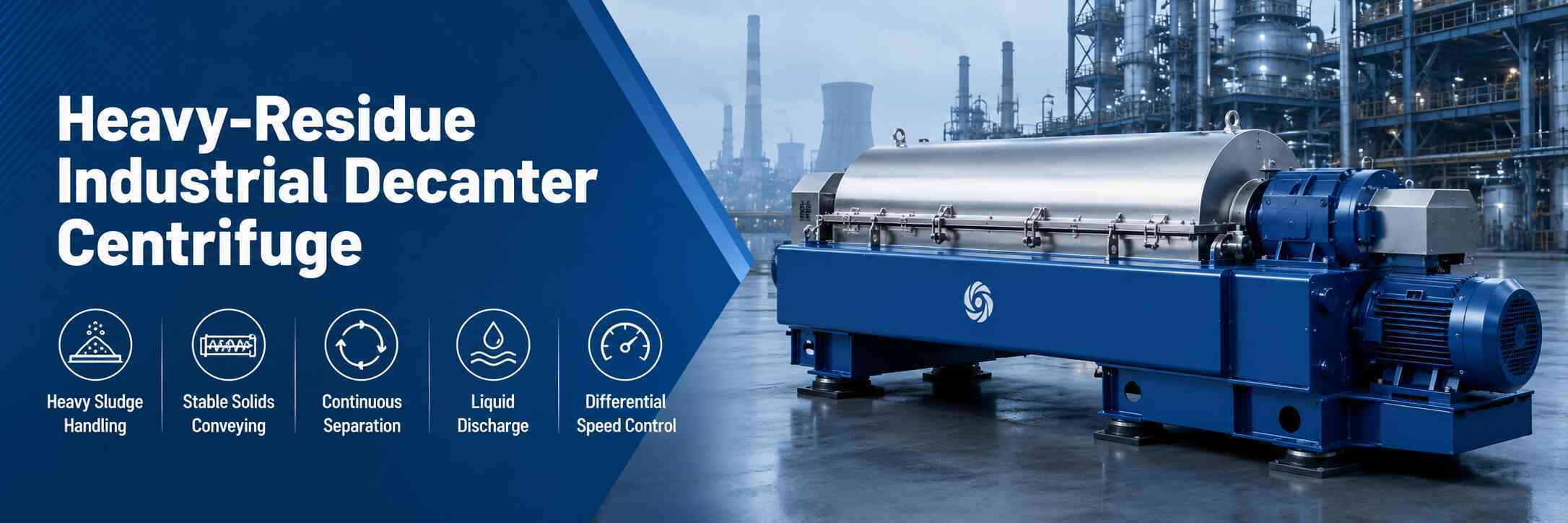
Heavy-Residue Industrial Decanter Centrifuge is designed for separating heavy sludge, sticky residue, tar sludge, high-solids slurry, and difficult-to-discharge industrial materials.
Compared with a standard decanter centrifuge, this machine focuses on high-torque screw conveying, anti-blockage discharge design, controlled differential speed, stable cake removal, and reliable operation under sticky or high-solids feed conditions.
Typical Coal Chemical Applications
- Coal chemical sludge dewatering
- Coking oily residue separation
- Coke tar sludge treatment
- Coal gasification sludge dewatering
- High-solids heavy sludge discharge
- Oily industrial sludge separation
- High-COD sludge reduction
- Coal washing fine sludge treatment
- Gasification black water sludge separation
- Process residue sludge reduction
- Oily scum and heavy residue handling
Why Heavy Residue Is Difficult to Discharge
Heavy-residue materials are more difficult to handle than ordinary wastewater sludge.
The main problem is not only separation. The harder part is often how to push the separated cake out continuously without blockage or overload.
Common difficulties include:
- Tar sludge may have high stickiness and poor fluidity
- High solids content increases screw conveying load
- Oil, tar, fine particles, and sludge flocs can form a dense sticky cake
- Heavy residue may not move smoothly inside the bowl
- Standard screw conveyors may face rising torque under heavy load
- Unstable cake discharge can cause material accumulation
- If discharge is not continuous, blockage risk increases
- Improper differential speed may cause either wet cake or torque overload
- Feed concentration fluctuation can suddenly increase machine load
For this type of material, the centrifuge should be selected as a heavy-duty cake discharge machine, not only as a basic solid-liquid separator.
Key Heavy-Residue Configuration Options
| Configuration |
Purpose |
| High-torque screw conveyor |
For dense and sticky sludge cake conveying |
| Heavy-duty gearbox |
Supports high load during cake discharge |
| Adjustable differential speed |
Balances cake dryness and discharge stability |
| Reinforced feed zone |
Handles heavy sludge impact |
| Large solids discharge opening |
Reduces blockage risk |
| Anti-blockage discharge design |
Supports continuous cake removal |
| Heating interface |
Optional for sticky tar sludge |
| Dosing / conditioning interface |
Optional for improving cake formation |
| Torque monitoring |
Helps prevent overload |
| PLC / VFD control |
Helps stabilize discharge under feed fluctuation |
How the Decanter Centrifuge Works in Coal Chemical Sludge or Coking Oily Residue
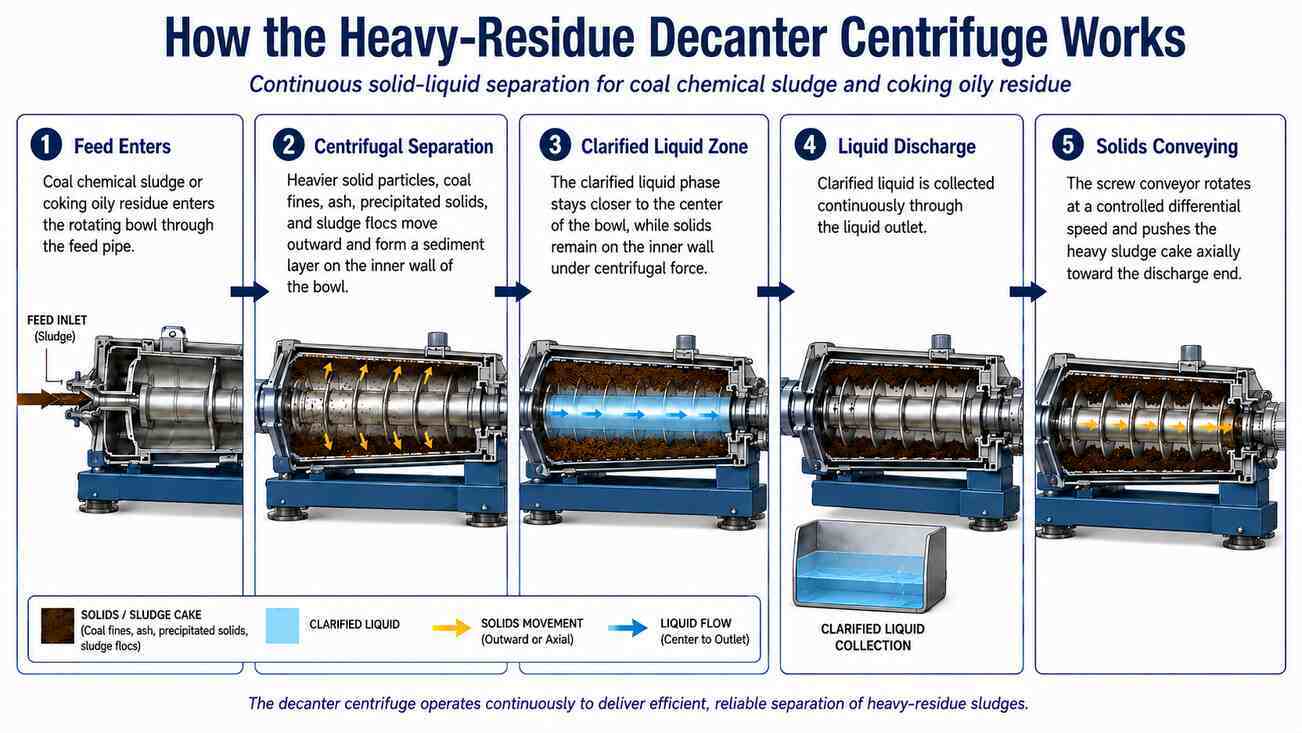
- Coal chemical sludge or coking oily residue enters the rotating bowl through the feed pipe.
- Under centrifugal force, heavier solid particles, coal fines, ash, precipitated solids, and sludge flocs move outward and form a sediment layer on the inner wall of the bowl.
- The clarified liquid phase stays closer to the center and is discharged continuously through the liquid outlet.
- The screw conveyor rotates at a controlled differential speed and pushes the separated heavy sludge cake toward the discharge end.
Technical Parameter
| Model |
Diameter (mm) |
Length (mm) |
Length-to-diameter rate |
G force |
Max solid discharge (m³/h) |
Weight (kg) |
Dimension (L×W×H) (mm) |
| PDC-10 |
250 |
1000 |
4 |
4080 |
0.4 |
1000 |
2410×800×1080 |
| PDC-12 |
4200 |
1350 |
4 |
3500 |
0.6 |
1200 |
2610×800×1080 |
| PDC-12 |
4200 |
1350 |
4.5 |
3180 |
1.2 |
1800 |
3495×840×1180 |
| PDC-18 |
4000 |
1600 |
4.5 |
3180 |
1.2 |
3200 |
3497×1020×1385 |
| PDC-18 |
450 |
2150 |
4 |
2500 |
2 |
3800 |
4447×1080×1385 |
| PDC-20 |
400 |
2250 |
4.5 |
2500 |
3.5 |
4000 |
4580×1140×1470 |
| PDC-21 |
530 |
2280 |
4.3 |
2500 |
5 |
5000 |
4924×1170×1540 |
| PDC-26 |
655 |
2800 |
4.3 |
2270 |
8 |
7000 |
4300×1900×1350 |
Main Advantages in Coal Chemical Heavy-Duty Conditions
Heavy Sludge Discharge Capability
High-torque configuration helps convey dense, sticky, and high-solids sludge more stably.
Suitable for Oily and Tar-Containing Residues
Two-phase or three-phase configuration can be selected according to whether oil recovery is required.
Reduced Sludge Disposal Volume
The centrifuge helps reduce liquid content and total residue volume, lowering downstream transport, drying, disposal, or incineration load.
Wear Protection for Coal Fines and Ash
Wear-resistant protection can be added to the screw conveyor, feed zone, and discharge ports to handle abrasive coal and mineral particles.
Anti-Corrosion and Sealing Options
Material and sealing options can be selected according to coal chemical wastewater composition, odor, vapor, and corrosion conditions.
Explosion-Proof Configuration Available
When oily residue, tar vapor, or hazardous site classification exists, explosion-proof motor, electrical control, grounding, and sealing options can be considered.
Better Adaptability to Feed Fluctuation
PLC / VFD control, torque monitoring, and differential speed adjustment help handle changing feed concentration and solids load.
Expected Results
With proper pretreatment, stable feeding, suitable high-torque configuration, and correct two-phase or three-phase selection, this coal chemical industrial decanter centrifuge can typically help achieve:
- 70–95% solid capture rate, depending on particle size and flocculation effect
- 60–90% suspended solids reduction, depending on separation target
- 25–45% cake solids content, depending on sludge type and oil/tar content
- 30–65% sludge or oily residue volume reduction
- 50–85% recoverable oil recovery, when a suitable three-phase process is used
- More stable discharge of heavy and sticky sludge
- Lower downstream drying, disposal, or incineration load
- Reduced manual cleaning compared with unstable batch handling
- Better process continuity under fluctuating feed conditions
Actual performance depends on solids content, oil/tar content, viscosity, temperature, particle size, flocculation effect, pretreatment, demulsification, machine configuration, and operating settings.
Important note: A decanter centrifuge mainly removes suspended solids, sludge, oil-associated residues, and separable oil phases. It does not directly remove dissolved COD. If the target is dissolved COD reduction, biological, chemical oxidation, adsorption, or other wastewater treatment processes may still be required.
What Data Is Needed for Selection?
To recommend a suitable coal chemical industrial decanter centrifuge, please provide:
- Feed material name
- Coal chemical process type
- Capacity requirement, in m³/h or tons/day
- Feed solids content
- Oil content
- Tar content, if available
- Water content
- Particle size distribution
- Sludge density
- Viscosity
- Temperature
- pH value
- COD level and whether COD is dissolved or particle/oil-associated
- Abrasion condition
- Corrosion condition
- Whether the feed contains flammable components
- Site hazardous area classification, if available
- Current pretreatment method: heating, dilution, demulsification, flocculation, screening, or thickening
- Target cake moisture
- Target liquid clarity
- Target oil recovery rate, if applicable
- Whether two-phase or three-phase separation is expected
- Downstream process after centrifugation
- Required operating hours per day
- Site voltage and control preference
- Need for explosion-proof system or not
- Need for skid-mounted system or not
For coal chemical and coking applications, oil/tar content, solids content, viscosity, temperature, abrasion, corrosion, and safety requirement are especially important before quotation.
FAQ
Is this machine suitable for coal chemical sludge?
Yes. It is designed for coal chemical sludge, coal gasification sludge, coking sludge, oily heavy sludge, tar-containing residue, and high-solids industrial sludge.
Can it separate coke tar residue?
It may be used for coke tar residue separation, but the result depends on viscosity, temperature, oil/tar content, solids content, and pretreatment. Heating or demulsification may be required.
Does the centrifuge reduce COD?
It can reduce COD associated with suspended solids, oil droplets, tar residue, and sludge particles. It does not directly remove dissolved COD. Dissolved COD usually requires downstream wastewater treatment.
Is explosion-proof configuration necessary?
It depends on material volatility and site safety classification. If the feed contains flammable oil, tar vapor, or hazardous gas, explosion-proof motor, electrical cabinet, grounding, and sealing design should be evaluated.
Can the machine handle sticky high-solids sludge?
Yes, but high-torque configuration, proper differential speed, stable feeding, and suitable pretreatment are important. For very sticky sludge, pilot testing or material testing is recommended.
Contact Peony for Partnership
If you have local customer channels or project resources involving coal chemical sludge, coking oily residue, coke tar sludge, coal gasification sludge, high-COD industrial sludge, or oily heavy sludge treatment, Peony welcomes cooperation.
Peony can support local agents, distributors, and project partners with technical model selection, two-phase or three-phase process recommendation, high-torque configuration, wear-resistant design, explosion-proof configuration, skid-mounted system integration, equipment manufacturing, installation guidance, commissioning support, spare parts, and after-sales service.
Please send us your target market, customer type, project background, and cooperation proposal. Our team will evaluate the opportunity and provide technical and commercial support for suitable coal chemical separation projects.