Specifications
Brand Name :
Beishun
Model Number :
XY-3I/450×1400
Certification :
ISO/CE
Place of Origin :
Qingdao
MOQ :
1set
Price :
Negotiable
Payment Terms :
L/C,T/T,Western Union
Supply Ability :
20sets
Delivery Time :
30day
Packaging Details :
20GP
Piston :
Chilled Cast Iron HS 72-75 Hardness
Unit Area Pressure :
21kg/cm2
Automatic Grade :
PLC or Manual
Cylinder Diameter :
500mm
Packing :
FCL/LCL
Structure :
Column/ Frame
Stroke :
300mm
Condition :
New
Working Layer :
1,2,4
Working Layer :
as your requirements
Usage :
For making bigger rubber products
Voltage :
220V
Cylinder Stroke :
Customized
Type :
Column
Power :
10kW
Number Of Rollers :
Three
Core Components :
PLC, Engine, Bearing, Gear, Pump
Roll Length :
1000mm
Heating Method :
Electric
Cooling System :
Optional
Roll Surface Hardness :
HS72-75
Roll Material :
Chilled Cast Iron
Guarantee Period :
12 months
Roller Material :
Nylon/Steel/Chilled Cast Iron
Roller :
Alloy chilled cast iron
Max Pressure :
10MPa
Warranty :
5years
Vacuum System :
Optional
Colour :
all
Description

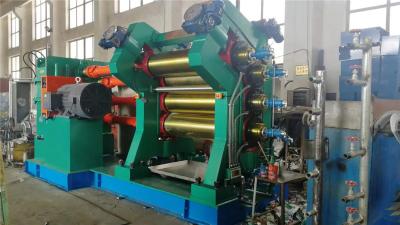
What is an F-Type 3-Roll Calender?

The "F-Type" refers to the arrangement of the rolls. In an F-type configuration, the three rolls are arranged in a vertical or near-vertical line, resembling the letter "F". The material typically feeds between the top and middle rolls and exits from the bottom (between the middle and bottom rolls).

The "3-Roll" means it has three massive, precisely machined cylinders that rotate in opposite directions to squeeze, smooth, and thin the rubber compound into a continuous sheet.


Key Features and Advantages for High-Quality Composite Rubber

1. Superior Sheet Quality and Dimensional Accuracy:

  • Precision Roll Grinding: The rolls are ground to extremely tight tolerances, ensuring perfect cylindricality and surface finish. This eliminates thickness variations.

  • Roll Bending Compensation: Modern F-type calenders are equipped with Roll Bending Systems (e.g., hydraulic cross-axis adjustment). This counteracts the natural "bowing" of the rolls under the immense pressure of the rubber, ensuring a perfectly uniform sheet thickness across its entire width.

  • Controlled Nip (Gap): The gaps between the rolls (nips) are micro-adjustable, allowing for precise control over the final sheet thickness.

2. Excellent for Composite and Laminated Structures:

  • The primary advantage of a 3-roll calender is its ability to perform "Friction Coating" or "Topping".

  • Process: A fabric (like nylon, polyester, or steel cord) is fed through the top nip. Simultaneously, a warm, soft rubber compound is fed into the same nip. The speed of the top and middle rolls can be set at a differential (friction ratio), forcing the rubber to penetrate and coat the fabric weave thoroughly.

  • The now rubber-coated fabric then passes through the bottom nip, where a second rubber sheet can be laminated onto the other side, or it is simply sized to the final desired thickness with a perfect surface finish. This is essential for products like conveyor belts, tire carcasses, and inflatable rafts.

3. Efficient Heating and Cooling:

  • The rolls are cored and designed as heat exchangers. They can be heated with steam, hot water, or thermal oil to a specific temperature profile.

  • Why this matters: Precise temperature control is vital for compound viscosity. A hot roll keeps the rubber soft and pliable for processing. A cooler roll can be used at the final nip to "set" the sheet and prevent it from sticking, a process known as "airing" the sheet.

4. Robust Construction and Control:

  • Built with a massive, rigid frame to withstand tremendous separating forces without flexing.

  • Driven by powerful, variable-speed motors that allow for precise control of roll speeds and friction ratios.

  • Integrated with a Programmable Logic Controller (PLC) and Human-Machine Interface (HMI) for storing recipes, automating the process, and ensuring repeatability.

  • Technical parameters
Specification Roller dia x length (mm) Mid-roller liner speed (m/min) Calendaring width(mm)
XY-3I1120 360x1120 7.5-22.5 900
XY-3L1120 360x1120 2-20 900
XY-3I1400 400x1400 8.8-26.39 1200
XY-3I1450 450x1450 2.5-25 1225
XY-3F1600 510x1600 2.5-25 1375
XY-3F1520 560x1520 1.5-15 1200
XY-3F1830 610x1730 4.5-45 1500
XY-3F2540 810x2540 3-30 2300
XY-3F3400 900x3400 0.54-5.4 3200
XY-4F1120 360x1120 7-21 900
XY-4F1400 400x1400 8.8-26.39 1200
XY-4Γ1600 560x1600 3.5-30 1400

Typical Process Flow in an F-Type 3-Roll Calender

Let's visualize the process for making a fabric-reinforced composite rubber sheet:

  1. Pre-Feeding: The rubber compound is pre-warmed in an extruder (roller die head) or on a 2-roll mill and fed continuously into the top nip.

  2. Fabric Insertion: The fabric substrate is fed into the same top nip, between the rubber compound and the middle roll.

  3. Coating (Top Nip): The rubber is forced into the fabric weave under heat and pressure. A speed differential between the rolls enhances penetration.

  4. Lamination/Sizing (Bottom Nip): The coated fabric passes to the bottom nip. Here, it can be calendered to its final gauge. Optionally, a second layer of rubber can be fed into this nip to create a symmetrical laminate.

  5. Take-Off and Cooling: The finished composite sheet is stripped from the bottom roll by a high-precision take-off conveyor. It then passes over a series of cooling drums to bring its temperature down, stabilizing the dimensions and preventing blocking (sticking to itself when rolled up).


Comparison with Other Calender Types

  • Inverted L-Type (4-Roll): More common for simple sheeting and plastic films. Excellent for thickness control but less straightforward for the friction coating process of a 3-roll F-type.

  • Z-Type (4-Roll): The rolls are arranged in a Z-pattern. This design minimizes roll deflection without complex bending systems because the separating forces are more in line with the frame. Excellent for very wide, high-precision sheets but can be more complex for fabric coating.

Summary: Why it's Ideal for High-Quality Composite Rubber

The F-type 3-roll rubber calender is the machine of choice because it uniquely combines three critical functions in one continuous, automated process:

  1. Precision Sheeting: It produces a rubber sheet with exceptional thickness uniformity and surface quality.

  2. Fabric Coating: Its design is inherently suited for forcing rubber into a fabric substrate, creating a strong, void-free bond.

  3. Laminating: It can easily combine multiple layers of rubber and fabric into a single, high-performance composite structure.

This makes it an indispensable asset in manufacturing high-tech rubber products where consistency, strength, and precision are non-negotiable.


Send your message to this supplier
Send Now

F-Type 3-Roll Rubber Calender Machine with 500mm Cylinder Diameter 10kW Power and 1000mm Roll Length for High-Quality Composite Rubber

Ask Latest Price
Watch Video
Brand Name :
Beishun
Model Number :
XY-3I/450×1400
Certification :
ISO/CE
Place of Origin :
Qingdao
MOQ :
1set
Price :
Negotiable
Contact Supplier
video
F-Type 3-Roll Rubber Calender Machine with 500mm Cylinder Diameter 10kW Power and 1000mm Roll Length for High-Quality Composite Rubber

Qingdao Beishun Environmental Protection Technology Co.,Ltd

Verified Supplier
4 Years
qingdao
Since 2010
Business Type :
Manufacturer, Seller
Total Annual :
4,000,000-5,500,000
Employee Number :
25~40
Certification Level :
Verified Supplier
Contact Supplier
Submit Requirement