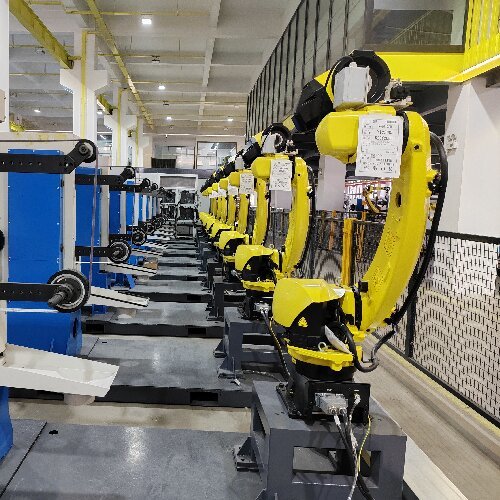
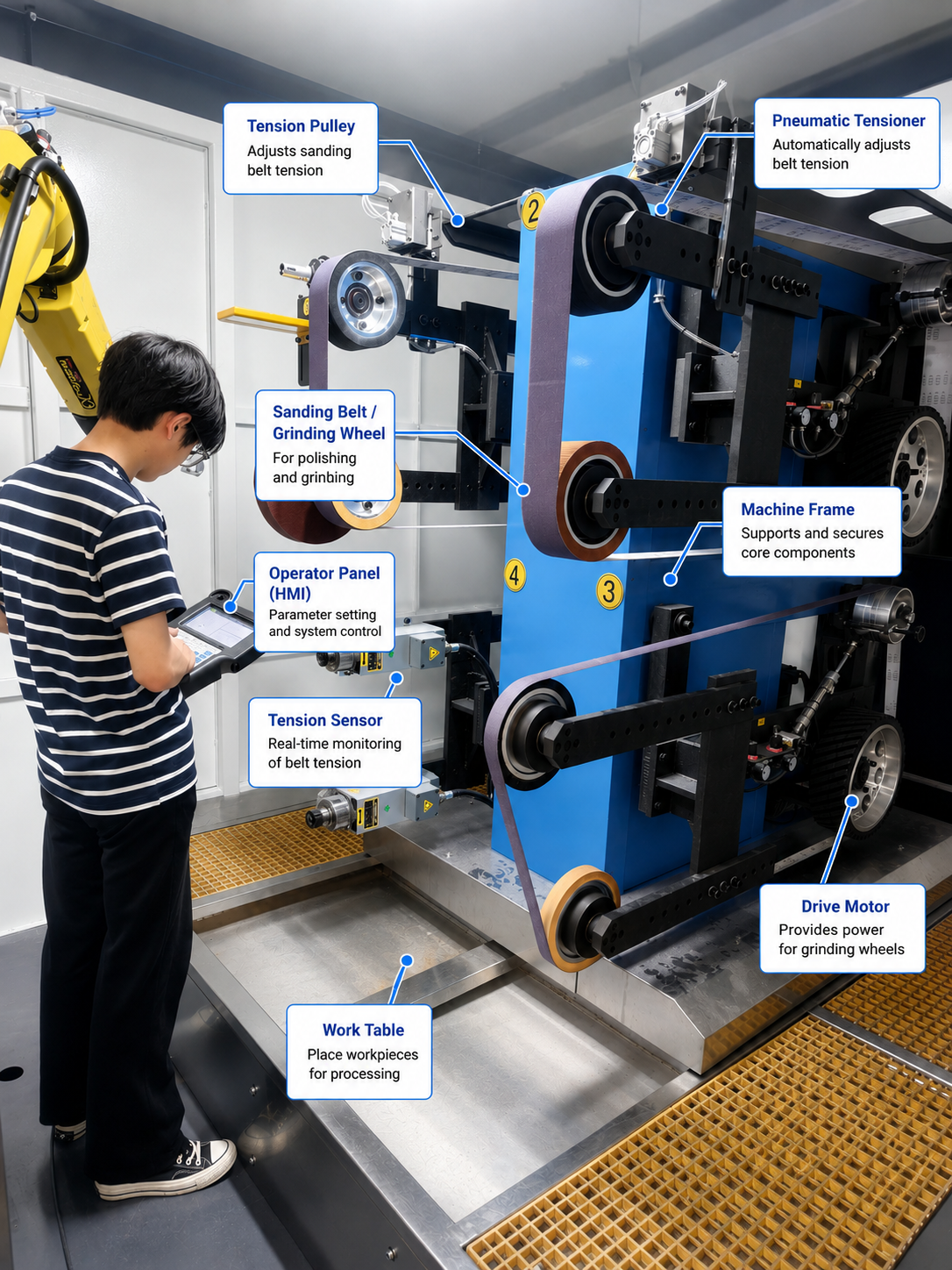
The Flexible Robotic Surface Finish System is engineered for manufacturers who cannot afford to choose between versatility and precision. Purpose-built for high-mix, variable-volume production environments, this system delivers automated deburring, grinding, polishing, and surface conditioning across dozens of part families — without dedicated fixturing, manual reprogramming, or production interruptions between changeovers.
Where conventional robotic finishing cells are optimized for single-part high-volume runs, this system is architected from the ground up for complexity: multiple materials, multiple geometries, multiple surface specifications — all managed intelligently within one compact workcell footprint.
For job shops, contract manufacturers, Tier 2 automotive suppliers, industrial equipment makers, and precision component producers, this is the finishing system that scales with your order book, not against it.
Traditional finishing automation breaks down in high-mix environments because:
This system eliminates all four constraints through adaptive sensing, software-defined flexibility, and modular tooling architecture.
Onboard 3D vision scans each incoming part and generates or selects the optimal finishing path in real time. New part variants are onboarded via CAD import or teach-and-confirm — no full reprogram required. Path library scales to 500+ active part programs with instant recall.
Automatic tool selection and force profile switching based on detected part material and surface specification. The system distinguishes aluminum die-casting flash from forged steel burrs and adjusts spindle speed, feed rate, and contact force accordingly — within the same production sequence.
Pneumatic quick-change end-effector system achieves tool swap in under 6 seconds. Supports simultaneous mounting of up to 8 tool types (flap wheel, wire brush, abrasive belt, polishing pad, carbide burr) accessible within a single cycle without cell interruption.
With the offline programming module, a new part can be onboarded in 2-4 hours using its CAD model. Without offline programming, teach-and-confirm onboarding typically takes 4-8 hours for a new geometry family. Either way, no new fixtures or hardware changes are required.
Yes — this is precisely the design intent. The system's cost-per-part is driven by its consistent cycle time, not batch size. Small batches incur no changeover premium. Customers routinely run single-piece prototype finishing alongside production batches on the same shift.
Material-specific process parameters (spindle speed, force profile, tool type) are stored per part program and selected automatically via vision identification. The tool magazine holds multiple tool types simultaneously — the robot selects the correct tool as part of the programmed sequence with no operator input.