Specifications
Model Number :
KS-1000
Dimensions :
2000 mm x 1500 mm x 1800 mm
MOQ :
1
Delivery Time :
90 working days
Degreesoffreedom :
6
Controlsystem :
Advanced CNC controller with teach pendant
Price :
68000-102000 USD
Cycletime :
Variable depending on task, typically 30-60 seconds per piece
Certification :
CE
Automationlevel :
Fully automated
Payment Terms :
L/C,D/A,D/P,T/T
Powersupply :
220V AC, 50/60 Hz
Reach :
1500 mm
Place of Origin :
China
Payloadcapacity :
10 kg
Supply Ability :
200-300 sets per year
Robottype :
Articulated robotic arm
Productname :
Robotic Surface Finishing System
Brand Name :
Kingstone
Precision :
±0.05 mm
Packaging Details :
wooden cases
Application :
Surface finishing and polishing of various materials
Description
Integrated Robotic Surface Finish System for Automotive Manufacturing
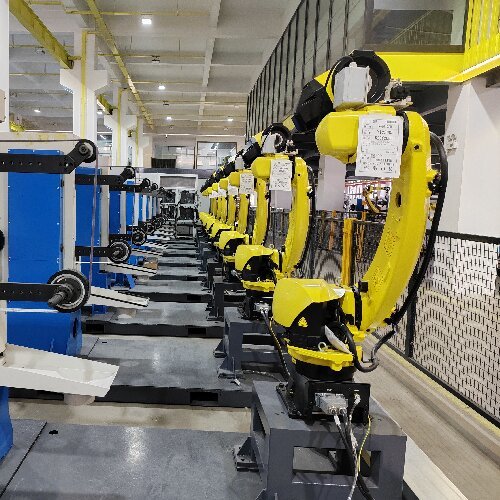
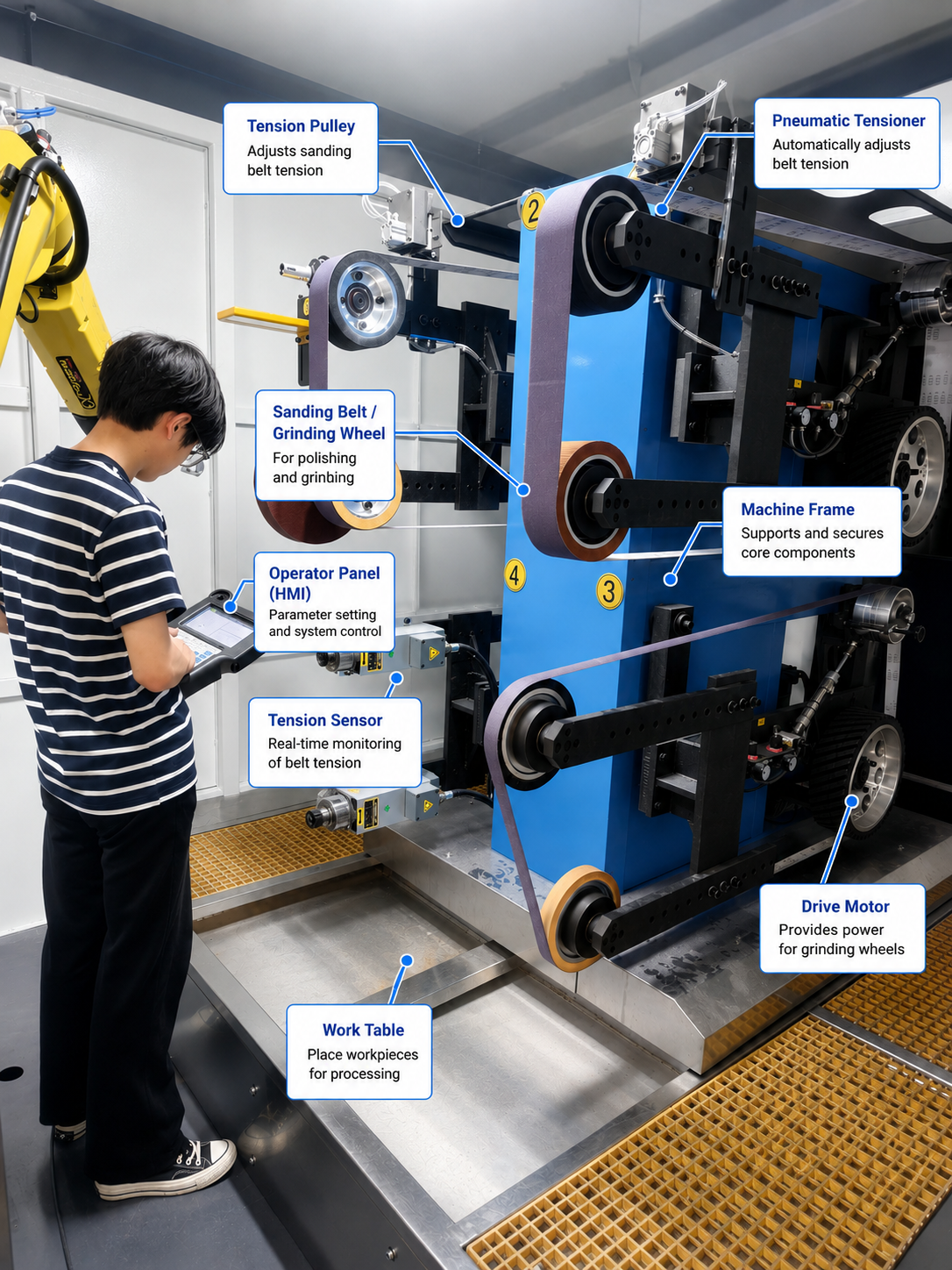
The Integrated Robotic Surface Finish System is a purpose-built automation solution for automotive manufacturers demanding consistent, high-throughput surface quality across complex metal components. Combining robotic deburring, grinding, polishing, and surface conditioning within a single integrated workcell, this system is engineered to meet the uncompromising tolerances of modern automotive production—from structural castings to precision-machined powertrain components.
Powered by 6-axis industrial robots with real-time adaptive force control, the system self-adjusts to part geometry variations inherent in casting and forging processes, delivering repeatable Ra values across every part, every shift, without operator dependency.
Integrated Robotic Surface Finish System for Automotive Manufacturing
Core Capabilities
Multi-Process Integration
Deburring → rough grinding → semi-finishing → final surface conditioning—all within one robotic cell. Eliminate multi-station transfer, reduce inter-process handling damage, and compress your finishing cycle.
Adaptive Force Control Technology
Servo-driven force regulation maintains programmed contact pressure within ±0.3N across variable surface contours. Prevents gouging on thin-wall sections and under-processing on cast flash—the two most common failure modes in manual automotive finishing.
Intelligent Part Recognition
3D vision system identifies part variants and locates datum features in real time. Supports mixed-model production runs without manual reprogramming—critical for automotive platform-sharing and flexible manufacturing strategies.
Process-Locked Quality Consistency
Every finishing parameter—feed rate, force profile, tool contact angle, RPM—is stored per part program. Quality output is decoupled from operator skill level, shift timing, or fatigue. SPC-ready data output for IATF 16949 traceability requirements.
Rapid Model Changeover
Software-driven part program switching achieves model changeover in under 90 seconds. Supports high-mix automotive lines where multiple platforms share the same finishing cell.
System Configuration Options
Robot Selection
  • Standard payload (20-50 kg): ideal for small-to-medium castings
  • Heavy payload (120-180 kg ABB / FANUC): for large structural and chassis components
Processing Modes
  • Dry finishing (standard)
  • MQL (minimum quantity lubrication) for aluminum polishing
  • Wet coolant circuit for precision grinding requirements
Cell Layout
  • Single-arm linear cell (in-line integration)
  • Dual-arm parallel cell (high-throughput twin-part processing)
  • Collaborative robot (cobot) variant for low-volume / flexible lines
Quality Integration Options
  • Post-process inline laser profilometer for 100% surface verification
  • CMM-probe fixture for critical datum face measurement
  • MES / ERP data push via OPC-UA for full traceability
Frequently Asked Questions
How does the system handle the natural dimensional variation between castings from the same die?
The 3D vision system scans each incoming part individually and generates a corrected robot path based on actual part geometry—not a nominal CAD model. Dimensional variation of up to ±1.5 mm is compensated automatically without operator intervention.
Our line runs 6 different platform variants. Can one cell handle all of them?
Yes. Each part variant is stored as an independent program with its own force profile, path data, and tool selection logic. Changeover between variants is triggered automatically by part ID (barcode scan or RFID) with no manual adjustment required.
What is the maintenance requirement and who provides support?
Planned maintenance intervals are every 1,000 operating hours (approximately quarterly for 2-shift operations). Remote diagnostics via VPN-connected HMI allow our engineers to monitor system health, push parameter updates, and troubleshoot without on-site visits. On-site support available within 48 hours globally for critical issues.
Send your message to this supplier
Send Now

Integrated Robotic Surface Finish System for Automotive Manufacturing

Ask Latest Price
Watch Video
Model Number :
KS-1000
Dimensions :
2000 mm x 1500 mm x 1800 mm
MOQ :
1
Delivery Time :
90 working days
Degreesoffreedom :
6
Controlsystem :
Advanced CNC controller with teach pendant
Contact Supplier
video
Integrated Robotic Surface Finish System for Automotive Manufacturing

Zhejiang Kingstone Robot & Technology Co., Ltd.

Verified Supplier
1 Years
zhejiang, wenzhou
Since 2010
Business Type :
Manufacturer
Total Annual :
150000-1000000
Employee Number :
80~105
Certification Level :
Verified Supplier
Contact Supplier
Submit Requirement