Product descriptions
120-300 TPD Vertical Waste Compaction Station – Large-Scale Cost-Efficient Hub
Designed for megacities, intercity waste transfer hubs, and large industrial clusters—especially key Belt and Road metropolises—our 120-300 TPD Vertical Waste Compaction Station combines heavy-duty vertical compression technology with economies of scale. It meets massive waste management demands with unparalleled throughput, slashing unit processing costs and optimizing long-term operational efficiency.
Core Economic & Efficient Advantages
- Scale-Driven Savings: Split into 120-200 TPD and 200-300 TPD sub-models, serving 35,000-100,000 residents or industrial zones. Achieves 20% lower cost per ton than aggregated small-to-medium compactors via optimized energy and labor allocation.
- Maximized Volume Reduction: Compression ratio up to 3.9:1 (waste density 1.02t/m³), cutting garbage truck trips by 70% and drastically reducing transportation, labor, and landfill fees.
- Energy-Optimized Operation: Variable-frequency hydraulic system + load-sensing technology, consuming 18-22kW/h per cycle (15% less energy per ton than standard heavy-duty models). 8-month maintenance intervals minimize downtime and repair costs.
- Stable Returns: 4-6 year investment payback period with predictable low operating costs, ideal for government-led projects, cross-city PPP partnerships, and waste-to-energy plant pre-processing.
Working Principle
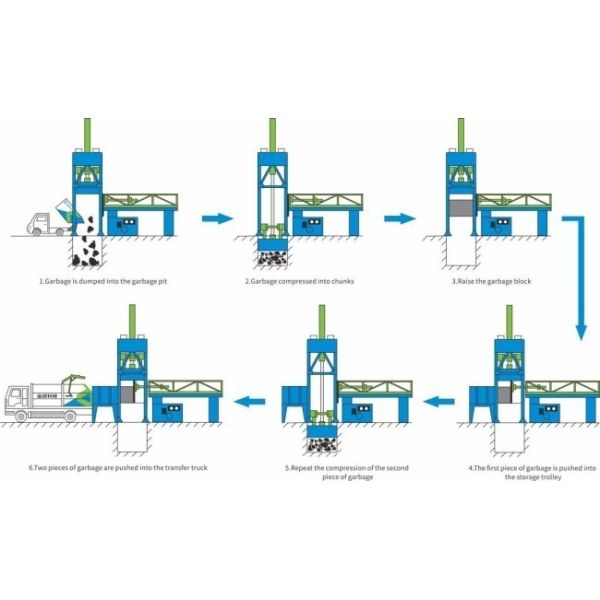
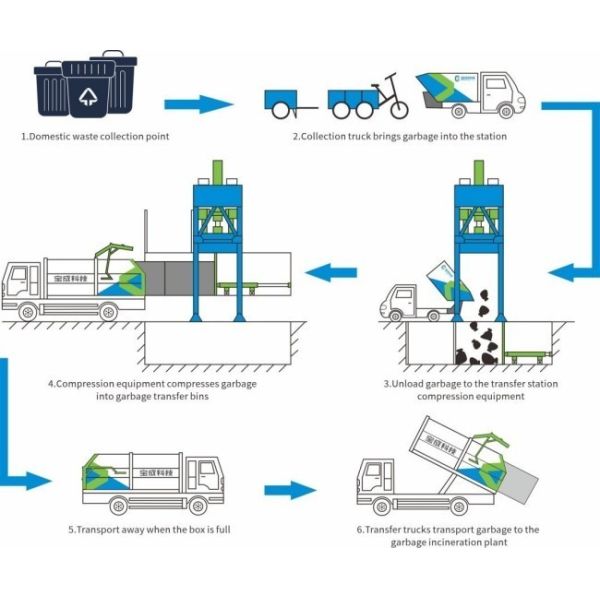
- Waste Loading: Dual widened inclined hoppers + optional automatic conveyors support multi-waste-stream feeding; anti-blocking agitators ensure smooth flow for bulky/high-moisture/industrial waste.
- Vertical Compression: Four synchronous hydraulic cylinders deliver concentrated downward pressure, synergizing with gravity to form ultra-dense blocks. Load-sensing adjusts pressure by waste volume, optimizing energy use.
- Sealed Continuous Transfer: Dual/triple alternating sealed bins eliminate downtime; full bins are hydraulically elevated, with high-speed automatic push plates completing truck transfers in 30-45 seconds.
- Eco-Friendly Treatment: Compression sewage undergoes closed-loop treatment (filtration + pH adjustment) before discharge; triple deodorization (biological + activated carbon + UV sterilization) eliminates odors/bacteria, meeting strict urban environmental standards.
System Configuration
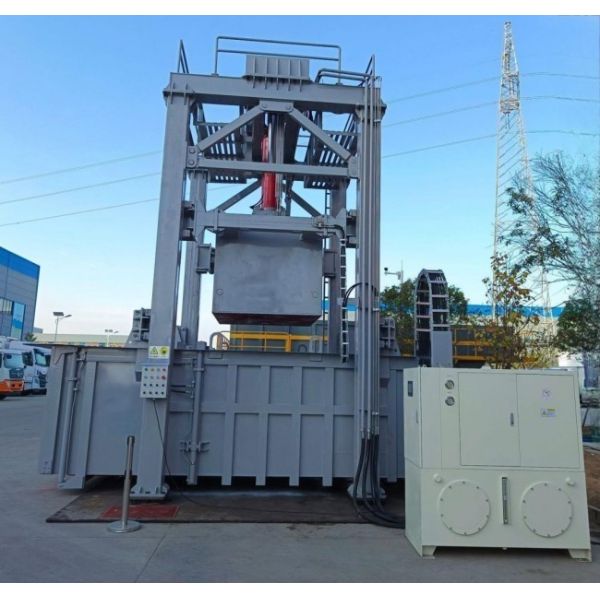
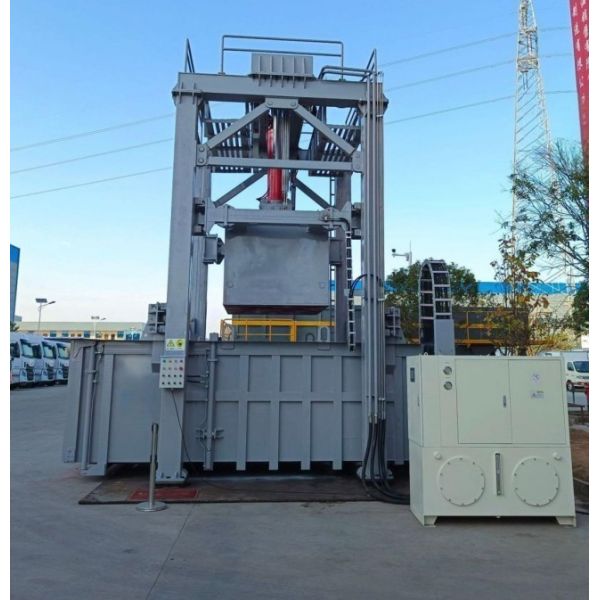
- Main Structure: 16Mn high-strength steel frame (14-16mm thickness) with four-cylinder synchronous compression + six reinforced guide columns for 24/7 heavy-load stability.
- Hydraulic System: Energy-saving variable-frequency oil pump, corrosion-resistant alloy cylinders, and precision pressure-regulating valves—optimized for continuous high-pressure operation.
- Control System: AI-assisted PLC with real-time data analytics, predictive fault diagnosis, and centralized management; supports remote parameter adjustment and energy optimization.
- Environmental Systems: Integrated sewage treatment, triple deodorization, and noise reduction (≤71dB), compliant with global top-tier environmental standards.
- Safety Systems: Multi-layer interlock protection, gas detection (methane/ammonia), fire alarms, and anti-overload/anti-fall devices—meeting ISO 14121 and OSHA standards.
Ideal Applications
Megacities/urban agglomerations, intercity waste transfer hubs, large industrial/logistics parks, waste-to-energy plant pre-processing facilities, and key Belt and Road smart city sanitation projects.
Why Choose This Model?
Leveraging economies of scale, it delivers unmatched cost efficiency with 24/7 continuous operation (via alternating bins), low unit energy consumption, and extended maintenance intervals. Compliant with global environmental and safety standards, it’s the top choice for large government tenders, cross-city PPPs, and waste-to-energy supporting facilities—offering reliable high throughput, tangible cost savings, and sustainable value for megacity sanitation management.
Product Specification
| Parameter | Details (120-200 TPD Sub-Model) | Details (200-300 TPD Sub-Model) |
| Daily Processing Capacity | 120-200 tons/day (3-shift operation) | 200-300 tons/day (24/7 continuous operation) |
| Floor Space | 18-20㎡ (space-efficient for large-scale demand) | 20-22㎡ (reinforced structure for ultra-high load) |
| Compression Ratio | 3.8:1 | 3.9:1 (top-tier in heavy-duty compactors) |
| Waste Density | 1.0t/m³ | 1.02t/m³ |
| Automation Level | AI-enhanced PLC + cloud IoT monitoring (75% manual labor reduction) | Full intelligent automation + multi-station centralized control (80% manual labor reduction) |
| Energy Consumption | ≤18kW/h per compaction cycle | ≤22kW/h per compaction cycle (lower unit energy consumption: 0.07-0.08kW/h per ton) |
| Transportation Cost Saving | 68% (vs. non-compacted waste transport) | 70% (vs. non-compacted waste transport) |
| ROI Period | 4-5 years | 4.5-6 years |
| Noise Level | ≤70dB | ≤71dB |
| Frame Material | 16Mn high-strength steel (14mm thickness, anti-deformation) | 16Mn high-strength steel (16mm thickness + reinforced ribs) |
| Hydraulic System Pressure | 32MPa | 35MPa (high-pressure stable compression) |
| Storage Bin Configuration | Dual alternating bins (12-14m³ each) | Triple alternating bins (14-16m³ each) |
| Maintenance Interval | 8 months | 8 months (with predictive maintenance alerts) |
| Environmental Compliance | EU ECOLABEL, GB/T 38592-2020, US EPA standards | EU ECOLABEL, GB/T 38592-2020, US EPA, and ISO 14001 |