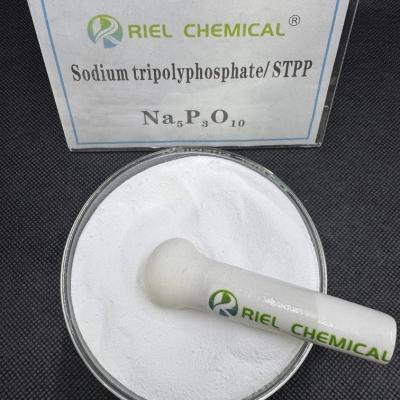
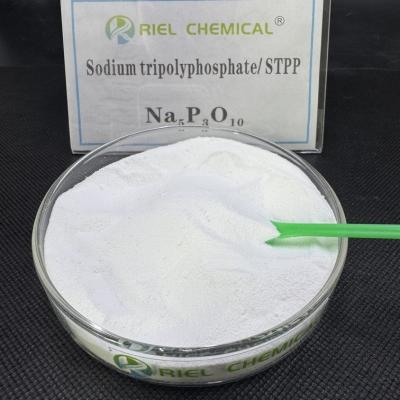
CAS 7758-29-4 Na5P3O10 Sodium Tripolyphosphate For Industry Stpp Powder
Product Attributes
| Attribute | Value |
| CAS | 7758-29-4 |
| EINECS | 231-838-7 |
| Appearance | White particles or powder |
| Crystalline hydrate | Water-free |
| Another name | Sodium Triphosphate |
| Life span | Two years |
| Available port | Qingdao Port, Tianjin Port, Shanghai Port, Lianyungang Port, Fujian Port, Guangzhou Port |
| Fusing point | 622℃ |
| Solubility | H2O: may be clear to slightly hazy |
| Density | 2.52 g/cm³ |
Product Description
CAS 7758-29-4 Na5P3O10 Sodium Tripolyphosphate For Industry
Key Attributes
Molecular formula: Na5P3O10
Molecular weight: 367.86
Industrial grade CAS: 7758-29-4
Industrial Grade Products & COA Meets GB/T 9983-2004 Standard
| Items for detecting and analyzing | Standard value |
| Main content: sodium tripolyphosphate ≥ | 96.0% |
| Phosphorus pentoxide P2O5≤ | 57.0% |
| Water insoluble≤ | 0.10% |
| Iron ≤ | 0.007% |
| Ph Value (1%) | 9.2-10.0 |
| Whiteness ≥ | 90 |
Physical and Chemical Properties of Sodium Tripolyphosphate
- Chemical Formula: Na₅P₃O₁₀
- Molecular Weight: 367.86 g/mol
- Appearance: White crystalline or powdery solid
- Form: Typically exists as an anhydrous compound (Na₅P₃O₁₀) or a hexahydrate (Na₅P₃O₁₀*6H₂O)
- Water Solubility: Highly soluble in water, with solubility increasing with temperature
- Other Solvent: Insoluble in organic solvents (e.g., ethanol)
- Aqueous Solution pH: The pH of a 1% aqueous solution is approximately 9.5-10.5, making it alkaline
- Decomposition Temperature: Decomposes at high temperatures (around 622°C)
- Hydrate Stability: The hexahydrate tends to effloresce in dry air
- Property: Strong hygroscopicity; easily absorbs moisture from the air
- Property: STPP has strong chelating ability with metal ions
- Application: Highly valuable in water treatment, detergents, and processing
History of Sodium Tripolyphosphate
Sodium Tripolyphosphate (STPP) is an important chemical product, widely used in detergent, processing, water treatment and other fields.
1. Early Discovery and Development
- Late 19th century: Chemical properties of phosphate were studied
- Early 20th century: STPP was synthesized as a highly effective chelating agent
2. Industrial Production
- Mid-20th century: Became key ingredient in detergent formulations
- 1950s-1970s: Mass-produced worldwide for household and industrial detergents
3. Environmental Issues and Substitution
- 1970s-1980s: Environmental concerns led to restrictions
- Development of alternatives like zeolite and sodium citrate
4. Modern Applications
- industry: Water retaining agent and quality improver
- Water treatment: Corrosion inhibitor and scale inhibitor
- Other industries: Ceramics, textiles, paper
5. Future Trends
- Environmentally friendly alternatives
- Technological innovation for more eco-friendly production
Uses of Sodium Tripolyphosphate
1. Detergent Industry
Main ingredient in many household and industrial detergents due to its excellent decontamination and water softening ability.
2. Industry
Used as a water retaining agent in meat and sea processing to improve taste and texture.
3. Water Treatment
Used as a corrosion inhibitor and scale inhibitor in water treatment systems.
4. Ceramic Industry
Used as a grinding aid and dispersant in ceramic production.
5. Textile Industry
Used as a washing aid and bleaching stabilizer in textile processing.
6. Paper Industry
Used as a dispersant and retention agent in papermaking.
7. Other Applications
Used in various cleaning agents and industrial cleaning applications.
8. Environmental Protection and Substitution
Gradually being replaced by environmentally friendly alternatives in some fields.
Frequently Asked Questions
1. What is your payment term?
We can accept T/T and L/C at sight as payment term.
2. Are you able to deliver on time?
Of course! We specialized in this line for many years, many customers make deals with us because we can deliver the goods on time and maintain top quality.
3. Do you provide free sample?
Yes, we can provide free sample. You only need to pay the express fee.
4. How about the price? Can you make it cheaper?
We always take the customer's benefit as the top priority. Price is negotiable under different conditions, we assure you to get the most competitive price.
5. Can I visit your company and factory in China?
Sure. You are very welcomed to visit our company in Weifang, China. (We will have someone responsible for picking up and dropping off at Weifang Airport)
6. What if there is a quality problem?
We have a professional and perfect after-sales service team, timely for you to deal with all problems.