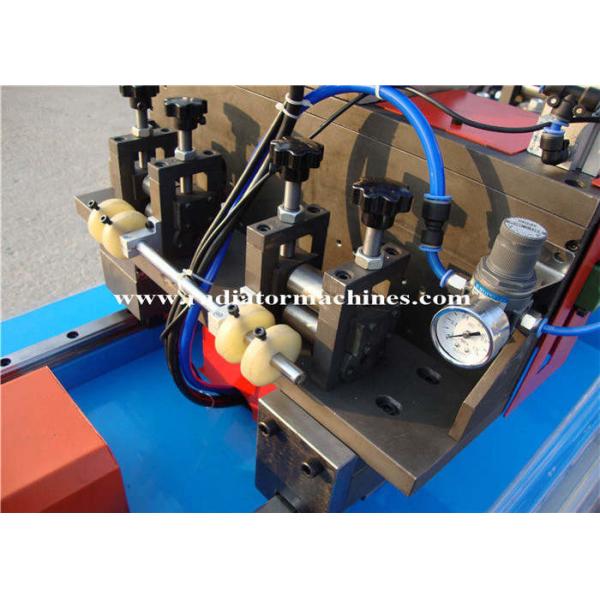
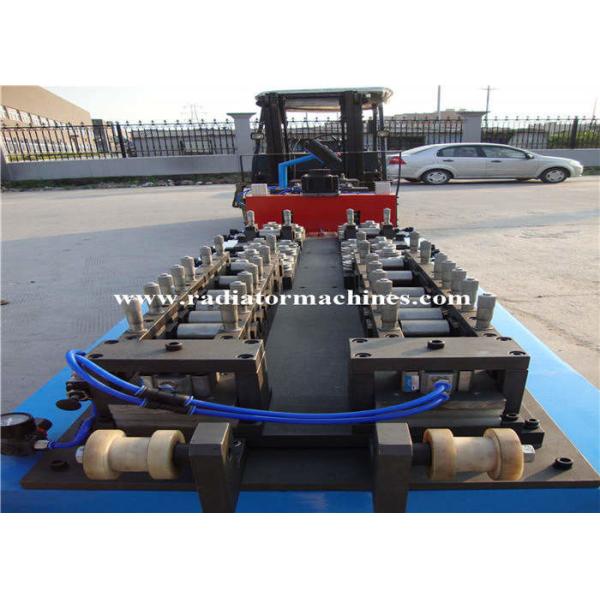
This production line integrates the GS-200 single-channel fin forming machine with an automatic core assembling machine, enabling fully automated core assembly from aluminum foil coils to finished cores. The fin former runs at a stable speed of 180m/min (max 200m/min), while the automatic core assembler handles tube magazine feeding, tube-fin matrix arrangement, core leveling/compressing, and header plate pressing/expanding in a complete workflow. Typical applications include high-volume automated production of passenger car and commercial vehicle radiator cores.
Difficult to balance fin forming speed and accuracy:Fin height consistency fluctuates at high speeds, and cut-off precision is hard to control. Root cause: lack of high-precision servo coordination between tension control and counting/cutting.
Low automation in tube-fin assembly:Tube and fin arrangement relies on manual placement – inefficient and inconsistent. Root cause: tube magazine feeding, tube separation, and fin introduction lack synchronized linkage.
Insufficient core assembly precision:Uneven tube ends lead to poor header plate expansion or tube deformation. Root cause: insufficient timing optimization among leveling, flattening, clamping, and pressing actions.
Disconnected process flow:Fin former and core assembler operate independently, requiring manual transfer between machines. Root cause: lack of interlock signals and automatic material docking design.
3.1 High-Speed Precision Fin Forming Machine (GS-200)
Max speed 200m/min, stable speed 180m/min, cutting frequency ≥100 cuts/min, cutting accuracy ±0 peak (cut exactly at peak)
Tension sensor with servo feed ensures fin height consistency across full speed range; fin height adjustable within allowable range
Counting worm and cut-off servo precisely coordinate – each fin strip has zero peak-count error, stopping uniformly at peak position
Carbide rolls with grinding + mirror polishing – service life ≥3 billion peaks (non-clad aluminum foil) for extended continuous operation
HMI stores 50 tooling specifications – one-touch recipe recall for fast changeover
3.2 Automatic Core Assembling Machine
Bundled tubes loaded directly into tube magazine – no plastic trays required; binding paper automatically removed; star wheel precisely distributes tubes; worm mechanism arranges tubes sequentially
Fin feeding mechanism receives finished fins from the former, automatically inserting them into set gaps between tubes
Tube-fin matrix transferred as a complete unit to core support platform; bridge platform ensures level docking without step difference
Leveling, flattening, clamping, and header pressing/expanding in coordinated sequence – cycle time ≤40s
Servo-driven with motion controller – operating parameters storable for fast changeover
3.3 Full-Line Integration
Fin former provides start/stop and fault signal ports for communication with core assembler – automatic material docking eliminates manual handling between processes
| Parameter | Specification |
|---|---|
| Core height | 350 – 800 mm |
| Core width | 100 – 700 mm |
| Core thickness | 16 – 32 mm |
| Tube width | 16 – 32 mm |
| Tube thickness | 1.4 – 2.0 mm |
| Fin height | 5 – 8 mm |
| Tube rows | Single row |
| Cycle time | ≤40 s/unit |
| Fin former stable speed | 180 m/min |
| Cutting accuracy | ±0 peak (cut at peak) |
| Roll service life | ≥3 billion peaks (non-clad aluminum) |
| Compressed air | 0.4 – 0.7 MPa |
| Power supply | 380V / 40A |
| Line dimensions (L×W×H) | 5500×2800×2700 mm |
| Line weight | ≈10.2 tons (4.2t former + 6t assembler) |
5.1 Recommended Scenarios
High-volume automated production of automotive radiator cores
Production upgrades seeking faster fin forming speed, higher precision, and reduced labor dependence
Customers requiring seamless automated interfacing between fin forming and core assembly
5.2 Key Selection Considerations
Product size range: Verify core height (350–800mm), width (100–700mm), thickness (16–32mm) are within coverage
Fin parameters: Confirm fin height (5–8mm) and aluminum foil thickness (0.05–0.15mm) are compatible
Fin width: Verify required fin width is within customizable range of 12–56mm
Capacity: Line cycle ≤40s/unit – calculate against daily output requirements
Q1: What is the service life of the forming rolls?
A: The rolls are made of carbide with a service life of ≥3 billion peaks (non-clad aluminum foil) and ≥2 billion peaks (clad foil). One-year warranty period.
Q2: How are the fin former and core assembler connected?
A: The fin former provides start/stop and fault signal ports for interlock communication. Finished fins are delivered directly to the assembler's fin feeding mechanism via a turnover and upright conveying device.
Q3: Is changeover convenient?
A: The fin former HMI stores specifications for 50 tooling sets – one-touch recall. The core assembler uses quick-change tooling with storable key position parameters – overall changeover is fast and efficient.
Q4: How is cut-off accuracy ensured?
A: A servo-controlled counting worm adjusts in real-time based on roll speed and material accumulation, precisely positioning each fin strip with zero peak-count error – cut consistently at the peak.
Q5: Can the equipment connect to MES systems?
A: Equipped with MITSUBISHI motion controller and PLC supporting data acquisition interfaces – MES integration available upon request.
Premium components: MITSUBISHI motion controller & servos, AIRTAC pneumatics, OMRON sensors, WEINVIEW HMI, SCHNEIDER buttons – long-term reliability
High-speed fin forming: 180m/min stable speed, carbide rolls with long life, high precision, and fast changeover
Fully automatic core assembly: Tube feeding, separation, fin insertion, leveling, flattening, and header pressing/expanding – all automated
Full-line integration: Fin former and core assembler automatically docked – no manual transfer between processes
Full support: User manual, inspection report, and remote diagnostics available