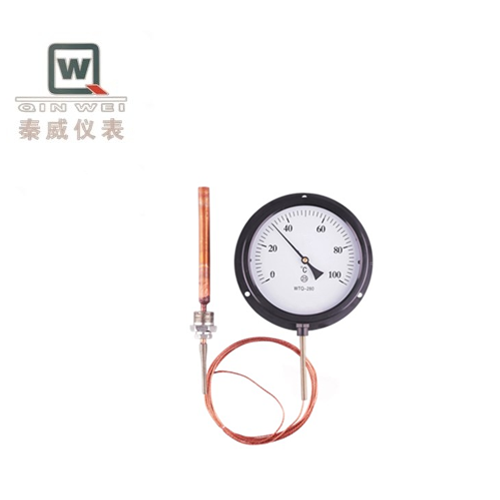
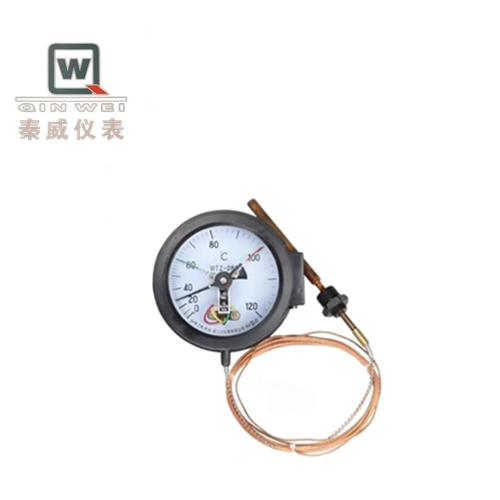
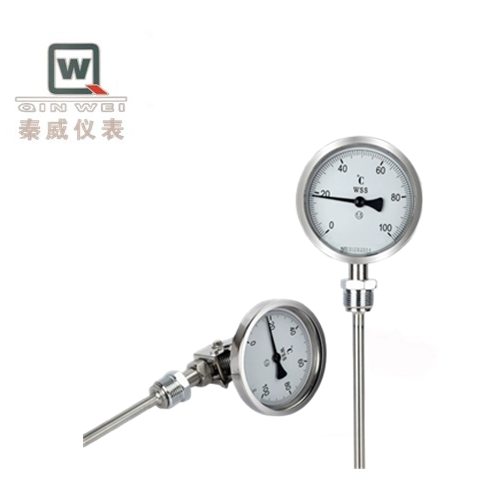
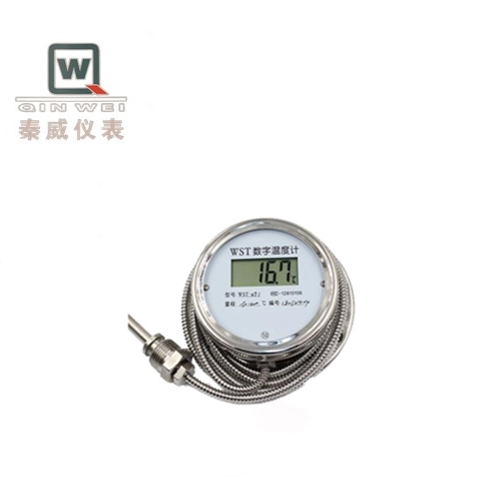
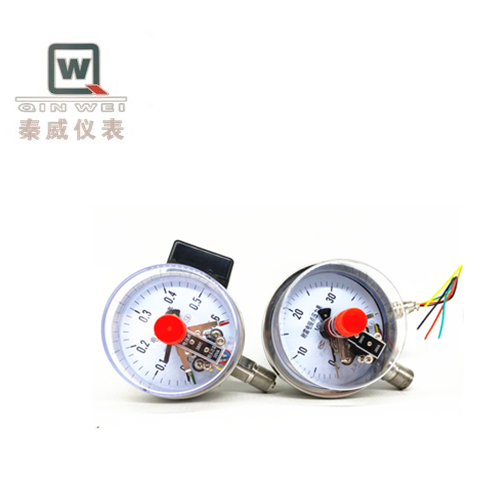
The steam pressure thermometer operates based on the law of saturated vapor pressure.
Filling medium: Low-boiling-point liquids and their saturated vapors (such as ,methyl chloride, ethyl chloride).
Principle: Based on the variation of saturated vapor pressure of low-boiling-point liquids with temperature.
Features:
- High sensitivity: Inside the bulb, the saturated vapor pressure changes significantly with temperature, thus the sensitivity is very high.
- Non-linear scale: The saturated vapor pressure has a non-linear relationship with temperature, resulting in a denser scale at the lower temperature range and a sparser one at the higher temperature range.
- Little influence from ambient temperature: The pressure only depends on the temperature at the bulb (where the evaporation interface is located), and changes in the ambient temperature of the capillary tube and the gauge head have almost no effect.
- Limited range: The measurement range depends on the boiling point of the liquid filled, and the range is usually narrow.
Typical application scenarios
- The characteristics of the steam pressure thermometer make it particularly suitable for fixed-point measurement or control at temperatures near room temperature, where high sensitivity is required and the ambient temperature is higher than the measured temperature.
- Refrigeration and air conditioning systems: This is its most classic application field. It is used to measure condensing temperature, evaporation temperature, ambient temperature, etc., and is often used to control the start and stop of compressors.
- Constant temperature water bath/oil bath: Situations in laboratories or industries where a fixed temperature needs to be maintained.
- Process alarm: Used as a simple temperature switch, for example, in grain storage and greenhouses for low or high temperature alarms.
- Automotive air conditioning: Some older car air conditioning control systems use steam pressure thermometers (temperature bulbs) as control components.
The steam pressure thermometer is an "extreme expert" within the pressure thermometer family. It achieves unparalleled sensitivity and immunity to environmental temperature changes (under ideal conditions) by relying on the principle of saturated vapor pressure. However, these advantages are offset by its severe non-linear scale and demanding installation environment requirements.