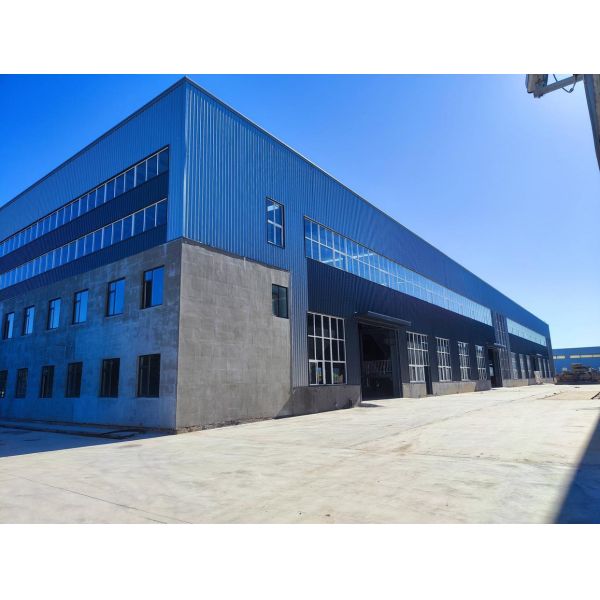
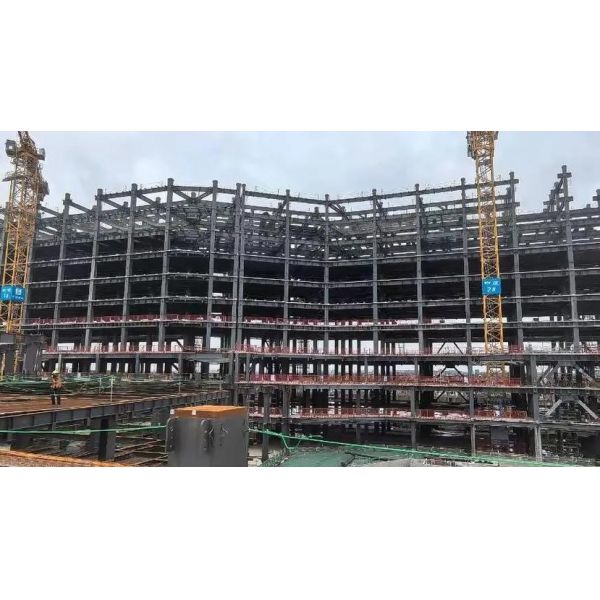
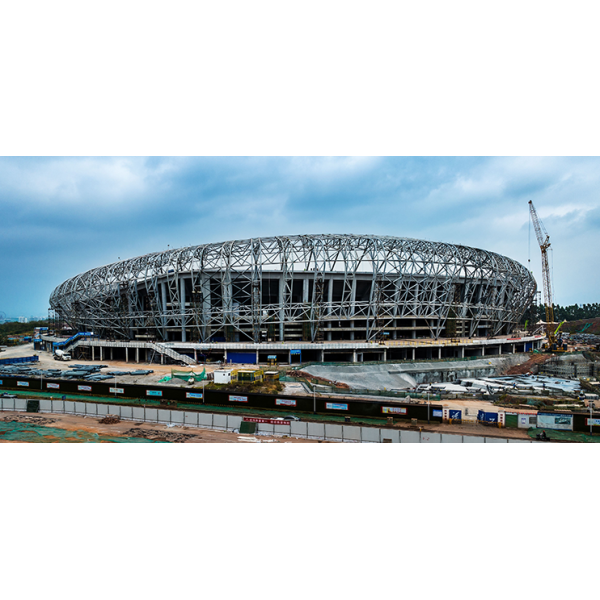
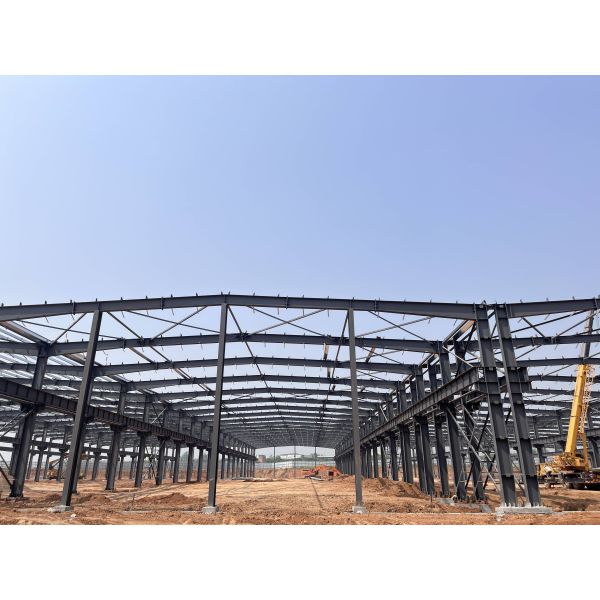
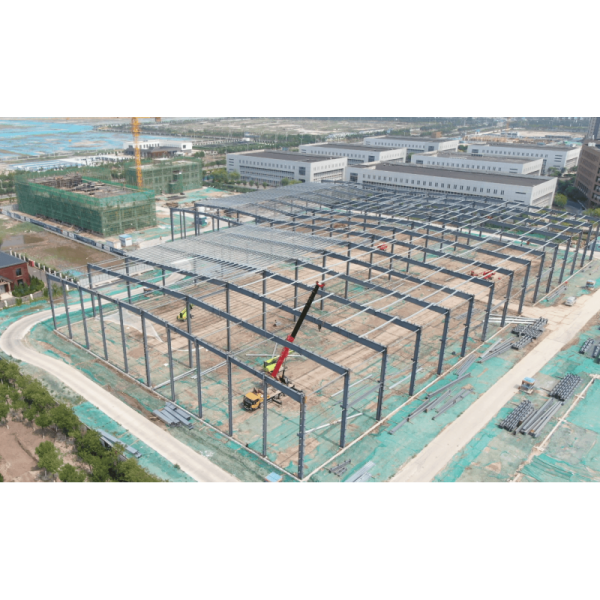
Engineered for seismic & extreme environmental loads — Designed to seismic fortification intensity 8 (GB 50011), with wind-load, snow-load and structural FEA independently verified by our in-house engineering team; adaptable to typhoon, hurricane and desert-corrosion site conditions.
High factory prefabrication, fast on-site erection — ≥85% factory prefabrication rate with ≥78% module standardization; bolt-up numbered assemblies that cut construction time by 55–72% versus conventional cast-in-situ concrete.
Internationally certified fabrication quality — EN 1090 CE-marked (Execution Class up to EXC 3), ISO 3834 / ISO 15614 welding-qualified, AWS D1.1 code-compliant; audited under ISO 9001 / 14001 / 45001 integrated management system.
Heavy-industry grade primary steel — Q355B main frames (equivalent to S355JR / A572 Gr.50), with full mill-material traceability; hot-dip galvanized or multi-coat epoxy primer systems specified per ISO 12944 corrosivity categories (C1–C5).
Large clear-span, future-expandable layout — Clear spans up to 60 m+ without interior columns; modular jointing supports later extension, mezzanine insertion and functional reconfiguration.
Green, low-waste erection — Structural steel is ≥85% recyclable; minimal on-site wet work and construction waste; optional insulated wall/roof panels (PU / EPS /rockwool) to meet international energy-efficiency requirements..
Parameter |
Specification |
Standard |
Factory Prefabrication Rate |
≥85% |
JGJ 1-2014 |
Construction Speed |
55-72% faster than traditional structures |
Industry Comparison Data |
Seismic Resistance Level |
Degree 8 Fortification |
GB 50011-2010 |
Steel Grade |
Q355B |
GB/T 1591-2018 |
Module Standardization Rate |
≥78% |
Enterprise Standard |
Design Service Life |
52 years |
GB 50068-2018 |
Fire Resistance Rating |
F60-F120 |
International Standards |
Energy Efficiency Standard |
Meets international energy efficiency requirements |
International Standards |
Highly modular design enables factory-scale production with stable, controllable quality.
Strong adaptability — optimized design tailored to regional climatic characteristics.
Significant cost advantage — lower whole-life-cycle cost than conventional buildings.
Flexible expansion capability for post-occupancy modification and functional reconfiguration.
Standardized production ensures consistent building quality, safety and reliability.
Excellent seismic performance — meets building safety requirements in earthquake-prone regions.
Eco-friendly construction — reduced site waste and high material recyclability.
Logistics centers & distribution warehouses.
Aircraft hangars & aviation maintenance facilities.
Office buildings & commercial complexes.
Schools, hospitals & public service facilities.
Indoor stadiums, gymnasiums & natatoriums.
Hotels, exhibition centers & convention halls.
Seismic-prone region structures (fortification intensity 8 and above).
Hurricane / typhoon-resistant high-wind designs.
Heavy snow-load roof systems (cold-climate regions).
Desert / high-temperature corrosive-environment coatings.
Rapid-deploy emergency & disaster-relief buildings.