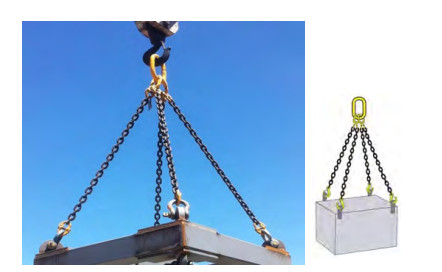
The Heavy Carbon Steel Large Swivel Safety Forged Crane Hook is a heavy-duty lifting component designed for cranes, hoisting equipment and industrial material handling systems.
The hook features a forged carbon steel construction and a swivel connection that allows controlled rotation of the hook under suitable lifting conditions. The swivel design can help reduce unwanted twisting in compatible lifting assemblies and improve load positioning during material handling.
A safety latch can be incorporated to help prevent the connecting component from accidentally disengaging from the hook when the hook is correctly positioned.
Large-size versions can be supplied for demanding industrial lifting applications, with WLL, dimensions, swivel configuration, hook opening and connection specifications customized according to the required lifting system.
Important: The actual Working Load Limit (WLL) must be confirmed for the specific hook model. Hook capacity depends on material, geometry, manufacturing process, swivel design and applicable lifting requirements.
The crane hook is manufactured from suitable carbon steel selected for the required mechanical properties and application.
The material specification can be selected according to the required:
For large industrial hooks, material traceability and mechanical-property control are important parts of quality management.
The hook body is produced using a controlled forging process.
Forging forms the steel into the required hook geometry and provides a dense metal structure suitable for load-bearing applications.
The final mechanical properties depend on the selected steel grade, forging process and heat treatment.
The swivel mechanism allows the hook to rotate around its connection axis under suitable operating conditions.
This can be useful when:
The swivel mechanism itself must be properly rated for the intended application.
A safety latch can be installed across the hook opening.
Its purpose is to help retain the connected sling, shackle or lifting component when the hook is correctly loaded.
The latch is not a load-bearing component and should never be used to support the lifting load.
Large forged crane hooks can be designed for different industrial lifting systems.
Depending on the application, specifications may include:
The final dimensions should be matched to the crane, hoist and lifting assembly.
| Parameter | Specification |
|---|---|
| Product Type | Large Swivel Safety Crane Hook |
| Material | Carbon Steel / Alloy Steel According to Specification |
| Manufacturing Process | Forged |
| Hook Type | Swivel Safety Hook |
| Application | Crane Lifting & Hoisting |
| WLL | Customized According to Model |
| Hook Opening | Customized |
| Overall Dimensions | Customized |
| Swivel Connection | Available |
| Safety Latch | Available |
| Heat Treatment | According to Material & Specification |
| Surface Treatment | Painted / Powder Coated / Customized |
| Marking | WLL / Size / Identification as Applicable |
| Proof Load Testing | Available According to Requirements |
| Certification | Available According to Applicable Standard |
| OEM / ODM | Supported |
The primary load-bearing component of the crane hook.
The curved lower section where the load connection should be properly seated.
Provides rotational movement around the designed axis.
Helps retain the connecting component inside the hook opening.
Connects the hook to the crane, hoist or compatible lifting assembly.
The Working Load Limit (WLL) is the maximum rated load that the hook is designed to support under specified conditions.
The WLL of a large swivel crane hook depends on:
The WLL should therefore be identified from the specific product marking and technical documentation.
For a complete crane lifting assembly, the rated capacity should also consider the weakest rated component.
| Feature | Swivel Crane Hook | Fixed Crane Hook |
|---|---|---|
| Rotation | Designed to rotate | Fixed connection |
| Load Positioning | More flexible | More limited |
| Twisting Control | Can help manage rotation | Depends on lifting assembly |
| Structure | Hook + swivel mechanism | Hook + fixed connection |
| Application | Dynamic positioning and specialized lifting | General lifting applications |
| Maintenance | Swivel mechanism requires inspection | Simpler structure |
The appropriate design depends on the crane system, load characteristics and lifting procedure.
| Advantage | Description |
|---|---|
| Forged Construction | Suitable for heavy-duty load-bearing applications |
| Carbon Steel | Material can be selected according to specification |
| Swivel Function | Allows controlled hook rotation |
| Safety Latch | Helps prevent accidental disengagement |
| Large Size | Suitable for larger lifting systems |
| Custom WLL | Capacity can be designed according to requirements |
| OEM Production | Dimensions and markings can be customized |
| Testing Available | Proof load and inspection can be arranged |
Used as a lifting connection for compatible overhead crane and hoisting systems.
Suitable for material handling systems where the hook's WLL and connection dimensions match the crane.
Can be used for lifting and positioning large machinery and industrial equipment.
Suitable for handling fabricated steel structures and large metal components with properly designed lifting points.
Large forged crane hooks can be used in heavy engineering and shipbuilding environments where appropriately rated lifting equipment is required.
Applicable to lifting heavy construction materials when the complete lifting system is correctly rated.
Start with the maximum load that needs to be lifted.
Select the hook based on its rated WLL and intended lifting configuration.
The upper connection must match the crane or hoisting equipment.
Important dimensions include:
The hook opening must be large enough for the intended shackle, sling or lifting component while maintaining proper seating.
A swivel design may be appropriate when controlled rotation is required.
However, the swivel should not be treated as a solution for uncontrolled load rotation or improper lifting practices.
The latch should operate smoothly and return to its intended position.
A damaged or malfunctioning latch requires inspection before use.
Raw carbon steel or specified alloy steel is inspected according to the required material specification.
The material is heated to the required forging temperature.
The heated steel is forged into the basic crane hook shape.
Excess material is removed and the hook geometry is formed to specification.
The forged hook undergoes controlled heat treatment according to the selected material and technical requirements.
Connection holes, swivel components and other precision areas are machined.
The swivel mechanism is assembled and checked for appropriate movement.
The safety latch and related components are installed.
The hook can be painted, powder coated or finished according to customer requirements.
Proof load testing and dimensional inspection can be carried out according to the applicable standard and customer requirements.
WLL, size, identification and other required information can be permanently marked on the hook.
Before using the crane hook:
The safety latch is a retaining device, not a load-bearing component.
For crane manufacturers, lifting-equipment suppliers and industrial distributors, the large swivel safety crane hook can be customized according to project requirements.
Available options include:
For an OEM quotation, buyers should provide:
Required WLL + Connection Type + Hook Opening + Quantity + Application + Standard + Testing Requirements.
A swivel crane hook is a lifting hook equipped with a rotational connection that allows the hook to turn around its designed axis under suitable operating conditions.
The product can be manufactured using carbon steel or another specified steel grade according to the required WLL and technical specification.
No. The safety latch is designed to help retain the connected component in the hook. The lifting load must be properly seated in the hook bowl.
Yes. Hook opening, connection dimensions, overall dimensions and other specifications can be customized for OEM projects.
Yes. Proof load testing and inspection can be arranged according to the applicable standard and customer requirements.
Please provide the WLL, hook type, connection dimensions, hook opening, quantity, application and required standard.
Yes, provided the hook and chain sling are compatible and the complete assembly is correctly rated for the intended lifting application.