Industrial Wiped Film Evaporator for High-Boiling Silicone Oils, Polymer Plasticizers & Specialty Chemical Separation
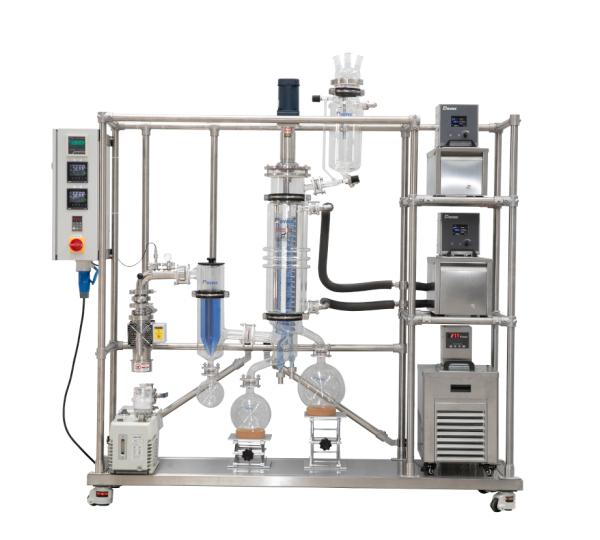
Designed for heavy-duty industrial processing, this robust stainless steel Wiped Film Evaporator excels at continuously separating high-boiling, viscous, and heat-sensitive chemicals that are beyond the capability of conventional fractionating columns. From silicone oil devolatilization and plasticizer purification to polymer intermediate recovery, the system provides a true continuous process with an unparalleled ability to handle viscosities up to tens of thousands of centipoise. Its modular, jacketed design and specialized high-torque drives ensure reliable, 24/7 operation while stripping unreacted monomers, catalyst residues, and volatile offcuts down to ppm levels, creating ultra-high-purity specialty chemical products that consistently meet high-performance material specifications.
Process engineers face a formidable barrier when distilling materials like high-viscosity silicone fluids, epoxy resins, or molten polymers. Traditional packed or tray columns immediately foul with gelling or polymerizing material, causing catastrophic pressure drop and shutdowns. In a simple batch pot still, the stagnant liquid pool exhibits terrible heat transfer and an extremely low surface-to-volume ratio. Extended heating required for product to boil from the pool drives unwanted side reactions, discoloration, and molecular weight changes in the product. The high boiling points of plasticizers or functional oils mean they require exceptionally high heater temperatures, yet exposure to this heat in a bulk pool for hours inevitably degrades product quality, making it impossible to meet demanding ASTM or ISO specifications for color and purity.
Our Industrial WFD system solves these mass and heat transfer limitations by mechanically generating a high-velocity, turbulent thin film. The high-torque, precision-balanced rotor is equipped with rigid, close-clearance wipers that forcibly spread even the most viscous fluids into a film of a few tenths of a millimeter. Under exactly controlled vacuum (down to 0.01 mbar), the effective boiling point is dramatically suppressed, allowing low-vapor-pressure plasticizers or silicone cyclics to be stripped out without overheating the main polymer chain. Volatiles evaporate in seconds and are condensed, while the purified base polymer steadily exits through a heated, positive-displacement residue discharge pump. This eliminates stagnation, enables continuous operation without fouling, and achieves residual volatiles in the low ppm range, recovering value from both the heavy product stream and light fractions.
| Parameter | Specification |
|---|---|
| Model Series | WFD-I (Industrial) |
| Material of Construction | SS304, SS316, Hastelloy C-276 for corrosive feeds |
| Rotor Drive | Direct-drive or magnetic drive, high-torque VFD |
| Viscosity Handling | 1 cP to 100,000 cP+ |
| Evaporator Area | 0.5 m² to 60 m² per single unit |
| Operational Mode | Continuous, 24/7 duty |
| Vacuum System | Integrated dry screw pump & roots booster package |
| Heating System | Thermic fluid heating with automatic temperature control |
| Residue Removal | Specially designed high-gravity-drain bottom cone with positive displacement pump |
| Special Options | Thermal half-pipe jacket for rapid temperature slew; CIP spray balls |
Viscous feed is pumped into the unit’s top chamber, where it flows onto a slowly rotating distribution ring. This evenly feeds the liquid onto the heated wall as mechanical wipers instantly generate a film just fractions of a millimeter thick. The massive surface renewal and high turbulence coefficient drive volatile materials (monomers, light ends) to the vapor-liquid interface. The vapors traverse a short path to the central condenser, while the purified heavy fraction is scraped down the body and discharged from a heated conical bottom. All operations are continuously monitored and automated via a central PLC.
Specification begins with your product’s thermal stability graph and viscosity curve. Request a pilot test with a 0.5m² unit to define the exact pressure/temperature/feed rate matrix. This provides the critical scale-up data: evaporation rate (kg/m²/hr) and residual volatiles. The wiper type is the critical engineering choice; zero-clearance, fixed-blade wipers maximize film turbulence for ultra-high-viscosity stripping. Ensure the vendor specifies the residue handling system carefully—a heated, conical bottom and jacketed residue pump are non-negotiable for high-melt-point polymers to prevent a "cold plug" that would halt production. Magnetic drives offer a premium zero-leakage option for toxic or valuable chemistries.