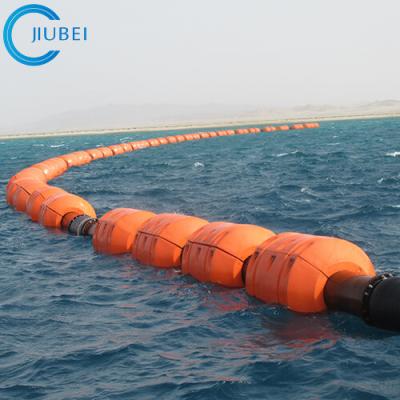
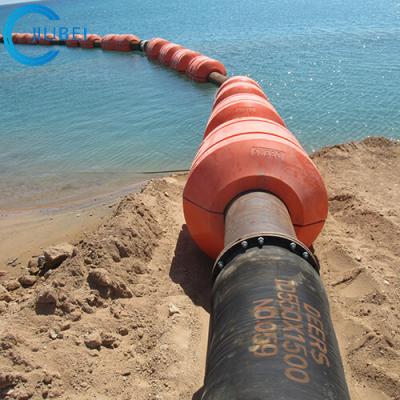
HDPE Dredging Pipe Floats Providing Buoyancy and Support for Discharge Hoses and Pipelines in Various Dredging Environmental Circumstances
Product Overview
Constructed with high-density polyethylene (HDPE) through rotational molding technology and filled with high-strength closed-cell polyurethane (PU) foam, these floats combine exceptional durability, corrosion resistance, and superior buoyancy performance. Unlike traditional steel floats, our HDPE dredging pipe floats feature a lightweight design that simplifies transportation and installation, while the integrated UV stabilizers ensure long-term resistance to harsh environmental factors such as sunlight, saltwater, and extreme temperatures (-60℃ to +80℃). Available in standard yellow, orange, or customized colors, the floats also serve as effective warning signs for nearby vessels, enhancing operational safety in busy waterways.
PE Float Dimension:
Float I.D. (mm) |
Float O.D.(mm) |
Float Length(mm) |
Thickness of Hull(mm) |
Floater Buoyancy (kg) |
| 110 |
500 |
500 |
7 |
98 |
| 125 |
500 |
800 |
7 |
150 |
| 160 |
500 |
800 |
7 |
145 |
| 220 |
600 |
700 |
7 |
180 |
| 250 |
600 |
700 |
7 |
175 |
| 280 |
700 |
900 |
7 |
340 |
| 310 |
900 |
1000 |
8 |
550 |
| 320 |
1000 |
1000 |
9 |
650 |
| 350 |
950 |
1000 |
9 |
600 |
| 390 |
1000 |
1000 |
9 |
600 |
| 400 |
1100 |
1100 |
9 |
900 |
| 450 |
1200 |
1200 |
11 |
1100 |
| 460 |
1300 |
1300 |
12 |
1400 |
| 495 |
1300 |
1300 |
12 |
1400 |
| 520 |
1300 |
1450 |
12 |
1500 |
| 550 |
1300 |
1500 |
12 |
1750 |
| 560 |
1400 |
1500 |
12 |
1900 |
| 600 |
1400 |
1600 |
13 |
2100 |
| 620 |
1450 |
1700 |
13 |
2400 |
| 670 |
1500 |
1860 |
14 |
2800 |
| 720 |
1500 |
1860 |
14 |
2800 |
| 735 |
1500 |
1800 |
14 |
2700 |
| 760 |
1800 |
2050 |
15 |
3100 |
| 800 |
1800 |
2160 |
15 |
3300 |
| 890 |
2000 |
2400 |
15 |
4600 |
| 940 |
2040 |
2500 |
16 |
4900 |
| 1040 |
2400 |
2600 |
16 |
7000 |
| 1140 |
2300 |
2550 |
16 |
7000 |
(Support customization)
Product Functions
- Reliable Buoyancy Support: Effectively disperses the weight of dredge pipelines and the slurry inside, preventing pipeline sinking and ensuring stable floating above the water level.
- Pipeline Protection: Absorbs and reduces impact energy from vessel collisions and wave shocks, minimizing wear and damage to dredge pipelines and hoses.
- Stabilization & Guidance: Helps maintain the pipeline's designed route during dredging operations, reducing deviations caused by water flow and wave disturbances.
- Environmental Adaptability: Resists corrosion from saltwater, chemicals, and acidic/alkaline substances, making it suitable for both freshwater and marine environments.
Product Applications
- Inland Waterway Dredging: River and lake sediment cleaning, channel deepening, and waterway maintenance projects. Ideal for shallow water conditions and areas with frequent pipeline movement.
- Port & Harbor Construction: Port expansion, berth dredging, and navigation channel improvement. The high-impact resistance ensures durability in busy port environments with heavy vessel traffic.
- Offshore Dredging & Reclamation: Coastal reclamation, offshore wind farm foundation construction, and seabed mining. Designed to withstand rough sea conditions and strong wave impacts.
- Mine & Industrial Dredging: Tailings discharge, coal washing wastewater treatment, and industrial wastewater pumping. Corrosion-resistant properties adapt to harsh industrial environments.
- Environmental Remediation: Eutrophic lake treatment, wetland restoration, and contaminated sediment dredging. The eco-friendly materials comply with international environmental standards and do not pollute water bodies.
Usage & Maintenance Notes
- During operation, regularly inspect the float connection status. Tighten any loose bolts and replace damaged gaskets in a timely manner to prevent float slippage or water ingress.
- Avoid collision between the floats and hard objects (such as rocks, ship hulls) to prevent damage to the HDPE shell. For high-risk areas, install additional防撞 guards if necessary.
- After long-term use, clean the float surface to remove marine organisms, sludge, or other attachments. This helps maintain buoyancy performance and extends the service life of the floats.
- When storing the floats, place them in a dry and ventilated area away from direct sunlight. Avoid stacking heavy objects on the floats to prevent deformation.
- If the float shell is cracked or the internal foam is waterlogged (resulting in reduced buoyancy), replace the float immediately to ensure operational safety.