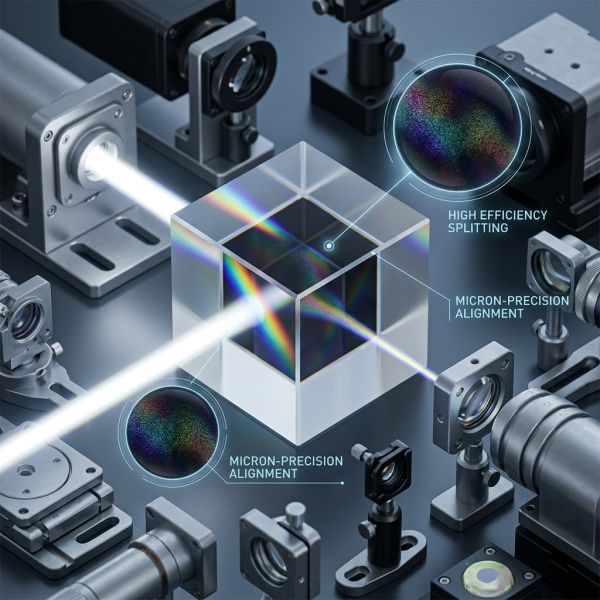
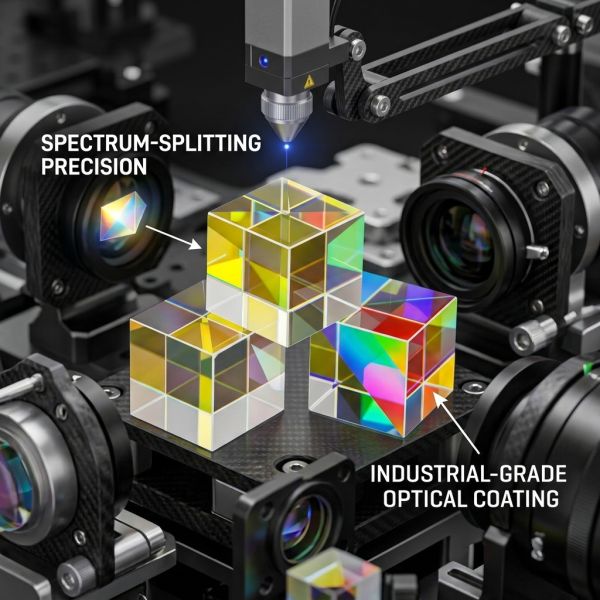
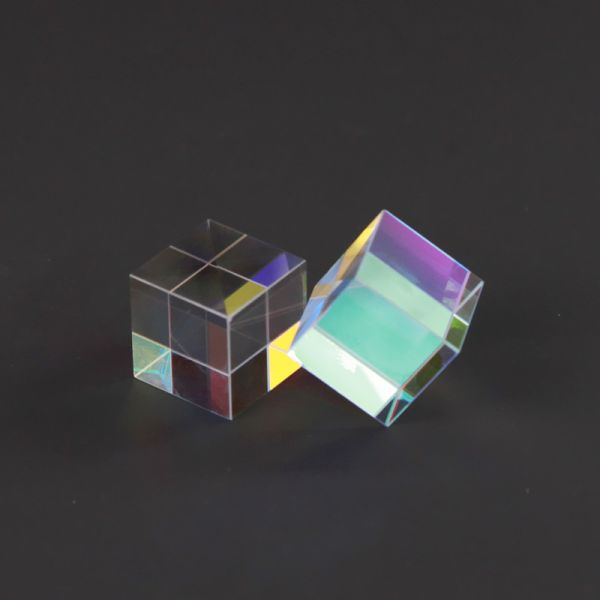
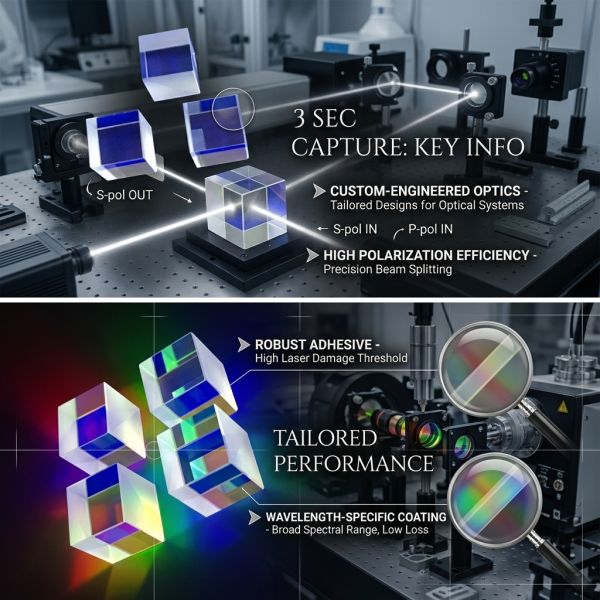
In long-wave infrared (LWIR) electro-optical systems, managing payload weight while maximizing optical aperture is a critical engineering challenge. Our Fresnel 90 Degree Ge Optical Prism Cube represents a disruptive advancement in infrared beam routing. Machined from monocrystalline or polycrystalline optical-grade Germanium (Ge), this specialized Optical Prism configuration replaces bulky, traditional solid-glass optics. By integrating a micro-structured Fresnel zoning pattern onto a compact 90 Degree deflection format, this Cube achieves high-efficiency infrared light bending and spectral focusing within a footprint spanning from 3mm To 100mm, minimizing volume and bulk weight in tactical optical benches.
Standard Germanium elements are inherently heavy due to the high density of the raw element (5.33 g/cm³), which limits their use in airborne gimbal systems, drone thermal payloads, and handheld night-vision hardware. Our Ge Optical Prism design bypasses this restriction by maintaining an ultra-thin active optical profile via diamond-turned Fresnel micro-grooves. Each 90 Degree reflective and refractive facet is optimized for the 8 - 14 μm thermal band, providing maximum transmission throughput, low chromatic dispersion, and high thermal stability under rapid environmental shifts common in defense and industrial monitoring applications.
Frequently Asked Questions
Q1: Why is Germanium (Ge) chosen for this 90 Degree Fresnel prism instead of standard optical glass?
A: Standard optical glasses (like silicate or borosilicate formulations) become completely opaque and act as an absolute barrier to light wave absorption above 2.5 μm. For thermal imaging and security applications operating in the Long-Wave Infrared spectrum (8 - 14 μm), specialized semiconductor substrates are mandatory. Germanium (Ge) features a vast transmission window extending from 2.0 μm out to 16.0 μm and boasts an exceptionally high refractive index, making it the premier material for elite thermal imaging and infrared beam splitting architectures.
Q2: How does the Fresnel design benefit a 3mm to 100mm Cube configuration?
A: In large aperture systems (up to 100mm), a solid Germanium prism is extremely heavy and prone to severe internal absorption losses because of the thick layer of material the light must travel through. The Fresnel design breaks down the continuous curved surface of a classic lens into a series of concentric, low-profile rings. This allows us to manufacture a Ge Optical Prism that maintains an ultra-thin profile across all sizes from 3mm To 100mm, drastically minimizing the optical absorption path length, maximizing thermal light transmission, and cutting raw material costs significantly.
Q3: How do you protect the delicate micro-grooves of the Fresnel prism from harsh field conditions?
A: Germanium is a relatively soft element (Vickers ≈ 780) and can be susceptible to environmental erosion. To guarantee absolute survivability, the structured surfaces of our Fresnel 90 Degree cubes are treated with a specialized Diamond-Like Carbon (DLC) hard coating. This thin-film layer approaches the physical hardness of natural diamond, providing complete protection for the Cube against scratching from blowing sand, saltwater corrosion, chemical solvents, and high humidity, ensuring long-term deployment in marine or desert theaters.
Q4: Can these Ge Optical Prisms handle dual-band infrared (MWIR and LWIR) requirements?
A: Yes. While standard configurations are optimized for the 8 - 14 μm LWIR band, monocrystalline Germanium naturally transmits Mid-Wave Infrared (MWIR, 3 - 5 μm) light as well. By altering our single-point diamond turning (SPDT) groove geometry and applying custom multi-layer broadband anti-reflection (BBAR) thin films, our engineering team can custom-tune the Custom Optical Prism to operate across both bands simultaneously. This makes it an ideal fit for dual-band thermal sensors and advanced fusion imaging platforms.