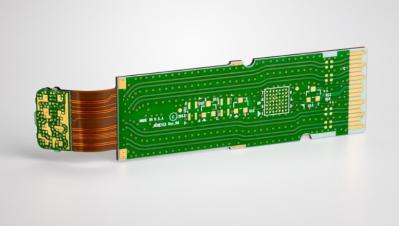
DIY Flexible Circuit Board with Gold Finish Bendable PI Substrate for Robotics
Our Customization Capabilities
We specialize in customized flexible printed circuit boards (FPCs) and rigid-flex PCBs, offering complete structural solutions from 2 layers to multiple layers. Our core advantages include using highly flexible polyimide substrates combined with high-end surface treatments such as electroless nickel immersion gold (ENIG), ensuring oxidation resistance and durability of solder joints. We support small-batch rapid prototyping and large-scale mass production, providing highly reliable flexible interconnection solutions for consumer electronics, automotive electronics, industrial equipment, and other applications.
Circuit Board Advantages
| High Density |
The multilayer design allows for high component density, making it suitable for complex electronic systems. |
| Reliability |
The combination of rigid and flexible sections enhances durability and reliability, especially in dynamic environments. |
| Thermal Management |
Multiple layers can be designed to improve heat dissipation and manage thermal performance. |
| Solderability |
The tin-spray finish ensures good solderability and protects the copper traces from oxidation. |
Technical Challenges in Rigid-Flex PCB Manufacturing
Flexible Section Challenges
- Material fragility: Thin, flexible substrates require specialized handling (e.g., carrier boards for horizontal processing) to prevent damage or misalignment.
- Chemical sensitivity: Polyimide materials are incompatible with strong alkalis, necessitating adjusted process parameters for desmearing and blackening.
- Lamination stability: Flexible layers exhibit poor dimensional stability, requiring controlled lamination conditions and specialized padding materials (e.g., polypropylene films) to ensure adhesion.
Rigid Section Challenges
- Stress management: Inconsistent glass fabric orientation and thermal stress during pressing can cause warping or delamination.
- Dimensional control: Shrinkage/expansion variations in flexible materials demand pre-compensation in rigid section fabrication.
- Via processing: Flexible layer window machining requires precise timing and parameter control to balance weld integrity and foldability.
Integration Challenges
- Layer alignment: Hybrid FPC/PCB production necessitates precise registration between flexible and rigid layers, often using OPE-punched tooling.
- Quality control: High-value assemblies require 100% inspection due to complex process flows and low yield rates.
- Process integration: Conflicting requirements between flexible (e.g., NOFLOW prepregs) and rigid (e.g., standard FR-4) materials complicate lamination and drilling.