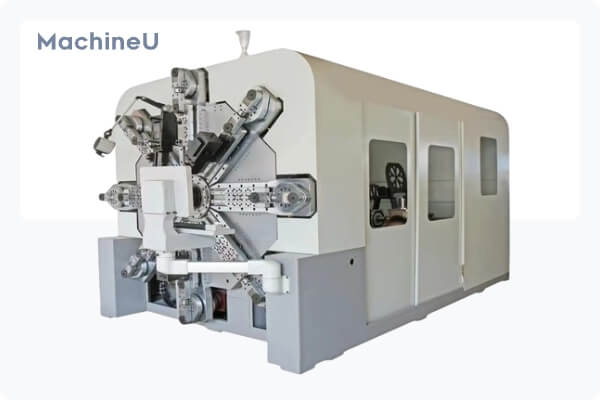
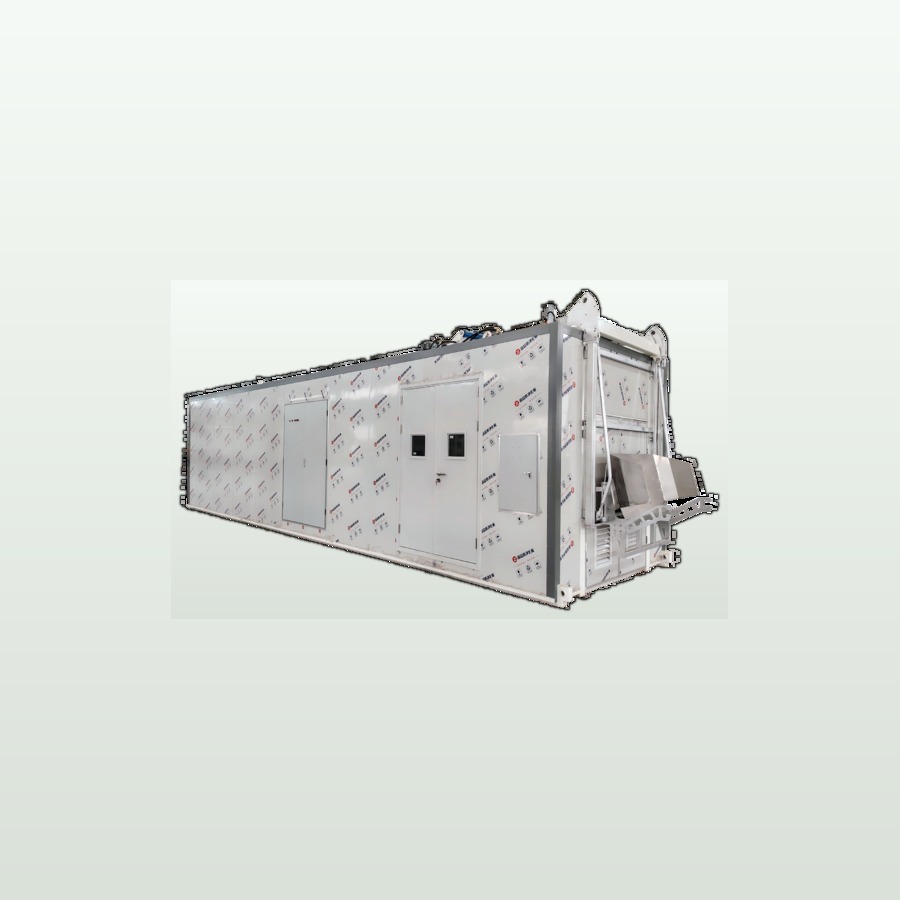
Engineered for on-site treatment, the MDU-5B removes the transport risk that comes with moving infectious material between hospitals and off-site plants. Infectious waste is processed inside a closed chamber at 2450 MHz, where microwave energy and holding time deliver a verified log reduction before the residue is conveyed to standard waste containers. Because the machine runs on electric power only, there is no open flame, no flue gas and no pressurised vessel on site.
Key Features| Parameter | Specification |
|---|---|
| Equipment model | MDU-5B |
| Treatment capacity | 300 kg/h (±10%), waste density 0.1–0.15 kg/l |
| Dimensions (L×W×H) | 8,500 × 2,900 × 3,300 mm |
| Overall weight | 13,000 kg |
| Required space (L×W×H) | 12,000 × 5,000 × 5,600 mm |
| Installed power | 120 kW (72 kW steam generator included) |
| Sterilization temperature | ≥95°C |
| Sterilization duration | ≥45 min |
| Sterilization effect | ≥6 log10 (Bacillus subtilis var. niger ATCC 9372) |
| Microwave frequency | 2450 ±50 MHz |
| Microwave generator power | 1.25 kW × 10 units |
| Shredding system | Double-shaft shredder with automatic reverse |
| Feeding form | Automatic lifting and charging system |
| Operation and control | PLC control, automatic process |
Loading is automatic: the charger lifts each container, empties it into the hopper and returns it empty, so the operator never touches the waste stream. Shredding follows immediately, which removes the volume and destroys the shape of sharps and containers. The reduced mass then travels through the microwave cavity and the holding section; temperature and residence time are controlled by the PLC and monitored continuously. Once the holding time has elapsed, the material is discharged by screw conveyor into a closed container. The PLC keeps a record of the batch so that treatment can be demonstrated during an inspection.
ApplicationsTypical installations include hospital waste rooms, dedicated treatment buildings at clinic groups, and centralised plants operated by collection companies. The machine handles the usual infectious stream: blood products, dialysis and isolation waste, sharps, cultures, laboratory specimens, surgery and pathology waste, animal tissue and bedding, and contaminated packaging or personal protective equipment from collection rounds. Sites that previously shipped waste to an off-site incinerator use the machine to cut transport cost and to keep custody of their waste on their own premises.
Packaging & Quality AssuranceBefore dispatch the line is assembled, wired and run at the factory, then partly dismantled only where transport height requires it. All openings are sealed, painted surfaces are wrapped, and electrical components are crated separately with desiccant. Documentation includes layout drawings, utility requirements, the biological validation report format and a maintenance schedule. Spare blades, door seals and temperature sensors are recommended as first-year stock, and technical support is provided remotely with on-site commissioning on request.