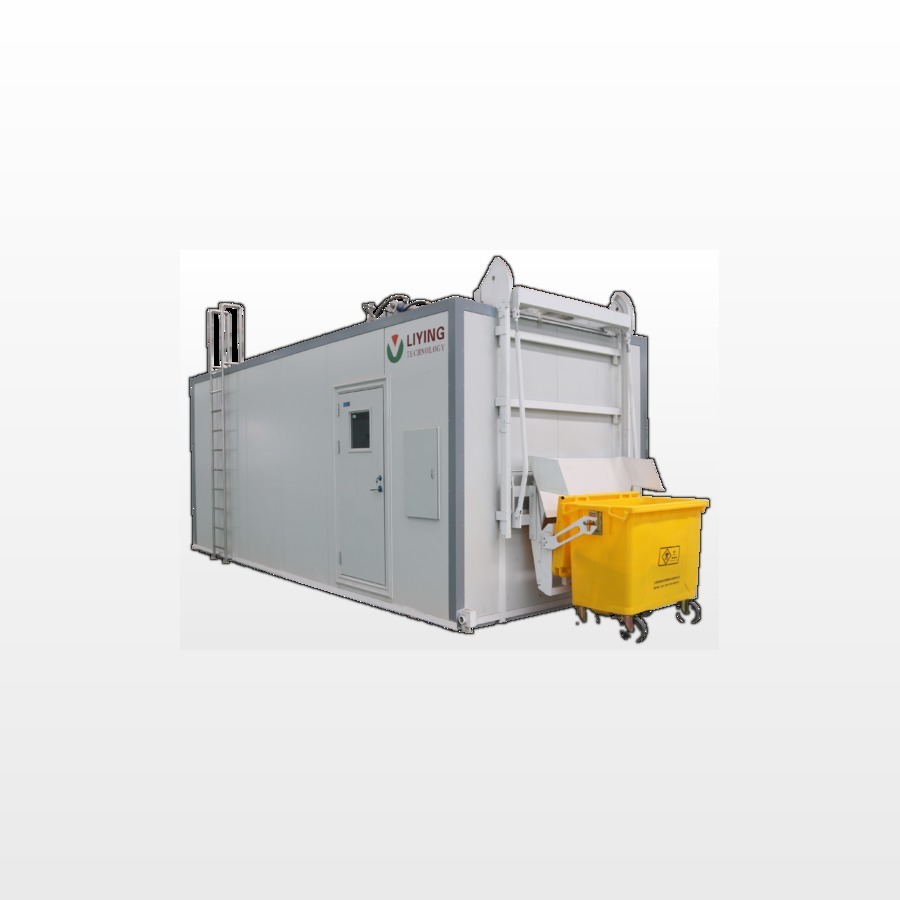
Designed as a replacement for autoclave and incineration routes, the MDU-10 delivers continuous processing instead of batch cycles. Waste enters, is shredded, is sterilised by microwave energy at 2450 MHz and leaves the machine within one pass, so there is no waiting for a chamber to cool between loads. The result is predictable throughput, lower labour input and a treatment record that can be presented to the local environmental authority.
Key Features| Parameter | Specification |
|---|---|
| Equipment model | MDU-10 |
| Dimensions (L×W×H) | 12,000 × 2,900 × 3,300 mm |
| Overall weight | 15,000 kg |
| Required space (L×W×H) | 15,000 × 5,000 × 5,600 mm |
| Installed power | 170 kW (108 kW steam generator included) |
| Sterilization temperature | ≥95°C |
| Sterilization duration | ≥45 min |
| Sterilization effect | ≥6 log10 (Bacillus subtilis var. niger ATCC 9372) |
| Microwave frequency | 2450 ±50 MHz |
| Shredding system | Double-shaft shredder with automatic reverse |
| Feeding form | Automatic lifting and charging system |
| Operation and control | PLC control, automatic process |
The process is designed so that untreated waste cannot bypass the sterilization stage. The feed and discharge paths are interlocked with the microwave and holding sections, and the PLC compares actual temperature and residence time with the set values before allowing discharge. Shredding before sterilization also reduces the physical size of sharps, so the residue can be handled as ordinary refuse. Records of each batch, including temperature and holding time, remain available for the environmental authority and for internal quality audits.
ApplicationsSites that operate the machine usually have a defined waste room with three-phase power and mechanical ventilation: hospital groups, private clinic networks, veterinary hospitals, research institutes, airport and port health facilities, and municipal treatment stations. The accepted stream covers infectious and potentially infectious material, sharps and sharps containers, blood bags and tubing, laboratory cultures, pathology samples, isolation and dialysis waste, and small volumes of trace chemotherapy waste. Because treatment happens on site, the infectious material never enters the public road network.
Packaging & Quality AssuranceThe line is supplied on a transport frame with lifting lugs, wrapped in protective film and, where required, packed in a plywood enclosure for container loading. Electrical cabinets and magnetrons are crated separately and marked with orientation labels. Standard documentation covers layout, foundation loads, power and ventilation requirements, operating instructions and a maintenance plan. Warranty terms cover structural and control defects, and a spare parts kit for the first year of operation can be supplied with the machine.