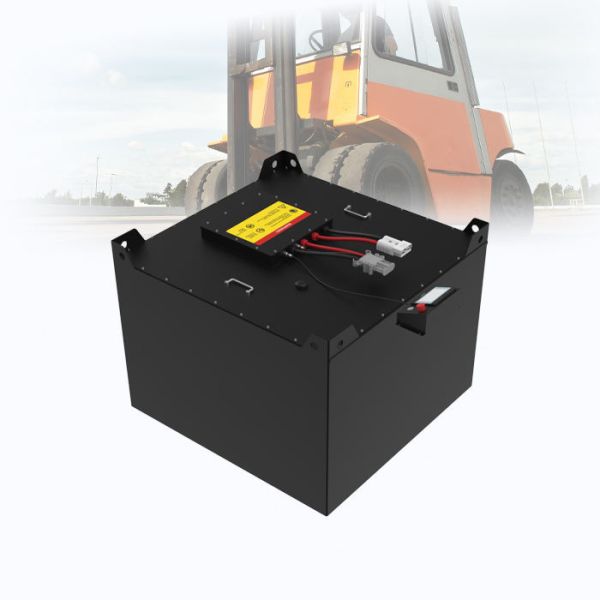
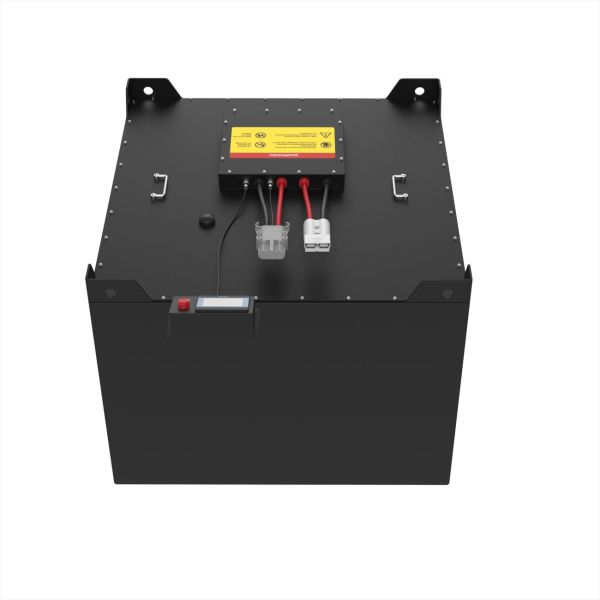
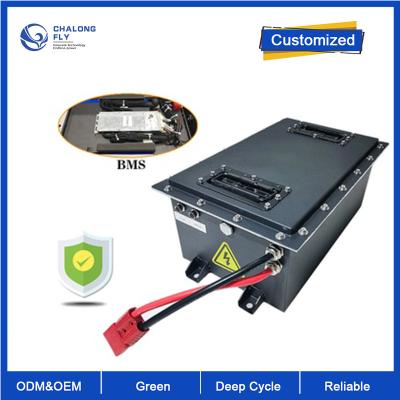
High-capacity energy system for Class I heavy-duty forklifts. Designed for continuous multi-shift operations with opportunity charging. 69.6 kWh total energy capacity. 5-year warranty.
| Parameter |
Specification |
| Nominal Voltage |
80V |
| Nominal Capacity |
870Ah |
| Energy Capacity |
69.6 kWh |
| Battery Chemistry |
LiFePO4 (LFP) |
| Cycle Life (@80% DOD) |
≥4,000 cycles |
| Standard Charging Current |
174A (0.2C) |
| Fast Charging Current |
435A (0.5C) |
| Charging Time (Standard) |
5.0 hours |
| Charging Time (Fast) |
2.0 hours |
| Continuous Discharge Current |
870A (1.0C) |
| Peak Discharge Current (60s) |
1,305A (1.5C) |
| Operating Temperature (Charge) |
0°C to +55°C |
| Operating Temperature (Discharge) |
-20°C to +60°C |
| IP Rating |
IP67 |
| Communication Protocol |
CAN Bus 2.0B, RS485, Modbus TCP (optional) |
| Weight |
Approx. 820 kg |
| Dimensions (L*W*H) |
1,250*850*780 mm (Customizable) |
| Installation Type |
Side-extraction / Roll-out compatible |
| Warranty |
5 years / 4,000 cycles |
| Certifications |
UL 1973, CE, UN38.3, IEC 62133, IEC 62619 |

Product Description
What Is an 80V 870Ah Lithium Forklift Battery?
An 80V 870Ah lithium iron phosphate battery is a high-capacity industrial energy system delivering 69.6 kWh of usable energy. This unit is engineered for Class I counterbalanced forklifts in heavy logistics, port operations, steel handling, and other high-intensity material transport applications where single-shift runtime exceeds 8 hours or where multi-shift continuous operation is required.
How Does High Capacity Translate to Operational Efficiency?
With 69.6 kWh of stored energy, this battery eliminates the need for battery swapping in most three-shift operations. When paired with opportunity charging stations at staging areas, the system can operate continuously across multiple shifts without dedicated battery change-out personnel or spare battery inventory. This configuration reduces capital expenditure on backup battery assets and associated charging infrastructure.
Engineering Features for Demanding Environments
-
Dual-module architecture: Independent BMS control for each half-pack ensures redundancy and fault isolation
-
Liquid cooling readiness: Optional thermal management channels for high-duty-cycle tropical operations
-
Reinforced steel enclosure: Impact-resistant housing rated for industrial material handling environments
-
Advanced BMS with data logging: 180-day operational history storage for fleet analytics and predictive maintenance
-
High-current busbar design: Low-resistance copper terminals rated for sustained 870A discharge
Technical Specifications
Complete Technical Specifications
| Category |
Parameter |
Value |
| Electrical |
Nominal Voltage |
80V |
| Electrical |
Nominal Capacity |
870Ah |
| Electrical |
Energy |
69.6 kWh |
| Electrical |
Cell Type |
Prismatic LiFePO4 |
| Electrical |
Configuration |
25S8P (Dual 25S4P modules) |
| Electrical |
Internal Resistance |
≤8 mΩ |
| Electrical |
Self-Discharge Rate |
<2% per month |
| Charging |
Standard Charge Voltage |
87.5V |
| Charging |
Max Charge Voltage |
91.25V |
| Charging |
Standard Charge Current |
174A (0.2C) |
| Charging |
Max Charge Current |
435A (0.5C) |
| Charging |
Charge Temperature Range |
0°C to +55°C |
| Discharging |
Cut-off Voltage |
62.5V |
| Discharging |
Continuous Current |
870A (1.0C) |
| Discharging |
Peak Current (60 sec) |
1,305A (1.5C) |
| Discharging |
Discharge Temperature |
-20°C to +60°C |
| BMS |
Protection Features |
Overcharge, over-discharge, over-current, short circuit, temperature, insulation fault protection |
| BMS |
Balancing Method |
Active balancing with cell-level monitoring |
| BMS |
Communication |
CAN Bus 2.0B, RS485, Modbus TCP (optional) |
| BMS |
Data Logging |
180-day operational data storage |
| Mechanical |
Enclosure Material |
Heavy-gauge powder-coated steel |
| Mechanical |
Dimensions (L*W*H) |
1,250*850*780 mm |
| Mechanical |
Weight |
~820 kg |
| Mechanical |
IP Rating |
IP67 |
| Mechanical |
Terminal Type |
Copper busbar M12 |
| Environmental |
Operating Humidity |
≤95% RH (non-condensing) |
| Environmental |
Altitude |
≤3,000 m |
| Environmental |
Cooling |
Natural convection / Optional liquid cooling |
| Compliance |
Certifications |
UL 1973, CE, UN38.3, IEC 62133, IEC 62619, ISO 9001 |
| Compliance |
Warranty |
5 years or 4,000 cycles (whichever comes first) |
Compatibility
Which Heavy-Duty Forklifts Can Use This Battery?
This 80V 870Ah battery is optimized for Class I counterbalanced forklifts with rated capacities from 3.5 to 8.0 tonnes. The side-extraction roll-out tray design is compatible with standard industrial battery changing systems. Custom dimension adjustments are available to match specific OEM battery compartment geometries.
Compatible Forklift Brands and Series
-
Toyota: 8FBN15-30, 8FBE20U series
-
Hyster: J3.0-5.5XN, E4.0-5.5XN series
-
Yale: GDP/GLP 30-55VX series (electric variants)
-
Linde: E25-E50 series
-
KION: Baoli KBE series (80V heavy-duty)
-
Doosan: B25X-7, B30X-7 series

Certifications
What Certifications Ensure Safe Heavy-Duty Operation?
High-capacity industrial lithium batteries require additional safety validation beyond standard consumer-grade testing. This battery carries IEC 62619 certification specifically for industrial secondary lithium cells and batteries, addressing risks associated with high-current parallel configurations.
| Certification |
Scope |
Significance |
| UL 1973 |
North American motive power safety |
Required for industrial vehicle deployment in US/Canada |
| CE |
European conformity |
Mandatory for EU and EEA market access |
| UN38.3 |
UN transport testing |
Certifies safe transport by air, sea, and land |
| IEC 62133 |
Secondary cell safety |
International baseline for lithium battery safety |
| IEC 62619 |
Industrial secondary lithium batteries |
Specific to high-capacity industrial applications |
| ISO 9001 |
Quality management |
Consistent design and manufacturing quality |
Social Proof
What Do Operations Managers Report?
"We deployed these 870Ah units across our port logistics fleet six months ago. The elimination of battery change-outs alone saved us 2.5 labor hours per truck per day. The CAN Bus integration with our fleet management system gives us real-time state-of-health data we never had with lead-acid."
— Sarah L., VP of Operations, Coastal Logistics Group

FAQ
How many shifts can this battery support without changing?
Under typical heavy-duty material handling conditions, this 69.6 kWh battery supports 10–14 hours of continuous operation on a full charge. With opportunity charging during operator breaks and meal periods, it can sustain continuous three-shift operations (24 hours) without battery swapping. Actual runtime varies based on average load weight, travel distance, and lift frequency.
What is the difference between the 200Ah and 870Ah models?
The 200Ah model (16.0 kWh) is designed for light-to-medium duty applications and single-shift operations in standard warehouses. The 870Ah model (69.6 kWh) is engineered for heavy-duty, multi-shift environments such as ports, steel mills, and high-throughput distribution centers. The 870Ah unit features dual-module architecture, optional liquid cooling, and higher continuous discharge capability.
Can this battery be charged with my existing forklift charger?
Existing chargers must be evaluated by a qualified technician. Lead-acid chargers typically use different voltage curves and lack the CAN Bus communication required for lithium BMS coordination. We recommend a lithium-specific charger programmed for 80V LiFePO4 profiles to ensure safe charging, proper cell balancing, and maximum cycle life.
How is the battery protected against deep discharge?
The BMS monitors state of charge in real time and triggers a warning at 20% SOC. At 10% SOC, the system reduces discharge current to protect cell integrity. Discharge is automatically terminated at the configurable cut-off voltage (default 62.5V). These layered protections prevent the deep discharge conditions that cause permanent capacity loss in lithium cells.
What maintenance does this battery require?
Lithium forklift batteries require no watering, equalizing, or acid spill containment. Scheduled maintenance is limited to annual inspection of terminal connections, enclosure integrity, and BMS firmware updates. The battery management system performs automatic cell balancing during each charge cycle, eliminating the manual maintenance routines required by lead-acid systems.
Is the battery waterproof for outdoor use?
The IP67 enclosure rating provides complete protection against dust ingress and temporary immersion in water up to 1 meter depth for 30 minutes. This rating supports outdoor operation in rain and wet conditions. For permanent outdoor installations or high-pressure washdown environments, an additional protective cover is recommended.
What data can I access through the CAN Bus interface?
The CAN Bus 2.0B interface broadcasts real-time data including: state of charge (SOC), state of health (SOH), individual cell voltages, pack temperature, charge/discharge current, cycle count, and fault codes. This data integrates with most fleet telematics platforms and forklift OEM display systems.
How is the battery shipped and installed?
The battery is shipped at approximately 30% state of charge in compliance with UN38.3 transportation regulations. Installation requires a certified forklift technician to verify compartment fitment, connect communication cables, and commission the system with the charger. On-site commissioning support is available globally.