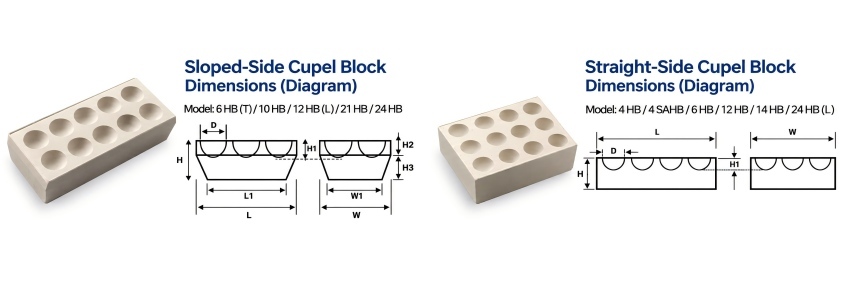
The Y&X cupel brick is the multi-cavity upgrade of the classic single cupel. Built as a refractory brick with independently machined round cup holes, each hole works exactly like one single cupel, so a laboratory can run a whole batch of samples in one cupellation cycle. This 12 hole model processes up to 12 samples per run.
Product Highlights
Full Magnesia Cupel Brick Series SpecificationsAll dimensions in mm. Weight values are approximate. "--" means top and bottom dimensions are identical for that model. Models with values in the bottom / boss / bevel columns have a beveled profile.
| Model | Holes | Hole Layout (L x W) | Top L (mm) | Bottom L (mm) | Top W (mm) | Bottom W (mm) | Height (mm) | Top Hole Dia. (mm) | Hole Depth (mm) | Boss Height (mm) | Bevel Height (mm) | Weight (approx. g) |
|---|---|---|---|---|---|---|---|---|---|---|---|---|
| 4HB | 4 | 2 x 2 | 48 | -- | 48 | -- | 20 | 18 | 6.5 | -- | -- | 97 |
| 4SAHB | 4 | 2 x 2 | 80 | -- | 80 | -- | 26 | 30 | 9 | -- | -- | 321 |
| 6HB | 6 | 3 x 2 | 76.5 | -- | 51 | -- | 20 | 20.5 | 8 | -- | -- | 150 |
| 6HB(T) | 6 | 3 x 2 | 82 | 72 | 60 | 50 | 20 | 22 | 7 | 6 | 14 | 184 |
| 10HB | 10 | 5 x 2 | 138 | 128 | 60 | 50 | 20 | 22 | 7 | 6 | 14 | 307 |
| 12HB | 12 | 4 x 3 | 80 | -- | 60 | -- | 20 | 14 | 7 | -- | -- | 204 |
| 12HB(L) | 12 | 6 x 2 | 165 | 155 | 60 | 50 | 20 | 22 | 7 | 6 | 14 | 375 |
| 14HB | 14 | 7 x 2 | 179 | -- | 54 | -- | 20 | 20 | 7.5 | -- | -- | 367 |
| 21HB | 21 | 7 x 3 | 172 | 162 | 76 | 66 | 20 | 22 | 7 | 6 | 14 | 476 |
| 24HB | 24 | 6 x 4 | 124 | 114 | 84 | 74 | 20 | 16 | 7 | 6 | 14 | 402 |
| 24HB(U) | 24 | 6 x 4 | 165 | -- | 120 | -- | 20 | 21.5 | 7 | -- | -- | 830 |
12 hole models: 12HB -- cavity layout 4 x 3, overall size 80 x 60 x 20 mm, top hole diameter 14 mm, approx. weight 204 g. 12HB(L) -- cavity layout 6 x 2, overall size 165 x 60 x 20 mm, top hole diameter 22 mm, approx. weight 375 g.
Large gold mine assay laboratories, high volume commercial testing institutions and precious metal refineries that need standardized batch cupellation with maximum efficiency. Pairs well with a Y&X cupellation furnace for a complete batch cupellation workflow.
A: A cupel is a single round dish for small or individual samples; a cupel brick is a multi-cavity block that cupels many samples per run. Both use the same 96% magnesia material and the same working principle. Under 20 samples per day, single cupels offer flexible pairing; for larger batches, a cupel brick is more efficient and provides a more uniform temperature field.
A: It processes up to 12 samples in one cupellation run, a practical step up from single cupels for medium volume laboratories. The one-piece brick heats uniformly and reduces temperature deviation between loading positions, improving consistency across a batch. Available in two layouts: 12HB (4 x 3 cavities, 80 x 60 x 20 mm) and 12HB(L) (6 x 2 cavities, 165 x 60 x 20 mm).
A: No. Cupel bricks can be placed directly into the cupellation furnace without pre-drying. The high purity magnesia formula gives excellent thermal shock resistance, so a brick at room temperature can enter the approximately 900°C working environment without cracking, saving preheating time and energy. If stored in extremely humid conditions (relative humidity above 85%), drying at 105°C for 2 hours before use is recommended.
A: They have low storage requirements; store them in a dry, ventilated place at room temperature. Unlike traditional bone-ash cupels, magnesia bricks are not affected by atmospheric humidity and will not freeze or degrade. Under proper storage they keep long term with unchanged performance, with a shelf life of more than 12 months under standard conditions.