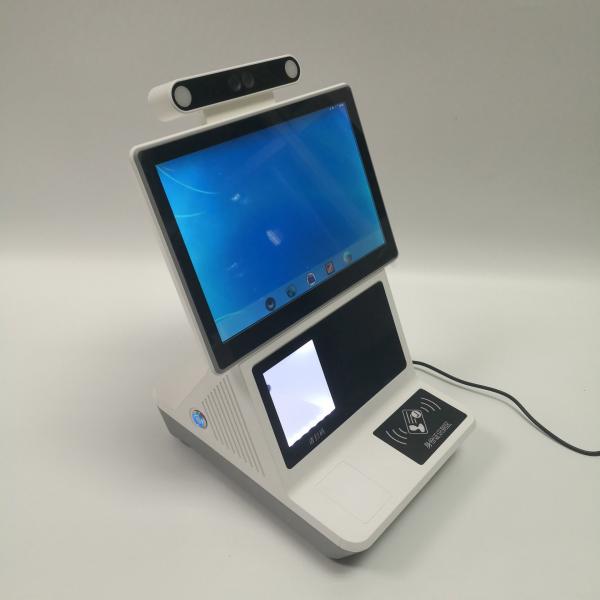
JP003 640x480 CMOS Mini 1D 2D Barcode QR Code Scanner Module USB TTL Interface
The JP003 640x480 CMOS Mini 1D 2D Barcode QR Code Scanner Module is a compact, high-performance decoding engine supporting both USB and TTL communication interfaces, ideal for embedded integration into kiosks, payment terminals, access control devices, and handheld scanners. Featuring a 640×480 CMOS image sensor with 60° horizontal and 45° vertical field of view, this module accurately decodes a wide range of 1D and 2D symbologies — including QR Code, Data Matrix, PDF417, EAN-13, Code 128, Code 39, and GS1 DataBar — with a decoding accuracy of ≥5mil and minimum symbol contrast of ≥20%. The module's ±55° angular tolerance and wide depth of field ensure reliable reading of payment QR codes (25–170mm) and EAN-13 barcodes (35–145mm), even in challenging orientations. Designed for demanding environments, the JP003 operates from -20°C to 60°C with ambient light adaptability up to 100,000 LUX, and has passed rigorous thermal shock, vibration, and drop tests. At just 37mm × 18mm × 9.8mm and 20g, it is the ideal scanning solution for compact product designs requiring high reliability.
Extensive 1D/2D Symbology Support: Decodes a comprehensive range of barcode types — from standard 1D codes (EAN-13, UPC, Code 128, Code 39, Codabar) to 2D codes (QR Code, Data Matrix, PDF417, AZTEC) — making it suitable for retail, logistics, and payment applications.
High-Decoding Accuracy: Achieves ≥5mil resolution for 1D barcodes, ensuring reliable reading of small, dense codes — essential for electronics manufacturing, healthcare labeling, and asset tracking applications.
Wide Angular Tolerance: Supports inclination and deflection up to ±55° with 360° rotation — allowing users to scan barcodes at almost any angle, reducing the need for precise alignment and improving user experience.
Flexible Communication Options: Supports USB (HID and Virtual COM) and TTL COM interfaces — enabling seamless integration with PCs, POS terminals, and embedded systems without requiring additional interface converters.
Low Power Consumption: Typical current draw of under 180mA at 5V (or optional 3.3V) — suitable for battery-powered and USB-powered devices.
Rugged Reliability: Passed 1.2-meter drop test onto concrete, 2000G vibration test, and 24-cycle thermal shock testing (-20°C to 60°C with 30-minute holds) — ensuring reliable operation in high-traffic, demanding environments.
Robust Ambient Light Adaptability: Operates in lighting conditions from 0 to 100,000 LUX — functional in direct sunlight, dimly lit retail spaces, and outdoor environments without performance degradation.
Embedded-Friendly Design with Dual Interfaces: The JP003 supports both USB and TTL communication in a single module, giving developers flexibility to connect to different host systems. For new designs, USB HID provides plug-and-play simplicity — no driver installation required. For legacy systems or embedded microcontroller-based designs, TTL serial communication enables direct connectivity to UART without a USB host. This dual-interface approach simplifies inventory management and reduces development time across multiple product lines.
Rugged Enough for High-Usage Scenarios: Consumer barcode scanners fail when dropped or exposed to temperature extremes. The JP003's 1.2-meter drop test rating (concrete floor), 2000G vibration tolerance, and 24-cycle thermal shock qualification (-20°C to 60°C with 30-minute holds) demonstrate reliability that meets industrial-grade standards. For self-service kiosks, unattended payment terminals, and handheld devices that endure daily abuse, this module delivers consistent performance without premature failure.
Works in Direct Sunlight and Dark Spaces: The JP003 operates across 0 to 100,000 LUX ambient light, eliminating the need for additional shading or special lighting considerations. In outdoor installations, direct sunlight doesn't wash out the scanner's illumination, maintaining reliable barcode reading even in challenging lighting conditions.
Angular Tolerance that Accommodates Natural Scanning: In real-world scanning, users rarely align barcodes perfectly. The JP003's ±55° inclination and deflection angles, combined with 360° rotation tolerance, enable comfortable, natural scanning posture. This reduces user fatigue in high-throughput applications, improves first-read rates, and minimizes delays at checkout counters, ticketing kiosks, and access control points.
Thermal Shock and Storage for Global Deployment: The 24-cycle thermal shock test from -20°C to 60°C simulates real-world temperature transitions — from cold storage facilities to tropical shipping containers. Combined with -40°C to 70°C storage temperature, the JP003 remains reliable for worldwide deployment without climate-related failure concerns.
| Model | JP003 |
| Image Sensor | 640×480 CMOS |
| Illumination Light | Working indicator: white light, success indicator: blue light |
| Supported Code Symbologies | 2D Codes: PDF417, Data Matrix, QR Code, AZTEC; 1D Codes: EAN-13, EAN-8, UPC-A, UPC-E, Code 39, Code 128, ISBN, Code 93, Code 11, UCC/EAN-128, GS1 Databar, Interleaved 2 of 5, Matrix 2 of 5, Industrial 2 of 5, Codabar, Standard 2 of 5, MSI-Plessey, GS1 composite code, etc. |
| Decoding Accuracy | ≥5mil for 1D barcodes |
| Typical Depth of Field | Alipay payment QR Code: 25–170 mm; EAN13 (13mil barcode): 35–145 mm |
| Minimum Symbol Contrast | ≥20% |
| Barcode Reading Angular Tolerance | Inclination ±55°, Deflection ±55°, Rotation 360° |
| Field of View | Horizontal 60°, Vertical 45° |
| Communication Interface | USB (HID, USB Virtual COM), TTL COM |
| Overall Dimensions | 37mm (D) × 18mm (W) × Max 9.8mm (H) |
| Net Weight | 20g |
| Operating Voltage | Default: 5V DC; Optional customized: 3.3V DC power supply |
| Rated Current | Typical value < 180mA (under 5V input) |
| Operating Temperature | -20℃ ~ +60℃ |
| Storage Temperature | -40℃ ~ +70℃ |
| Operating Humidity | 5% ~ 95% RH, non-condensing |
| Ambient Light Adaptability | 0 ~ 100,000 LUX |
| Thermal Shock Resistance Upper Limit Temperature | 60℃ (140 ℉) |
| Thermal Shock Resistance Lower Limit Temperature | -20℃ (-4 ℉) |
| Thermal Shock Resistance Single Cycle Mode | 30 minutes high temperature hold + 30 minutes low temperature hold |
| Thermal Shock Resistance Total Test Cycles | 24 cycles |
| Vibration Test | 2000G, 0.7ms, half-sine wave, 3-axis testing |
| Drop Test | 1.2 meters free fall onto concrete floor |