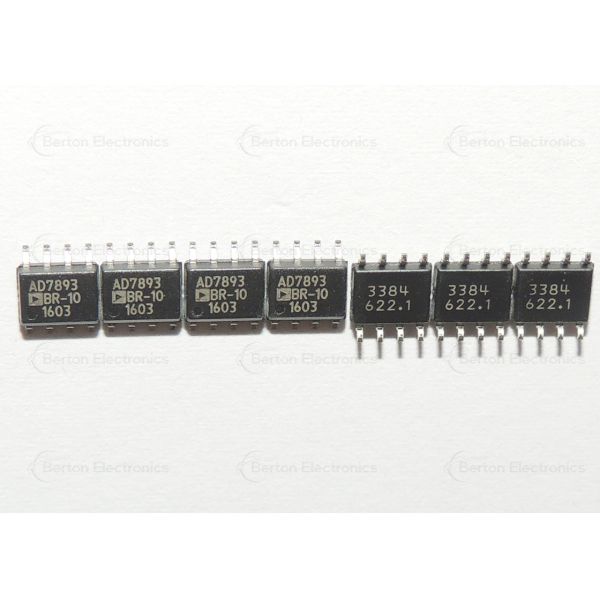
The AD7893BR-10 is a high-performance, low-power 12-bit successive approximation register (SAR) analog-to-digital converter (ADC) developed by Analog Devices. It is designed for precision signal conversion in industrial, instrumentation, and embedded systems, offering a blend of accuracy, speed, and energy efficiency. Its "BR-10" suffix indicates a 10 µs maximum conversion time and a wide operating temperature range, making it suitable for dynamic and harsh-environment applications.

- Resolution: 12-bit (4096 discrete output codes), ensuring precise digitization of analog signals with minimal quantization error.
- Conversion Speed: Maximum conversion time of 10 µs (typical: 8 µs), enabling real-time sampling of dynamic analog signals (e.g., sensor outputs, voltage transients).
- Accuracy Specifications:
- Integral Nonlinearity (INL): ±1 LSB (max) at 25°C, ensuring linear conversion across the full input range.
- Differential Nonlinearity (DNL): ±0.5 LSB (max), eliminating missing codes and ensuring consistent step size between consecutive digital outputs.
- Offset Error: ±2 LSB (max), with on-chip calibration capability to minimize zero-point drift.
- Gain Error: ±2 LSB (max), ensuring stable conversion gain across operating conditions.
- Input Range: Single-ended, unipolar analog input with a flexible range (configurable via external reference voltage, V_REF). Common ranges include 0 V to V_REF (e.g., 0 V to 5 V or 0 V to 3.3 V, depending on V_REF).
- External Reference Input (V_REF): Accepts a stable external reference voltage (typically 2.5 V to 5.5 V) to define the ADC’s full-scale input range. Using a precision reference (e.g., AD580) further enhances conversion accuracy.
- Power Supply:
- Analog Supply (V_ANA): 2.7 V to 5.5 V, optimized for low noise to preserve analog signal integrity.
- Digital Supply (V_DIG): 2.7 V to 5.5 V, compatible with most microcontroller (MCU) or digital signal processor (DSP) logic levels.
- Low Power Consumption:
- Active Mode: 1.8 mW (typical) at 5 V supply and 100 kSPS (samples per second) throughput, ideal for battery-powered devices.
- Power-Down Mode: 0.1 µW (typical), significantly reducing energy usage during idle periods.
- Serial Interface: 3-wire Serial Peripheral Interface (SPI) (SCLK, CS, SDO), enabling simple integration with MCUs, DSPs, or FPGAs. The interface supports both 8-bit and 16-bit data transfers for flexible readout.
- Control Logic:
- Chip Select (CS): Active-low signal to initiate conversion and select the device (supports multi-device bus sharing).
- Conversion Trigger: Conversion starts automatically when CS is pulled low, simplifying timing control.
- Data Readout: 12-bit digital output is shifted out serially on the SDO pin during the conversion cycle, allowing simultaneous conversion and data transfer for improved throughput.
- Output Format: Straight binary (for unipolar input ranges), with the most significant bit (MSB) first for easy alignment with digital systems.
- Temperature Range: Industrial grade, -40°C to +85°C, ensuring stable performance in harsh environments (e.g., industrial control cabinets, outdoor sensors).
- Noise Performance: Low input-referred noise (15 µV rms, typical) and high signal-to-noise ratio (SNR: 69 dB, typical at 5 V supply), preserving small-signal details.
- Package: 8-lead SOIC (Small Outline Integrated Circuit) package, offering compact size and easy PCB (Printed Circuit Board) assembly.
The AD7893BR-10’s precision, speed, and low power make it suitable for a wide range of applications requiring accurate analog-to-digital conversion:
- Balanced Performance: Combines 12-bit precision with 10 µs speed, meeting the needs of both static (e.g., temperature) and dynamic (e.g., current transient) signal applications.
- Low Power: Ultra-low power consumption in active and power-down modes, making it ideal for battery-operated or energy-constrained systems.
- Easy Integration: Simple 3-wire SPI interface and minimal external components (only requires an external reference and decoupling capacitors) reduce design complexity and BOM (Bill of Materials) cost.
- Industrial Ruggedness: Wide temperature range and robust accuracy specs ensure reliable operation in harsh industrial or outdoor environments.
- Cost-Effective: Offers high precision at a competitive price point, making it a preferred choice for mid-range precision applications where 16-bit ADCs may be overspecified.