LWIR 384x288 / 12μm Thermal Imaging Security Camera Module Uncooled
Product Overview
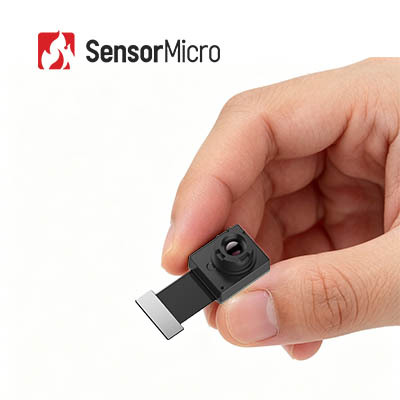
MICO412 is a thermal module specifically designed for rapid integration into thermal security cameras. Comprising a 384x288/12μm uncooled infrared detector, comprehensive optical components, signal processing circuitry, and proprietary image processing algorithms, the MICO412 infrared camera module delivers clear imagery, smooth performance, superior quality, and multiple lens options.
This thermal camera core can be integrated into security cameras ranging from short to long distances, making it ideal for integrators requiring high-quality imaging and robust, reliable performance in security and monitoring applications.
Main Features
- Low-cost and Energy-efficient Solution
- Equipped with self-developed 384*288/12μm wafer-level infrared detector for clear cost advantage
- Integrated with dedicated ASIC chip for high energy efficiency
- Optimized SWaP
- Ultra-compact size: 22.2*22.2*27.2mm (excluding lens)
- Lightweight: 30.3±2g
- Low power consumption: 680mW
- Easy Development & Quick Integration
- Provides native analog or digital video output supporting CVBS/USB/MIPI standards
- Easy mounting with minimal structural design effort
Product Specifications
| Model |
MICO412 |
| IR Detector |
| Sensitive Material |
VOx |
| Resolution |
384*288 |
| Pixel Size |
12µm |
| NETD |
≤30mK/F1.0/25℃ |
| Spectral Response |
8~14μm |
| Optical Lens |
| Focus/F# |
4.8/F1.0 | 9.1mm/F1.0 | 13mm/F1.0 |
| FOV |
51°(H)*39°(V) | 28.4°(H)*21.5°(V) | 20°(H)*15°(V) |
| Detection Range (8 pixels) |
|
99m (5'11" tall person) 360m (4m*3m vehicle) |
| Type |
Fixed Focus Athermal |
| First lens sealing/coating |
IP67 |
| Image Processing |
| Analog Video |
PAL(default) / NTSC |
| Digital Video |
USB/MIPI |
| Frame Rate |
25Hz/30Hz/50Hz |
| Start-up Time |
≤6s |
| Image Algorithm |
NUC/DRC/DNS/DDE/SFFC |
| Pseudo Color |
11 types - customizable |
| Electrical Interface |
| Standard External Interface |
3PIN interface (A1251-WV-S-3P) | 9PIN interface(A1251-WV-S-9P) | 26PIN interface(DF56C-26S-0.3V-51) |
| Video Interface |
CVBS | USB | MIPI |
| Power Supply |
| Supply Voltage |
DC: 5V~24V |
| Steady Power Consumption |
≤680mW@5V, 23±3℃ |
| Mechanical |
| Dimension |
22.2mm*22.2mm*27.2mm (L*W*H) |
| Weight |
30.3±3g |
| Environmental Adaptability |
| Operating Temperature |
-40℃~+70℃ |
| Storage Temperature |
-45℃~+85℃ |
| Humidity |
5%~95%, non-condensing |
| Vibration |
Random Vibration, 5.35grms, 3-axis |
| Impact |
Half Sine Wave, 40g/11ms, 3 Axis, 6 Direction |
| Certification |
RoHS2.0/Reach |
Industrial Applications
The MICO412 thermal camera module can be integrated into security cameras with temperature monitoring capabilities for short to ultra-long distance applications, including PTZ Cameras, Box Cameras, and Speed Dome Cameras.
Our Product Line
- High sensitivity and excellent performance
- World-leading technology in infrared industry
- Various infrared detectors available - both uncooled and cooled IR detectors in different formats and pixel sizes
- Volume production to ensure fast delivery - three production lines with annual production capability up to millions of detectors
Frequently Asked Questions
1. What is infrared thermal imaging?
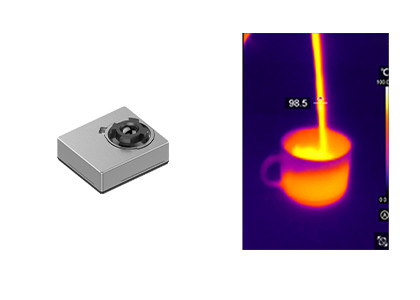
Infrared thermal imaging is a method that utilizes infrared radiation and thermal energy to gather information about objects. By detecting radiation differences between objects and their background environment, as well as variations within different parts of objects themselves, infrared thermal images display radiation fluctuations throughout a scene, revealing its distinctive characteristics.
2. What is the advantage of infrared thermal imaging?
- See through total darkness
- Identification under camouflage
- Long range detection
- Heat distribution detection
- Non-contact temperature measurement
- Occupation awareness
3. What is the applications of infrared thermal imaging?
Temperature measurement and all-weather imaging are two fundamental functions of infrared thermal imaging technology. Products developed using these technologies are widely used in traditional fields including electric power, security & monitoring, industrial manufacturing, scientific research, and medical treatment.