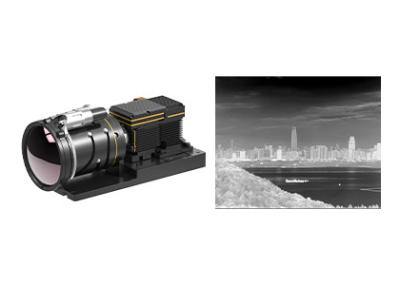
The EYAS G1010HMG cooled AD module consists of a 1024×768/10μm HOT cooled infrared detector and an AD circuit board, equipped with an RS046 rotary Stirling cryocooler. It converts the analog output signal of the cooled infrared detector into a digital video stream, while also providing drive power and control timing.
This module helps OEM customers quickly test and verify detectors, simplifies the integration process between cooled infrared detectors and complete systems, and significantly accelerates development progress. HOT (Operating temperature up to 150K) modules boast optimized Size, Weight, and Power (SWaP) and reliability, which is ideal for lightweight applications that require high stability.
| Model | EYAS G1010HMG |
|---|---|
| Resolution | 1024×768 |
| Pixel Size | 10μm |
| Spectral Response | 3.7μm±0.2μm~4.8μm±0.2μm |
| IR Detector NETD(23℃) | 20mK(F2) 25mK(F4) |
| Frame Rate | 1~100Hz, adjustable (50Hz by default) |
| Working Mode | Snapshot, ITR/IWR Integration Modes, Anti-blooming, Windows Mode |
| Standard External Interface | 60pin: 37201-SM060-032W1R01 5pin: A1257WR-S-5P-LCP |
| Digital Video | 16 bit CameraLink (CameraLink DualBase mode) |
| External Sync | CC1: External frame synchronous |
| Communication | CameraLink UART (Default)/ RS232 (customizable) Baud rate: 9600bps (Default) |
| Power Supply | AD Board: 5V Cryocooler: 12V |
| Steady Power (23℃) | ≤6W |
| Cooling Time(23℃) | ≤3min |
| Size(mm) | 72×87×51 |
| Weight(g) | ≤250 |
| Operating Temperature | -40℃~+71℃ |
The EYAS G1010HMG thermal imaging module is widely used in many areas such as NDT, Environmental Monitoring, Long-Range Surveillance, Scientific Research, and more.
According to the cooling method, infrared focal plane arrays can be divided into cooled and uncooled thermal imaging detectors. The cooled FPA infrared detector mainly adopts Dewar bottle/quick start throttling refrigerator and Dewar bottle/Stirling cycle refrigerator. While the uncooled FPA thermal IR detector works at room temperature and is the core of uncooled thermal imaging systems. The most common heat-sensitive materials include vanadium oxide (Vox) and amorphous silicon (a-Si). Vanadium oxide material is the mainstream choice in the current market due to its high temperature resistance coefficient and high thermal sensitivity.
An array of photosensitive elements is arranged on the focal plane array detector. Infrared rays emitted from infinity are imaged on these photosensitive elements of the focal plane array through the optical system. The detector converts the light signal into an electrical signal and performs integral amplification, sampling, output buffer and multiplexing system, and is finally sent to the monitoring system to form an image.