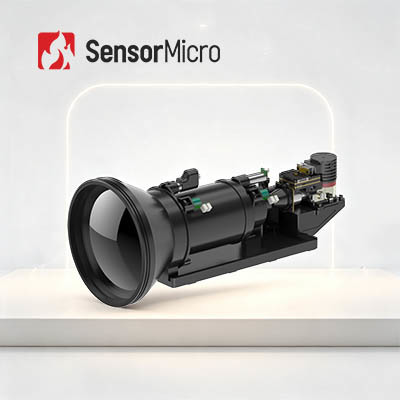
The EYAS G1212MA cooled AD module consists of a 1280×1024/12μm megapixel high-definition MWIR cooled infrared detector with an analog-to-digital (AD) board. Equipped with an RS058 rotary Stirling cryocooler, it delivers stable digital video output by converting analog signals from the detector into high-quality digital streams. Designed to support OEM customers, the EYAS G1212MA enables faster detector testing, streamlined system integration, and accelerated development cycles.
| Model | EYAS G1212MA |
|---|---|
| Indicators | |
| Resolution | 1280×1024 |
| Pixel Size | 12μm |
| Spectral Response | 3.7μm±0.2μm~4.8μm±0.2μm |
| IR Detector NETD(23℃) | 18mK(F2/F4) |
| Working Mode | |
| Frame Rate | 1~100Hz, adjustable |
| Working Mode | Snapshot |
| ITR/IWR Integration Modes | Anti-blooming Windows Mode |
| Electrical | |
| Standard External Interface | 60pin: 37201-SM060-032W1R01 5pin: A1257WR-S-5P-LCP |
| Digital Video | 16 bit CameraLink (CameraLink DualBase mode) |
| External Sync | CC1: External frame synchronous |
| Communication | CameraLink UART (Default)/ RS232 (customizable) Baud rate: 9600bps (Default) |
| Power Supply | AD Board: 5V Cryocooler: 24V |
| Steady Power (23℃) | ≤12W |
| Cooling Time (23℃) | ≤7min |
| Size (mm) | 148×59×80 |
| Weight (g) | ≤630 |
| Operating Temperature | -40℃~+71℃ |
The EYAS G1212MA thermal imaging module is widely used in many areas such as NDT, Environmental Monitoring, Long-Range Surveillance, Scientific Research etc.
A wide range of product formats including infrared detectors, camera cores, and modules to meet various integration requirements.
Multiple array resolutions, pixel sizes, wavebands, and lens options combinations provide greater flexibility for diverse applications.
Multiple interface options make integration straightforward and enable rapid development across multiple application fields.
There are currently two types of infrared thermal imaging sensors on the market, cooled and uncooled. Uncooled IR detector operates at ambient temperature. It is based on semi-conductor industry and thus usually can be fabricated in big volume with small size and low cost. Uncooled IR detectors are widely used in portable/handheld/mobile devices. Cooled IR detectors are packaged in a unit that keeps them at an extremely low temperature which shall be supported by a cryo cooler. They are much bigger, more expensive and less reliable than uncooled sensors, mainly due to the complex cooling systems they require. However, the cooled systems are incredibly sensitive and usually work with long focal length optics to achieve long range mission.
The cooled infrared focal plane detector operates at a low temperature which is provided by a detector dewar cooler (ddc). It has high sensitivity and can distinguish more subtle temperature difference than uncooled infrared detector. It can detect, identify and recognize objects at a very long range which is more than ten kilometers away. The structure of cooled detector is very complex which results in a relatively high cost than uncooled detector.
In nature, all objects whose temperature is higher than absolute zero (-273℃) can radiate infrared rays. By using the infrared camera detector to measure the infrared radiation temperature difference between the target itself and the background, you can get different infrared images, which are also called thermal images.
Infrared radiation that emitted by target enters the sensing range of the thermal detector, then the infrared detector converts the radiation signal of different intensity into the corresponding electrical signal, and then through amplification and video processing, forms the infrared image that can be observed by the naked eyes.