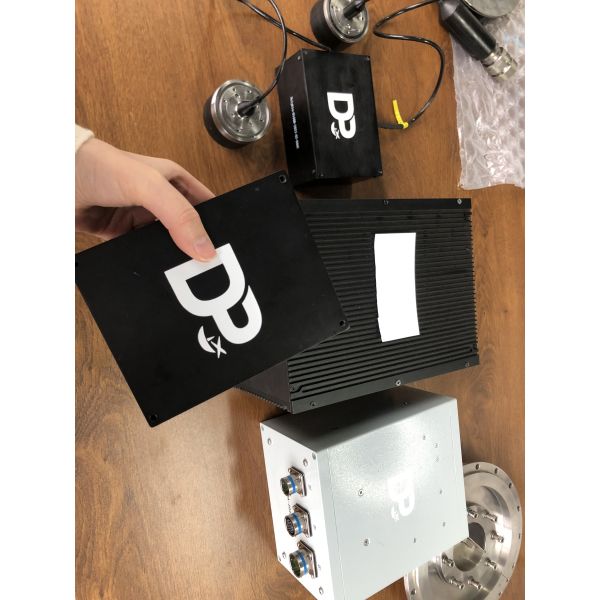
The DP-D300A Doppler Velocity Log (DVL) is a state-of-the-art underwater navigation sensor designed for autonomous underwater vehicles (AUVs), submersibles, and survey vessels. Featuring advanced phased-array transducer technology, it provides real-time 3D velocity measurement, accurate bottom-altitude detection, and intelligent data validity assessment, ensuring high-reliability underwater navigation in both bottom-tracking and water-tracking modes. The system seamlessly integrates with Inertial Navigation Systems (INS) for enhanced positioning accuracy during extended missions.
Key Features
- Automatic Bottom/Water Mode Switching: Optimizes performance based on seabed proximity and water column dynamics.
- 3D Real-Time Velocity Measurement: High-resolution X, Y, Z-axis velocity output for precise navigation control.
- Bottom-Altitude Sensing: Measures vertical distance to seabed for safe operation and depth monitoring.
- Fault Self-Check & Intelligent Data Validation: Ensures system reliability and identifies invalid data in real-time.
- Internal Data Logging: Stores up to 312 hours of mission-critical navigation data for post-processing analysis.
- Rapid System Initialization: Delivers valid velocity data within 45 seconds after power-on.
Technical Specifications
- Operating Frequency: 120 kHz
- Input Voltage: 24V ± 2V DC
- Velocity Range: -15 kn to +15 kn
- Velocity Accuracy: Better than 3‰ ± 3 mm/s
- Maximum Bottom-Tracking Depth: 300 m (typical seabed)
- Minimum Detectable Depth: ≤ 4 m (static measurement)
- Transducer Rated Depth: ≥ 500 m (customizable)
- Power Consumption: Average ≤ 50 W, Peak ≤ 192 W
Mechanical & Electrical Interfaces
- Electronic Unit Dimensions: ≤ 240 × 205 × 140 mm, rectangular housing, bottom-mount installation
- Transducer Array Dimensions: ≤ Φ290 × 65 mm, connected via adapter flange to submersible hull
- Communication Protocols:
- RS422 for real-time velocity and bottom-altitude data (PD6 protocol, ASCII, fixed-length, checksum-enabled)
- Dual RS232 ports for debugging, internal data configuration, and data retrieval
- Electrical Interfaces: Three main connectors for transducer array, velocity output, and power/debug/data interfaces
- Signal Definitions: Detailed pinout for XS1–XS3 connectors ensures correct integration with vessel or AUV systems
System Composition & Working Principle
- Components: Phased-array transducer, electronic unit, and communication cables (transducer cable, data/debug cable, power cable)
- Working Principle: Emits phased-array acoustic pulses; received echoes are processed for Doppler frequency shifts and time delay to calculate vehicle speed and bottom-altitude. Results are uploaded via digital signal processing module to the main navigation system (typically INS) for combined navigation.
Applications
- AUV & Submersible Navigation: Provides reliable velocity and altitude information for precise underwater maneuvering.
- Hydrographic & Oceanographic Survey: Bathymetric mapping, seabed profiling, and environmental monitoring.
- Autonomous Mission Planning: Integrates with INS and vessel control systems for long-duration scientific and industrial missions.
- Marine Construction & Offshore Operations: Navigation support in shallow and deep-water operations.
- Scientific Exploration: High-accuracy data for seabed studies and resource monitoring.
Usage & Best Practices
- Ensure transducer is submerged before powering on to avoid permanent damage.
- Connect all cables properly before powering the system; avoid hot-plugging.
- Maintain rigid mounting of transducer array; orientation should align with vessel heading.
- Keep transducer face as level as possible with water surface.
- Minimum bottom-altitude after immersion: ≥ 4 m, with unobstructed radiation field.
- Operate at DC24V ±2V for personnel and equipment safety.
Performance Validation
- Field trials conducted from May 29–31, 2023, on Zhanghe River, covering >5 km at 5 kn speed.
- Four single-pass tests showed absolute velocity accuracy better than 0.3%, with >98% effective data rate.
- Rapid initialization: valid velocity output achieved within 30 seconds after power-on.