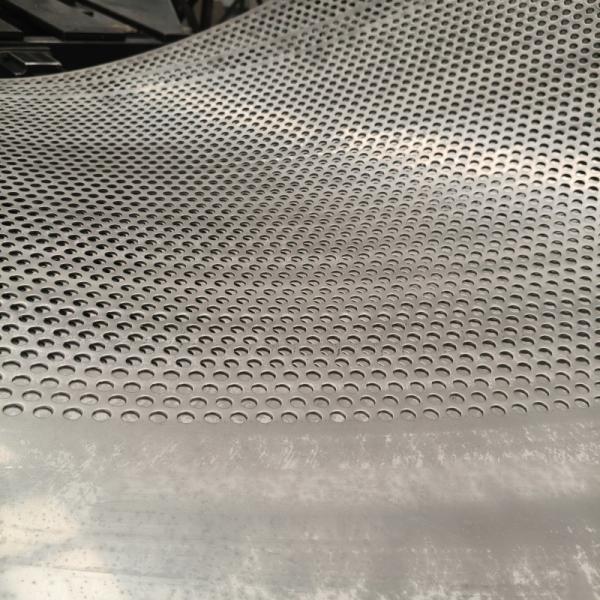
Customizable perforated metal sheets support ventilation, filtration, sound insulation and decoration.
Perforated metal sheet (also called punched metal plate) is a versatile metal processing material formed by stamping various hole shapes on metal plates via professional equipment. Integrating ventilation, filtration, sound insulation, protection and decoration, it boasts excellent structural stability and environmental adaptability, with customizable specifications and stable performance—widely applied in construction, industrial manufacturing, environmental protection, aerospace and other fields. This article comprehensively introduces its core attributes, specifications, applications and advantages with concise data.
1. Core Product Specifications & Customization
Perforated metal sheets offer both standardized specs and full customization to meet diverse needs, covering key dimensions and hole parameters:
- Plate Size & Thickness: Conventional sizes include 1000mm×2000mm, 1250mm×2500mm, 1500mm×3000mm (ultra-long/wide customizable); thickness ranges 0.2mm–20mm (thin: 0.2mm–1.5mm for decoration/filtration; medium: 1.5mm–6mm for ventilation/protection; thick: 6mm–20mm for heavy-duty screening/support).
- Hole Types: Round (universal, uniform force), square (high strength, isolation), slotted (large ventilation/drainage), hexagonal (honeycomb stability, decoration), and customized speciion/drainage), hexagonal (honeycomb stability, decoration), and customized special shapes (triangular, plum blossom, etc.).
2. Key Technical Parameters
Technical parameters directly determine product performance, with standard ranges as follows:
| Key Parameter |
Conventional Range |
Functional Impact |
| Hole Diameter |
0.5mm–50mm |
Small holes (≤3mm) for precision filtration; large holes (≥10mm) for ventilation/heat dissipation |
| Hole Pitch |
2mm–80mm |
Denser holes (smaller pitch) = better ventilation but lower structural strength |
| Open Area Rate |
10%–80% |
Higher rate = stronger permeability/drainage but weaker load-bearing |
| Dimensional Tolerance |
±0.1mm–±0.3mm |
Small tolerance ensures high precision for matching equipment |
3. Common Materials & Surface Treatments
3.1 Material Types (Performance & Applications)
| Material |
Core Advantages |
Applicable Scenarios |
| 304 Stainless Steel |
Rust/corrosion resistance, high toughness, food-grade |
Food processing, medical facilities, architectural decoration |
| 316 Stainless Steel |
Chloride/salt spray resistance, harsh environment adaptability |
Marine engineering, chemical industry, coastal buildings |
| Galvanized Steel |
Low cost, good hardness, basic rust prevention |
Industrial protection, warehouse isolation, civil ventilation |
| Aluminum Alloy |
Lightweight, ductile, easy processing, heat dissipation |
Sunshade panels, ceilings, sound-absorbing panels |
| Carbon Steel |
Ultra-high hardness, strong bearing capacity, low price |
Industrial filters, heavy equipment protection, mine screening |
3.2 Surface Finishing
- Original Metal Color: Natural luster, wear-resistant, for industrial equipment.
- Powder Coating: RAL standard colors (black, white, gray, etc.), scratch-resistant, for architectural decoration.
- Anodized (Aluminum): Champagne gold, bronze, etc., no fading, high-grade decoration.
- Galvanized Silver Gray: Low cost, for ordinary industrial protection.
- Polished Mirror (Stainless Steel): Smooth reflective, for high-end decoration/precision accessories.
4. Main Application Fields
- Construction & Decoration: Exterior wall cladding, sunshade panels, ceiling sound-absorbing panels, guardrails, stair treads.
- Industrial & Mechanical Protection: Equipment covers, machine tool isolation nets, conveyor filter plates, workshop ventilation partitions.
- Environmental Protection & Filtration: Air/water treatment filters, dust removal equipment, grain screening.
- Civil & Commercial: Speaker grilles, lamp heat dissipation panels, supermarket shelves, decorative furniture.
- Special Industries: Marine engineering, chemical anti-corrosion equipment, medical sterile equipment, mine screening.
5. Comprehensive Advantages
Compared with plastic mesh and ordinary flat metal plates, perforated metal sheets offer irreplaceable benefits: high structural strength, strong corrosion resistance, customizable performance/appearance, good ventilation/sound absorption, recyclable materials, long service life, and low maintenance cost—an eco-friendly multi-functional material.
Conclusion
Through flexible matching of materials, colors, specifications and parameters, perforated metal sheets integrate functionality and decoration. With advanced processing technology, customized products are increasingly used in modern construction, industrial production and precision manufacturing. Selecting appropriate materials and parameters based on actual needs maximizes service performance and economic value.