Specifications
Brand Name :
ZG
Model Number :
MS
Certification :
CE
Place of Origin :
China
MOQ :
1PC
Price :
10USD/PC
Payment Terms :
L/C,D/A,D/P,T/T,Western Union,MoneyGram
Supply Ability :
1000PCS
Delivery Time :
5-8 Working days
Packaging Details :
Strong wooden box for Global shipping
Description
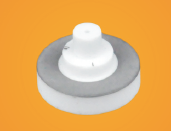
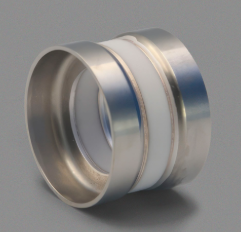
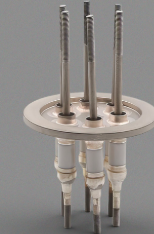
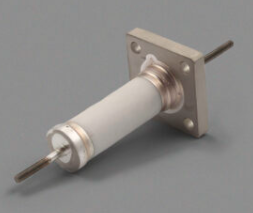
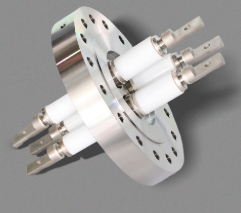
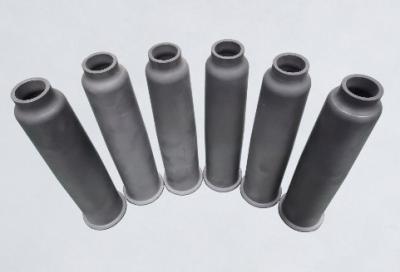
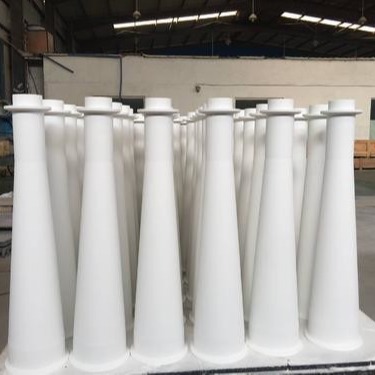
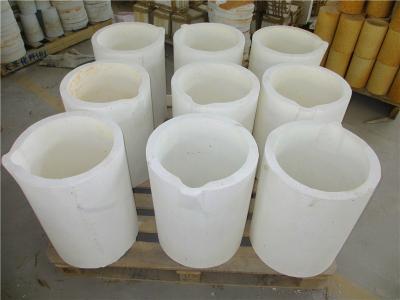
Metallized Ceramics Component

ZG supplies custom Metalized Alumina Ceramics. These metallized ceramics are ideal for use within high vacuum, high voltage and high pressure applications.
We provide metallized ceramic for power grid tubes, vacuum interrupters, RF windows, metallized rings and components for insulators and sensors.
Material Properties
Alumina is one of the most commonly used engineering ceramic materials, offering high hardness and wear resistance with excellent electrical insulation properties. ZG high-purity alumina 94-96% ceramics (Al2O3) are used as a ceramic base material. Other ceramic base materials can be use on request.
Manufacturing Process
Common metalized alumina ceramics consist Molybdenum based paints followed by nickel plating. A coating of molybdenum and manganese particles mixed with glass additives and volatile carriers is applied to the ceramic surface to be brazed. The application of the coating may be hand-painted, sprayed, or robotically applied. After air drying, the coating is fired in a wet hydrogen environment at 1450°-1600°C leaving a "glassy" metallic coating 300-500 micro-inches (7.6-12.7 microns) thick, to ensure high bond strength between the metallized layer and the ceramic base.
The fired coating is subsequently plated with a 0.001-0.003 in. (25.4-76.2 microns) layer of nickel. The nickel plating is sinter-fired at 850-950°C in a dry hydrogen atmosphere leaving a finished metallic surface that can be readily brazed using standard braze filler metals.
Advantages of Ceramics
  • Low dielectric loss-the dielectric constant
  • High thermal conductivity
  • Thermal expansion coefficient-the thermal expansion coefficients of ceramics and metals are close
  • High bonding strength-high bonding strength between metal layer and ceramic
  • High operating temperature-ceramics can withstand high and low-temperature cycles with large fluctuations, and can even operate normally at high temperatures of 500-600 degrees
  • High electrical insulation the ceramic material itself is an insulating material and can withstand a high breakdown voltage
Technical Specifications
Tensile Strength, Kovar Cup Method > 20,000 psi, avg. (138N/mm2)
Helium Leak Rate < 10-9 cc/sec
Thermal Shock Resistance room temperature to 850C will not burst or leak after five operations
High Tensile Strength Low Helium Leak Rate Metallized Ceramics Component with High Thermal Conductivity
Send your message to this supplier
Send Now

High Tensile Strength Low Helium Leak Rate Metallized Ceramics Component with High Thermal Conductivity

Ask Latest Price
Brand Name :
ZG
Model Number :
MS
Certification :
CE
Place of Origin :
China
MOQ :
1PC
Price :
10USD/PC
Contact Supplier
High Tensile Strength Low Helium Leak Rate Metallized Ceramics Component with High Thermal Conductivity

HENAN ZG INDUSTRIAL PRODUCTS CO.,LTD

Verified Supplier
6 Years
henan, zhengzhou
Since 2007
Business Type :
Manufacturer, Distributor/Wholesaler, Importer, Exporter
Total Annual :
5000000-8000000
Employee Number :
50~100
Certification Level :
Verified Supplier
Contact Supplier
Submit Requirement