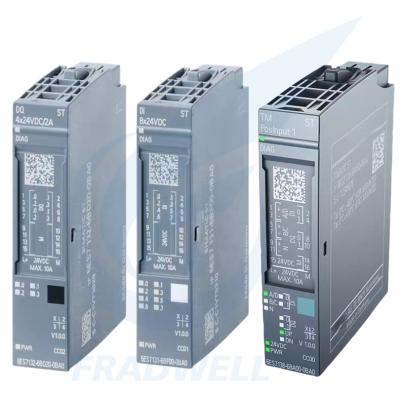
XSFQ7 Blade Bus Controller: Your Top Pick for Mid-Small Scale Motion Control in Advanced Manufacturing
The XSFQ7 Blade Bus Controller is a premium solution designed for mid-small scale motion control applications in advanced manufacturing. Featuring a compact blade-type design that optimizes space utilization and simplifies system integration, it delivers high-precision motion synchronization and reliable bus communication performance, meeting the demanding control requirements of complex production processes. As an ideal choice for cost-effective yet high-performance motion control, it balances efficiency, flexibility, and stability to drive operational excellence in modern manufacturing environments.
Product Features
- Blade-Type Compact Design: Space-saving blade structure for easy installation and integration into mid-small scale motion control systems, reducing equipment footprint while ensuring convenient maintenance and expansion.
- High-Precision Motion Synchronization: Advanced motion control algorithms support multi-axis linkage and real-time position feedback for precise and smooth motion control in complex manufacturing processes.
- Reliable Bus Communication: Supports mainstream industrial bus protocols for stable, high-speed data transmission between controllers, actuators, and upper monitoring systems.
- Tailored for Advanced Manufacturing: Optimized hardware and software configuration to match operational characteristics of advanced manufacturing industries, compatible with various production equipment and process requirements.
Product Advantages
- Cost-Effective Solution: Balances high performance and reasonable pricing, providing small and medium-sized enterprises with a cost-efficient alternative to high-end motion control systems.
- Enhanced Production Efficiency: High-precision synchronization and fast response capabilities minimize motion errors and downtime, improving overall efficiency and product qualification rates.
- Strong Compatibility & Flexibility: Compatible with a wide range of industrial devices and bus protocols, allowing flexible system configuration and supporting future upgrades.
- Low Maintenance & Operational Burden: Compact blade design simplifies troubleshooting and component replacement, while stable communication reduces unexpected failures and long-term operational costs.
Core Technical Parameters
| Category |
Core Parameters |
| Motion Control Capability |
Supported Axes: Max 32-axis coordinated control Interpolation Functions: Linear interpolation, circular interpolation, helical interpolation Pulse Output: Max 10MHz output frequency, supporting pulse/direction and dual-pulse modes |
| Bus Protocol Support |
Synchronous Serial Protocols: SSI, BiSS C, EnDat 2.x Incremental Encoder: A/B/Z quadrature signal, supporting x1/x2/x4 decoding modes Industrial Bus: EtherCAT, Profinet (compatible with mainstream industrial standards) |
| Communication Interfaces |
Ethernet Interface: 2× Gigabit Ethernet (1000Mbps auto-adaptive) Serial Interface: 2× RS485, 1× RS232 High-Speed Interface: 25MHz SPI interface, 16Mbit/s UART interface |
| Storage Specifications |
Program Memory: 64MB Flash Data Memory: 128MB DDR2 SDRAM Expansion Storage: Support local U-disk storage and program import/export |
| Digital I/O Configuration |
Built-in I/O: 24× digital inputs, 16× digital outputs (with overcurrent protection) Expansion Capability: Max support for 4096 input/4096 output isolated I/O expansion |
| Analog Interface |
Analog Input: 4 channels (0-10V, 0.2% accuracy) Analog Output: 2 channels (0-10V, 0.5% accuracy) Refresh Time: ≤10ms |
| Hardware Specifications |
Supply Voltage: 24V DC (wide voltage range 18-30V) Power Consumption: ≤12W (fanless heat dissipation) Operating Temperature: -40℃~+125℃ Package Size: 180×120mm (compact blade-type design) |
| Core Performance |
Operation Speed: 0.02μs per instruction Position Resolution: 64-bit encoder counting Communication Latency: ≤7ns (bus synchronization latency) Programming Environment: Support multi-task programming and custom protocol development |
Complete Model Parameter Table
| Product Model |
Supported Axes |
Core Function Version |
Compatible Bus Protocol |
Key Configuration Highlights |
Overseas Certification Standards |
| XSFQ7-2S-E |
2-axis |
Standard Version |
EtherCAT |
Basic linear/circular interpolation, 24-channel digital I/O, 64MB Flash memory |
CE, RoHS, FCC |
| XSFQ7-2S-P |
2-axis |
Standard Version |
Profinet |
Profinet IO compatible, 10MHz pulse output, U-disk program import/export supported |
CE, RoHS, TÜV |
| XSFQ7-4P-E |
4-axis |
Enhanced Version |
EtherCAT |
4-axis coordinated control, 64-bit position resolution, communication latency ≤7ns |
CE, RoHS, FCC, UL |
| XSFQ7-4P-P |
4-axis |
Enhanced Version |
Profinet |
High-precision synchronous control, SSI/BiSS C encoder supported |
CE, RoHS, TÜV, UL |
| XSFQ7-8P-E |
8-axis |
Enhanced Version |
EtherCAT |
8-axis coordination + helical interpolation, 128MB DDR2 memory, dual Gigabit Ethernet ports |
CE, RoHS, FCC, UL, KC |
| XSFQ7-8P-P |
8-axis |
Enhanced Version |
Profinet |
EnDat 2.x protocol supported, 4-channel analog input, overcurrent protection for outputs |
CE, RoHS, TÜV, UL, KC |
| XSFQ7-16H-E |
16-axis |
Advanced Version |
EtherCAT |
16-axis synchronous control, custom protocol development, 4096-point I/O expansion support |
CE, RoHS, FCC, UL, KC, CSA |
| XSFQ7-16H-P |
16-axis |
Advanced Version |
Profinet |
Multi-task programming, high-speed SPI/UART interfaces, wide-temperature operation (-40℃~+125℃) |
CE, RoHS, TÜV, UL, KC, CSA |
| XSFQ7-32H-E |
32-axis |
Advanced Version |
EtherCAT |
32-axis max coordination, 0.02μs/instruction operation speed, redundant communication |
CE, RoHS, FCC, UL, KC, CSA, ATEX |
| XSFQ7-32H-P |
32-axis |
Advanced Version |
Profinet |
Full protocol compatibility, hot-swappable expansion supported, low power consumption ≤12W |
CE, RoHS, TÜV, UL, KC, CSA, ATEX |
Industry Applications & Scenarios
- Automotive Component Manufacturing: Perfect for small-to-medium auto parts production lines including precision stamping of sensor brackets, assembly of electronic control units (ECUs), and servo-driven welding of micro-components.
- Electronics & 3C Product Assembly: Ideal for assembling smartphones, laptops, and smart wearables including PCB component placement, battery cell stacking, and screen module bonding.
- Precision Instrument Making: Used in producing lab equipment, medical devices, and optical instruments such as calibrating pressure sensors, assembling microscope lens groups, and fabricating miniaturized flow meters.
- Packaging Machinery: Fits mid-sized packaging lines including labeling machines for bottled drinks, carton folding and sealing equipment, and snack food portioning systems.
- Textile & Garment Machinery: Applied to computerized embroidery machines, fabric cutting systems, and seamless underwear knitting equipment.
- Solar Panel Production: Used in the assembly of solar cell modules including aligning and bonding solar cells, trimming edge seals, and testing module electrical performance.
Common Q&A for Overseas Installation & Operation
Q1: Just unboxed and powered on, the controller's indicator light won't turn on and it can't connect to the bus. Checked the power cable and it's fine--what's wrong?
A: It's most likely a voltage mismatch issue. Power grids vary across overseas regions. Our controller runs on 24V DC, but it must use the matched wide-voltage power adapter (18-30V DC input). Also, double-check if the positive and negative power terminals are reversed--reversed wiring can directly prevent industrial devices from working.
Q2: Using it in a European factory, the controller fails to connect to on-site Profinet devices, and bus scanning keeps failing. Other brands worked without issues before--why?
A: This is a common pitfall caused by bus parameters not being adjusted to European industrial standards. First, confirm you're using the model with the "P" suffix. Then, modify the device name and station number to match the customer's Profinet network configuration. Also, remember to install bus terminal resistors to prevent signal attenuation during long-distance wiring.
Q3: The controller keeps freezing and restarting after a week of use in a high-temperature workshop. The fan isn't blocked--what's the cause?
A: Our controller uses a fanless heat dissipation design, relying on its metal casing for heat conduction. It must be tightly mounted to the customer's cabinet mounting plate, and the cabinet must have ventilation openings. Also, if the workshop temperature stays above +100℃ for extended periods, we recommend installing cabinet cooling fans to extend equipment lifespan.
Q4: North American customers report that the circuit breaker trips repeatedly after grounding the controller. Not grounding it risks electrostatic damage--how to fix this?
A: The problem lies in incorrect grounding methods. Our controller uses protective grounding and must be connected to the factory's dedicated grounding bar--never mix it with the neutral line. Additionally, if there are high-frequency welding machines or other interference devices in the workshop, install an isolation transformer to avoid electromagnetic interference-induced false tripping.
Product Certification & Quality Assurance
Global Market Certifications
- CE Certification (EU Market): Complies with EU's Low Voltage Directive and Electromagnetic Compatibility Directive, ensuring safe operation in all EU member states and EFTA countries.
- FCC Certification (US Market): Meets electromagnetic radiation standards of the US Federal Communications Commission, suitable for deployment in the United States and FCC-recognizing regions.
- UL Certification (North American Market): Passed safety certification of Underwriters Laboratories, confirming compliance with strict North American safety standards.
- TÜV Certification (European High-end Market): Certified by TÜV Rheinland, verifying reliability and compliance with German industrial quality standards.
- RoHS Certification (Global Environmental Standard): Complies with EU's Restriction of Hazardous Substances directive, meeting global environmental protection requirements.
- ATEX Certification (Explosive Environment Application): High-end models certified for safe use in Zone 2 explosive gas environments, suitable for petrochemical and pharmaceutical industries.
Quality Assurance System
ISO-Standardized Production Process: The entire production process strictly follows ISO 9001 quality management system and ISO 14001 environmental management system standards. From raw material procurement to component assembly, each link is equipped with full-time inspectors, and key processes such as circuit board welding and functional testing are 100% inspected.
Rigorous Reliability Testing: All product models must pass a series of strict reliability tests including high/low temperature testing (-40℃~+125℃ for 1000 hours), vibration & shock testing, humidity testing (95% RH for 500 hours), and long-term aging testing (full-load operation for 2000 hours).
Global After-sales Quality Guarantee: Provide 2-year global warranty service for all products. During the warranty period, if there are non-human quality problems, free replacement of new products or parts is supported.