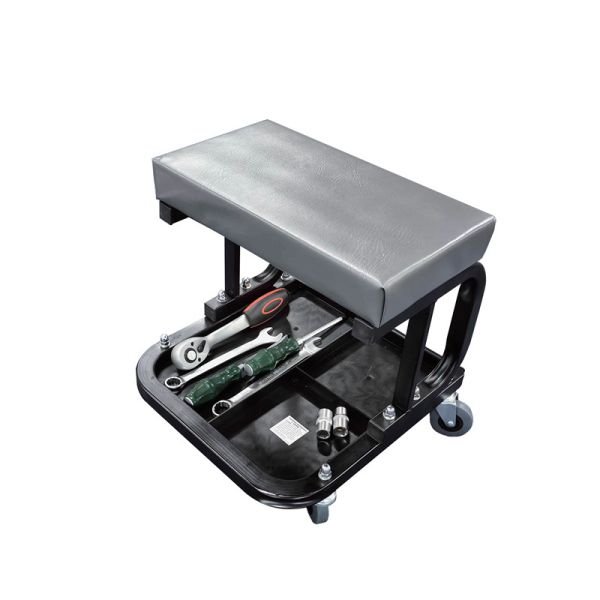
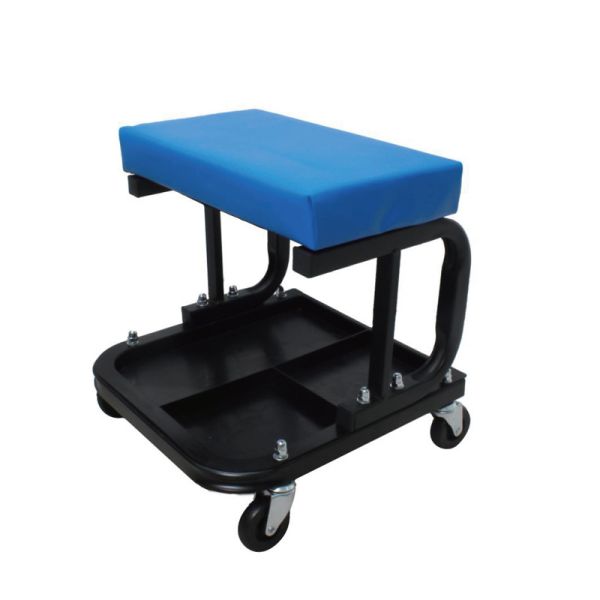
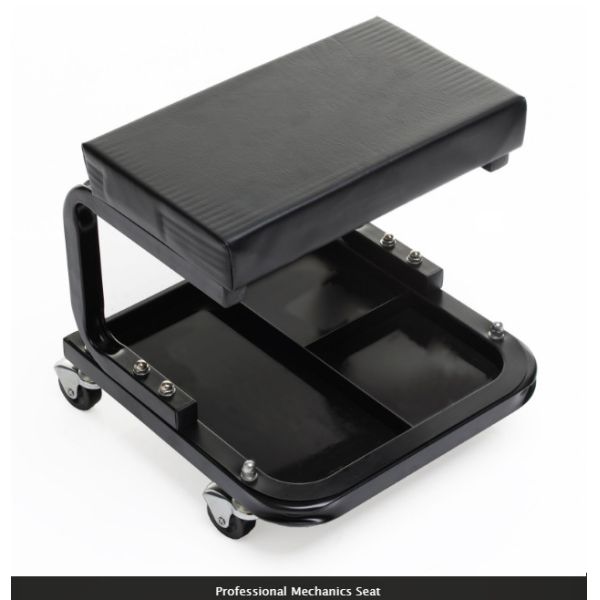
The YD11-007 Metal Mechanic's Seat is a professional equipment designed to address the pain points of "traditional mechanic seats having weak load capacity and easy deformation, stuffy and dirty seat surfaces, and cumbersome movement". With "strong metal support + lightweight portability + ventilated anti-stuffiness" as the core, it balances stability and comfort, providing a "durable, easy-to-move, and comfortable" sitting solution for auto repair, equipment maintenance and other scenarios. Its core advantages are as follows:
- Metal Reinforced Frame + Under-Seat Reinforced Bracket, Stable and Durable with 120kg Load Capacity
- Strong Support Against Deformation: The main frame is integrally formed from 1.5mm-thick cold-rolled steel plate, and an additional 1.2mm-thick reinforced bracket (distributed in a "cross" shape) is added under the seat, forming a dual load-bearing structure of "frame-bracket". The overall torsional strength reaches 320N·m, with a rated load capacity of 120kg; even if a mechanic sits on the seat with 25kg heavy tools (such as torque wrenches), the frame shows no bending. Compared with ordinary plastic seats (mostly 80kg load capacity), the stability is increased by 50%;
- Anti-Rust and Wear-Resistant: The electrostatic spray-painted surface has strong adhesion, showing no rust in 150-hour salt spray tests. When used in oily and humid environments of auto repair shops, engine oil and gear oil can be wiped clean with a cloth without paint peeling. The service life is 7-8 years, which is twice the durability of ordinary painted seats.
- Ultra-Lightweight Design (4.1kg), Easy Carrying for One Person
With a net weight of only 4.1kg, equivalent to the weight of a large bottle of mineral water, it has two advantages:
- High Portability: Adult women can carry it with one hand, easily moving it from the warehouse to the maintenance workstation or pushing it from one end of the workshop to the other, adapting to the "multi-station rotation work" scenario in auto repair shops; compared with metal seats of the same load capacity (mostly 6-8kg), the carrying difficulty is reduced by 60%;
- Space-Saving Storage: With an overall size of 360×365×365mm, it can be stacked for storage (up to 6 units stacked). The package size is only 370×140×380mm, and 10 units can be packed in one box during logistics transportation. Compared with bulky seats, the storage and transportation costs are reduced by 40%.
- Ventilated Metal Seat Surface, No Stuffiness During Long Sitting in Summer
The seat surface adopts a metal mesh design with 5mm apertures, balancing practicality and comfort:
- Ventilated and Anti-Stuffy: The mesh structure allows natural air circulation, so there is no stuffiness even when sitting for more than 1 hour in summer. Compared with solid plastic seat surfaces (which are stuffy and easy to sweat), the body temperature is reduced by 3-5℃, and the comfort is increased by 80%;
- Anti-Dirt and Easy to Clean: The 5mm aperture is small enough to prevent small parts such as screws and washers from falling, while avoiding the accumulation of oil and dust; if oil is spilled, it can be cleaned by blowing with a high-pressure air gun without repeated wiping, and the cleaning efficiency is increased by 70%.
- 4 Swivel Mute Casters, Flexible Movement in Narrow Spaces
Equipped with 4 2.5-inch high-elastic rubber swivel casters, which combine smoothness and muteness:
- Mute Without Disturbance: The friction noise between the rubber casters and the ground is ≤45 decibels (equivalent to library ambient volume), which will not interfere with adjacent workstations or customer rest in 4S store indoor maintenance areas and closed workshops of agricultural machinery repair stations. Compared with traditional metal casters (noise ≥75 decibels), the noise is reduced by 40%;
- Flexible Without Sticking: The casters support 360° omnidirectional rotation, with a minimum turning radius of only 25cm. In areas with dense equipment in the workshop (such as between tool racks and multi-station maintenance areas), it can be adjusted by gently pushing, with a rolling resistance of ≤30N. Compared with fixed-stand seats, the movement efficiency is increased by 500%, reducing the physical consumption of mechanics moving back and forth to pick up items.
-
Auto Repair Shop Car Inspection Workstation
An auto repair shop performs chassis pipeline inspection on a Honda Fit (chassis clearance 13cm), and the mechanic uses the YD11-007 seat: 4 swivel casters slide smoothly to the side of the car, the metal frame stably supports the body, and the under-seat reinforced bracket prevents deformation during long sitting; the ventilated seat surface relieves summer stuffiness, and the position can be adjusted at any time to check the pipeline status during inspection. Tools are placed beside the legs (the seat has sufficient load margin), and the inspection time for a single car is shortened from 60 minutes to 40 minutes, adapting to the "efficient car inspection" scenario.
-
4S Store Vehicle Maintenance Rest Area
A 4S store conducts regular maintenance on a Toyota Corolla. After maintaining 3 vehicles, the mechanic uses the YD11-007 seat: The lightweight design allows easy pushing to the rest area, the ventilated seat surface prevents sweating and stuffiness, and the mute casters do not disturb other customers; there is no need to find a dedicated rest chair during maintenance intervals, and the mechanic can sit down for a short rest, adapting to the "efficient 4S store maintenance + convenient rest" scenario.
-
Agricultural Machinery Repair Station Parts Assembly
An agricultural machinery repair station assembles chassis parts for a Dongfanghong tractor, and the mechanic uses the YD11-007 seat: The metal frame resists dust and oil in the agricultural machinery station, the swivel casters move flexibly on the concrete floor, and the mechanic can get close to the workbench to assemble parts; the seat mesh prevents small screws from falling, and after assembly, the seat surface dust can be cleaned with an air gun without additional cleaning, adapting to the "efficient agricultural machinery parts assembly" scenario.
-
Home Garage DIY Repair
A car owner replaces the brake pads for a Wuling Hongguang MINI in his home garage, using the YD11-007 seat: The 4.1kg weight is easily carried from the garage corner to the side of the car, and the swivel casters help accurately align with the brake pad position; the metal seat surface provides stable load capacity, and wrenches can be temporarily placed during repair, adapting to the "convenient home DIY repair" scenario, allowing basic inspection and repair without professional equipment.
A1: No, the aperture design is suitable for small parts protection. The 5mm aperture is slightly larger than the 3mm screw, but the seat edge is designed with a 1cm-high anti-slip flange, which will block the screws and prevent them from sliding off the seat surface; at the same time, the metal strip spacing of the mesh panel is small, so screws will be caught between the metal strips to further prevent falling. You can safely place small parts on the seat edge during daily inspection.
A2: The risk is low, and the structural design ensures stability. The bottom frame of the seat is 365mm wide, with a low center of gravity (only 10cm from the ground). Even if pushed by children, it is not easy to tip over due to center of gravity shift; at the same time, the casters have built-in damping, requiring slight force to push, which can reduce the collision risk caused by random pushing by children. It is recommended to place the seat away from children's activity areas during daily use to further ensure safety.
A3: No, the caster material and design ensure anti-slip performance. The outer layer of the rubber casters is designed with serrated anti-slip patterns to enhance friction with the oily floor; at the same time, the 4 casters are distributed in a "rectangle" shape, with a ground contact area of 0.02㎡, so there is no slipping risk even on the floor with engine oil spills; it is recommended to clean the oil and debris in the caster patterns with a brush every month to maintain anti-slip performance and avoid oil hardening affecting rolling.
A4: Long-term use in this way is not recommended, as there is a risk of insufficient safety margin. The total weight of a 110kg mechanic plus a 15kg tool bag is 125kg, exceeding the 120kg rated load capacity. Although short-term emergency use may not cause obvious problems, long-term overloading will lead to fatigue deformation of the under-seat reinforced bracket and accelerated wear of caster bearings, shortening the product service life. For daily use, it is recommended to place the tool bag in the ground tool cart and only put commonly used small tools (≤10kg) on the seat edge to ensure the total weight is within 120kg and guarantee safety.