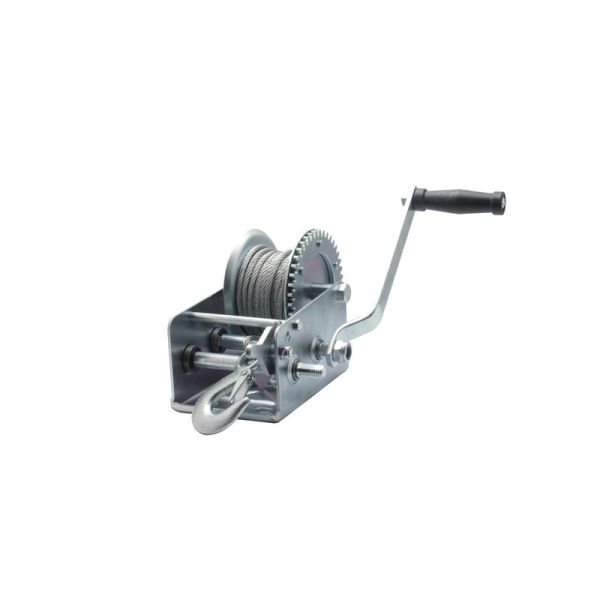
Centered on "high-wear-resistance steel cable + graded labor-saving + power-free universality", the YD30-012B Series Cable Hand Winch is optimized to address traction pain points in power-free, high-wear scenarios. Its core highlights are as follows:
The steel cable is made of hot-dip galvanized high-carbon steel, which outperforms ordinary iron wire cables in:
- 80% Higher Cut Resistance: No scratches or wire breaks on the cable surface when rubbing against outdoor rocks or metal edges. For example, when pulling 1100kg equipment over gravel ground, the cable shows no wear marks;
- Superior Rust Resistance: Zinc layer thickness ≥10μm, no rust after 72-hour salt spray test. Even if briefly soaked in rain or exposed to mud, it can still work normally after rinsing with clean water, adapting to dusty and humid outdoor scenarios;
- Tensile Resistance Without Deformation: The 6.0mm cable can withstand 8000N tension (far exceeding the 1600kg load requirement), no length elongation or diameter reduction after 2000 repeated stretches, and its service life is twice that of ordinary steel cables.
The entire series adopts solid gear structure with precise gear ratio design:
- Low-Load Models (001-002, 250-363kg): 3.2:1 gear ratio, only about 75N of force (equivalent to lifting a 7.5kg object) is needed to pull a 250kg heavy load. The cable retracts/releases 60mm per handle shake, ensuring high operation efficiency;
- Medium-to-High Load Models (003-011, 450-1600kg): The basic 4.1:1 gear ratio ensures labor-saving daily operation. High-load models (007-011) add an 8.1:1 low-speed gear – the low-speed gear amplifies torque by 8.1 times, requiring ≤190N operating force to pull a 1600kg heavy load (even women can shake it easily), while the high-speed gear is suitable for fast retraction/release of empty cables, balancing efficiency and labor-saving.
Supports clockwise/counterclockwise handle shaking, realizing both "traction" and "relaxation" functions:
- It can pull equipment and moor ships during traction; during relaxation, it can slowly lower heavy objects (such as backyard stones and engineering parts) without disassembling the winch to adjust direction. It adapts to both "pulling" and "lowering" needs, avoiding the operational limitations of traditional one-way winches.
Built-in ratchet brake structure with the feature of "locking when releasing the handle":
- When suspending a load, there is no need to hold the handle continuously – the brake system automatically locks the cable. Even if the hand slips or you leave temporarily, the load will not slide. For example, when lifting 900kg engineering parts, you can pause at any time to adjust the position, and the parts remain stable after brake locking, solving the pain point of "needing continuous force" with traditional winches;
- The braking torque far exceeds the rated load – a 1600kg load shows no displacement after braking, with a safety factor of 2.5 times, avoiding equipment damage or personal injury caused by load sliding.
The net weight of the entire series ranges from 19kg to 30kg. Medium-to-low load models (001-006) can be carried by one person, and high-load models (007-011) can be moved by two people:
- For example, during outdoor off-roading, the 003 model (27kg) can be placed in the off-road vehicle trunk. When the vehicle is trapped, it can be taken out and fixed on the bumper, realizing self-rescue quickly without relying on external power. During backyard operations, one person can carry the winch from the warehouse to the operation point without tools.
Equipped with standard M10 mounting holes (hole spacing 60mm×90mm), compatible with reserved mounting positions of most equipment:
- For fixed installation, expansion bolts in the accessory kit can be used to fix it on backyard brackets or engineering equipment bases; for mobile use, it can be hung on off-road vehicle bumpers or camping ground fixed piles via hooks. Installation and debugging take only 5-10 minutes, no professional mechanical knowledge required.
Scenario Requirement: An off-road vehicle is trapped in mud outdoors and needs traction for self-rescue (vehicle weight 1800kg, trapping resistance approx. 1200kg). No power supply is available, so the tool needs to be rugged and labor-saving.
Operation Process:
- Temporary Fixation: Select Model YD30-012B-009 (1100kg load, 8.1:1 low-speed gear), fix the winch to the reserved holes on the off-road vehicle rear bumper with mounting bolts to ensure firmness;
- Cable Connection: Pull out the 6.0mm steel cable, connect the hook to a tree (or rescue anchor) 10 meters ahead via a D-type shackle, and shake the handle to tighten the cable;
- Self-Rescue Operation: Switch to 8.1:1 low-speed gear, shake the handle to pull the vehicle. Due to torque amplification, one person can drive the vehicle by applying 180N force, and the trapped vehicle can be pulled out of the mud within 30 minutes. When direction adjustment is needed halfway, release the handle to lock the brake without continuous force application;
Result: Replacing the traditional "manual pushing + shovel digging", the self-rescue time is shortened from 2 hours to 30 minutes. The cable is resistant to mud wear and can be used normally after rinsing with clean water, adapting to off-road and outdoor rescue scenarios.
Scenario Requirement: An 800kg generator (with base) needs to be moved from the garage to the backyard corner in a family yard. The site is narrow, so forklifts cannot be used, and a safe manual tool is required for traction.
Operation Process:
- Fixed Installation: Select Model YD30-012B-007 (800kg load), fix the winch to the backyard load-bearing wall with expansion bolts to ensure the installation surface load-bearing ≥1000kg;
- Equipment Traction: Connect the cable hook to the generator base tow ring, switch to 4.1:1 high-speed gear to quickly retract/release the cable until it is tight; then switch to normal operation, shake the handle to pull the generator. Due to 2-way operation, the direction can be adjusted at any time to avoid collision with the wall;
- Precise Positioning: After the generator reaches the target position, release the handle to lock the brake, and workers can fix the equipment without extra effort;
Result: No multi-person collaboration is needed – one person can complete the handling, avoiding muscle strains caused by manual handling. The handling efficiency is increased by 85%, adapting to narrow-space operations such as backyards and garages.
Scenario Requirement: A small engineering site needs to pull an 1100kg cement mixer to the construction point (20 meters away), and a ship dock needs to temporarily moor a 1500kg small cargo ship. No power supply is available, so the tool needs to be rugged and rust-resistant.
Operation Process:
- Engineering Traction: Select Model YD30-012B-009 (1100kg load, 5.5mm cable), fix it to the load-bearing pile at the engineering site, connect the cable to the mixer traction point, and shake the handle to pull the equipment. The 5.5mm cable is resistant to cement slurry wear with no breaking risk;
- Ship Mooring: Select Model YD30-012B-011 (1600kg load, 6.0mm cable) with galvanized material for the humid dock environment. Fix the winch to the dock bracket, connect the cable to the cargo ship mooring ring, shake the handle to tighten the cable, and the cargo ship remains stable after brake locking;
Result: The engineering traction efficiency is increased by 90%, and ship mooring is more stable than the traditional "manual rope pulling". No rust occurs after 6 months of use in humid environments, reducing maintenance costs.
A1: Choose based on the dual factors of "load + scenario wear degree":
- Basic Matching: For load ≤363kg (001-002), select 4.0mm cable; for load 450-650kg (003-005), select 4.5mm cable; for load 700-900kg (006-008), select 5.0mm cable; for load 1100-1600kg (009-011), select 5.5-6.0mm cable. Ensure the cable breaking force ≥3 times the actual load;
- Scenario Adjustment: For outdoor scenarios with many rocks and high wear (such as off-roading, engineering), it is recommended to upgrade to a cable with one larger diameter (e.g., select 5.5mm instead of 5.0mm for 800kg load) to enhance cut resistance; for dry, low-wear scenarios (such as backyards), choose according to basic matching.
A2: Slight rust does not affect the load; timely handling can extend the service life:
- Load Impact: When the cable surface has slight rust (no obvious rust pits or broken wires), the actual load capacity can still maintain more than 90% of the rated value. For example, a slightly rusted 6.0mm cable can still pull 1440kg (1600kg×90%) load and can be used normally;
- Handling Method: Gently polish the rusted part with fine sandpaper (1200 grit) to remove rust, then apply special lithium-based grease for steel cables (thickness 1-2mm) to prevent subsequent rust. If the rust is severe (with rust pits or ≥3 broken wires per strand), replace the cable in time to avoid breaking risks.
A3: It is mostly due to insufficient lubrication or cable winding issues, not a gear fault:
- Insufficient Lubrication: Lubricating oil on gears is lost after long-term use, causing jitter during meshing. Disassemble the gear cover, clean internal dust, and apply lithium-based grease to the gear meshing area and pins. Shake 3-5 times after application to restore smoothness;
- Cable Winding: Uneven winding of the cable on the drum (such as overlapping, skewing) can cause jitter during retraction/release. Release the brake, fully extend the cable, and then rewind it evenly on the drum to ensure no overlap between turns – this will resolve the jitter issue.
A4: The cable does not become brittle at low temperatures; preheating and lubrication are required for handle shaking:
- Cable Performance: High-carbon steel cables maintain good toughness at low temperatures (-25℃), with no brittleness or breaking when bent, and can be retracted/released normally. If exposed to low-temperature environments for a long time, it is recommended to retract the cable into the drum after use to avoid winding difficulties caused by snow and ice;
- Handle Shaking: Gear lubricating oil may solidify at low temperatures, making shaking difficult. Before use, idle the handle 10-15 times (without load) – heat generated by gear friction will melt the lubricating oil. Start load operation only after the handle shakes smoothly to avoid gear damage caused by brute-force shaking.