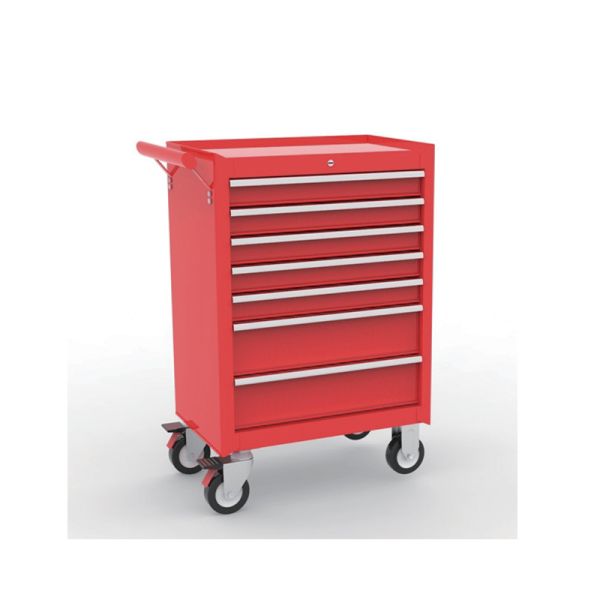
This multifunctional plastic-steel tool cabinet focuses on "high durability + high storage capacity + flexible mobility". It is optimized to address the pain points of industrial-grade tool management. Compared with traditional tool cabinets, it has significant advantages in material strength, user experience, and scenario adaptability. Its core highlights are as follows:
Adopting plastic-steel composite material, the cabinet body is made of 1.0mm-thick steel, and the drawers are made of 0.8mm-thick steel. It not only retains the impact resistance of steel (able to withstand slight drops from a height of 1m without denting) but also integrates the corrosion resistance of plastic (able to resist erosion from engine oil and cutting fluid without pressure); compared with pure steel tool cabinets, its weight is reduced by 20%, making it easier to move; compared with pure plastic tool cabinets, its impact resistance is increased by 60%, with no cracking during long-term use, and a service life of more than 10 years, which is 1.5 times that of traditional tool cabinets.
- Surface Protection: The powder coating process combined with customized colors not only has a neat and uniform appearance (adapting to the industrial style of the workshop) but also has strong stain resistance—if engine oil is spilled on the cabinet surface, it can be cleaned by wiping with a rag without residual stains; no rust occurs after 72-hour salt spray test, and the cabinet body will not rust even when stored in a humid warehouse for a long time;
- Drawer Protection: The 2 drawers are equipped with built-in 2.5mm-thick EVA liners, which are soft and non-slip, avoiding wear and scratches caused by hard contact between tools and drawers, especially suitable for storing precision tools (such as vernier calipers and torque wrenches); the liners can be cut into different shapes as needed to adapt to special-shaped tools such as screwdrivers and wrenches for more flexible classified storage.
With 7 pairs of 16-inch (45mm) ball slide rails, the pull resistance is only 5N, and the drawers can be easily pushed with one hand. Even when fully loaded with 30kg of tools, the pull is still smooth without jamming; the drawers can be optionally equipped with soft-close and auto-return functions—the soft-close function avoids collision noise and part shaking caused by forceful closing, and the auto-return function ensures the drawers are fully closed to prevent tool falling. Compared with tool cabinets with ordinary slide rails, the user experience is increased by 90%.
The total storage volume of the 2 drawers reaches 65L. A single drawer can hold a 25kg socket set + a 10kg wrench set, or a 15kg electric tool + a 5kg part box, meeting the demand for "one-stop storage of a full set of tools"; there are no fixed compartments in the drawers, and free partitioning can be carried out with EVA liners to adapt to tools of different sizes. Compared with tool cabinets with fixed compartments, the storage flexibility is increased by 80%, and one unit can replace multiple sets of traditional tool racks.
Equipped with 5-inch TPR casters (2 fixed casters + 2 swivel casters with full brakes), the wheel surface width is 40mm, and the rolling resistance is ≤8N on concrete floors, floor tiles, etc. Even when the cabinet is fully loaded with 50kg of tools, it can be easily turned by one person, with a minimum turning radius of 1.2m, enabling flexible movement between workshop equipment gaps (such as between lathes and assembly lines); the TPR material has excellent mute effect, with a rolling noise of ≤55dB, lower than the workshop environmental noise (65dB), avoiding interference with operations.
- Braking Stability: The 2 swivel casters are equipped with full braking function. After stepping on the brake pedal, the casters are completely locked, and the cabinet body will not move even when subjected to lateral force (such as workers picking up heavy tools). Compared with tool cabinets without brake casters, the static stability is increased by 95%;
- Anti-Theft Protection: One set of central flat locks + keys can lock the entire cabinet to prevent tool loss, especially suitable for multi-workstation sharing or centralized warehouse storage scenarios, avoiding wrong taking and private use of tools;
- Convenient Handles: The oval side handles fit the curvature of the palm, with no sense of tightness on the hands when pushing or holding. Even when pushing for a long time, no soreness occurs. Compared with straight rod handles, the labor-saving effect is increased by 30%.
Scenario Requirement: An auto repair shop needs to equip maintenance workstations with a full set of tools (25kg socket set, 15kg hydraulic jack, 10kg electric drill) and turnover between 3 workstations every day. The tool cabinet needs to have strong load-bearing capacity, flexible mobility, and resistance to engine oil pollution.
Operation Process:
- Technicians organize the tool cabinet in the tool room: Place the socket set and hydraulic jack in the lower drawer (fixed by cutting grooves in the EVA liner to avoid shaking), and place the electric drill and screwdrivers in the upper drawer. Lock the central lock to prevent tool loss.
- Push the tool cabinet to the maintenance workstation with one hand, step on the brake pedal to lock the casters, and open the drawer to take tools—the ball slide rails are smooth without forceful pulling; during the maintenance interval, if engine oil splashes on the cabinet surface, it can be cleaned by wiping with a rag.
- When switching workstations, unlock the casters and push the tool cabinet. The TPR casters do not slip on the oily floor, making it easy to move to the next workstation without the need for multi-person collaboration in handling.
Result: The plastic-steel material is oil-resistant and the drawers are highly smooth. Compared with traditional tool carts (load-bearing ≤60kg), it can carry a full set of auto repair tools at one time, increasing maintenance efficiency by 60% and reducing technicians' physical consumption by 50%.
Scenario Requirement: A mechanical workshop needs to store precision tools (5kg vernier calipers, 8kg torque wrenches) and heavy tools (20kg bench vices, 15kg hexagon wrench sets). The workshop floor is dusty, so the tool cabinet needs to be dust-proof, tool-protective, and able to store tools stably.
Operation Process:
- Before maintenance, place the bench vice and hexagon wrench set in the lower drawer (separated by EVA liners to avoid collision), and place the torque wrench and vernier caliper in the upper drawer (the soft EVA material prevents scratches). After closing the drawer, it automatically returns to ensure sealing and dust-proofing.
- Push the tool cabinet to the lathe, lock the casters after braking, and take tools—the central lock design prevents non-operating personnel from opening it by mistake, protecting precision tools from random touch; during maintenance, if dust falls on the cabinet surface, it can be cleaned by blowing with compressed air without in-depth cleaning.
- After maintenance, put the tools back in place, lock the cabinet, and push it to the tool room for storage. The powder coating resists dust accumulation and remains clean during long-term use.
Result: The EVA liners protect precision tools and the central lock prevents theft. Compared with open tool racks (tools are easy to get dusty and lost), the precision retention rate of precision tools is increased by 90%, and the tool loss rate is reduced by 95%.
Scenario Requirement: A hardware warehouse needs to centrally store 15 sets of small and medium-sized tools (each set includes wrenches and screwdrivers, with a total weight of 8kg) and 10 boxes of parts (6kg per box). The tool cabinet needs to carry bulk loads, save space, and facilitate inventory management.
Operation Process:
- Warehouse managers load 10 sets of tools (total weight 80kg) and 6 boxes of parts (total weight 36kg) into 2 drawers (each layer load is about 58kg, not exceeding the load-bearing limit). The EVA liners are labeled and partitioned for quick identification.
- Place the tool cabinet against the wall, and it occupies only 0.31m² (68.8×45.9cm) after the casters are locked. Compared with traditional tool racks (occupying 1.2m²), the space utilization rate is increased by 74%, allowing the warehouse to accommodate more tools.
- When workers collect tools, they unlock the cabinet with a key, quickly take and place tools according to the labels, and update the collection records simultaneously to avoid tool backlog or shortage; during bulk replenishment, push the tool cabinet to the unloading area with casters, no manual handling required.
Result: Large-capacity storage + convenient inventory. Compared with scattered storage (tools scattered on multiple shelves), the warehouse management efficiency is increased by 70%, the tool inventory time is reduced by 60%, and the logistics cost is low during bulk transportation (180 units can be loaded in a 40HQ container).
A1: It can bear the weight safely with no risk of breakage or tilting. The casters are made of 5-inch TPR material, and each caster has a rated load-bearing capacity of ≥40kg. The total load-bearing capacity of the 4 casters is ≥160kg (far exceeding the full-load weight of the cabinet); moreover, the casters adopt a "2 fixed + 2 swivel with brake" layout. When fully loaded, the center of gravity falls on the center of the caster set, and no tilting occurs even if slight bumps are encountered during pushing; after a 1.5x rated load (240kg) test for 1 hour, the casters show no deformation or breakage, and can be safely used in heavy-load scenarios.
A2: Jamming is mostly caused by dust accumulation on the slide rails, and the failure of the return function is mostly due to spring aging. It can be fixed by following these steps:
- Slide Rail Cleaning: Pull the drawer out completely, use a brush to clean dust and metal debris (easily accumulated in industrial scenarios) in the slide rails, then wipe the slide rail surface with a dry cloth, drop 2 drops of lithium-based grease (a thin layer to avoid dust adhesion), and pull the drawer repeatedly 3-5 times to relieve jamming;
- Auto-Return Function Repair: If the auto-return function fails, open the side cover of the drawer and check whether the spring is broken—if broken, replace it with a spring of the same specification (diameter 1.2mm, length 30mm, available in hardware stores), and test the return effect after installation; if the spring is not broken, adjust the spring tension (slight stretching or compression) to restore the auto-return function.
A3: One person can push it easily with the help of correct posture + caster characteristics. The specific tips are as follows:
- Pushing Posture: Hold the oval side handles with both hands (the distance between the handles is suitable for shoulder width), lean the body against the cabinet (using body weight to assist in 发力), and push in the direction consistent with the rolling direction of the swivel casters to avoid increasing resistance by pushing obliquely. This posture can reduce physical consumption by 25%;
- Floor Selection: Prioritize pushing on flat and oil-free passages. If the floor is oily, lay cardboard in front of the casters (to enhance friction) to prevent the casters from slipping;
- Load Distribution: Place heavy tools in the lower drawer (lowering the cabinet's center of gravity) to avoid excessive load on the upper layer leading to cabinet tilting, improving pushing stability and reducing force burden.
A4: Color and LOGO customization are supported, and the customization cycle is only 3-5 days longer than that of the standard model. The specific instructions are as follows:
- Color Customization: RAL color code or Pantone color code can be provided, and the powder coating color can be accurately matched to the overall style of the workshop (e.g., mechanical blue, industrial gray). There is no additional cost for customization (for bulk orders ≥50 units);
- LOGO Customization: The drawer handles are made of aluminum alloy, and enterprise LOGOs or tool cabinet numbers (facilitating asset management) can be laser-engraved. The LOGO size is ≤50×20mm, and the customization fee is negotiated based on the quantity (customization fee can be waived for bulk orders ≥100 units);
- Cycle Difference: The delivery cycle for standard models is 3-7 days, while the customized models require an additional 3-5 days (including color adjustment and LOGO production time). For bulk procurement, the delivery date can be confirmed with the manufacturer in advance without affecting the production plan.