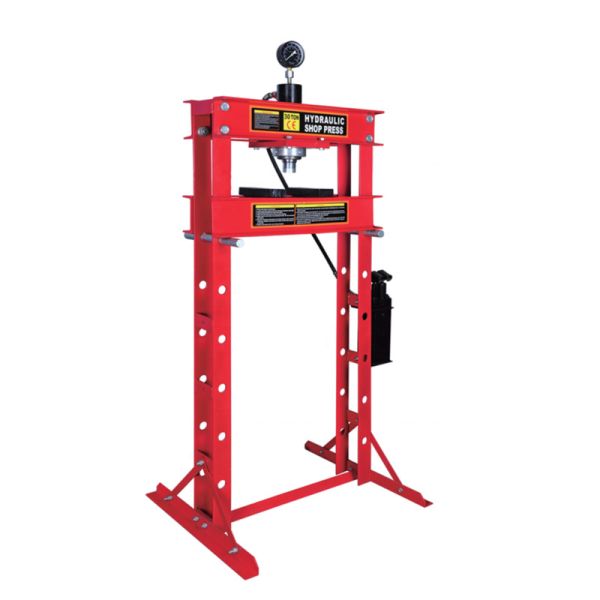
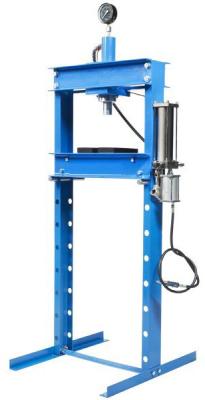
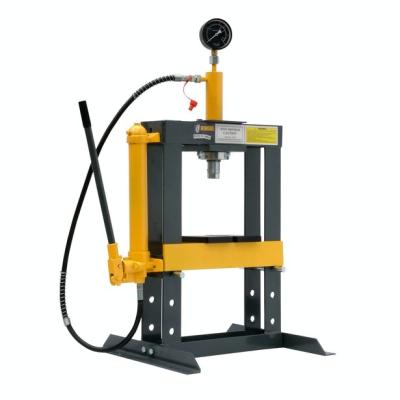
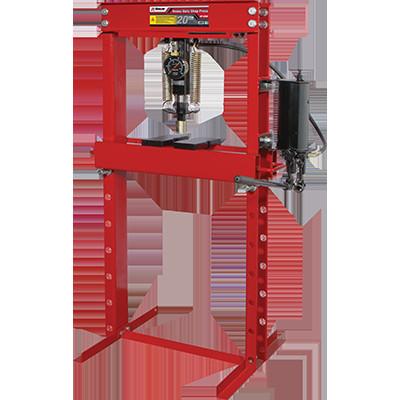
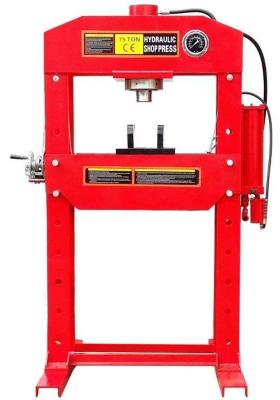
The YD06-013 30-Ton Hydraulic Shop Press with Double Pump and Gauge is an industrial-grade hydraulic device focusing on "efficient dual drive, wide-range operation, and precise pressure control". Specifically designed for processing and maintenance of medium-to-heavy workpieces, it relies on dual-pump collaborative drive, ultra-wide working range, and stable load-bearing performance. It is suitable for heavy machinery factories, auto repair centers, large hardware processing plants, and other scenarios that require high operation efficiency and pressure accuracy. It can efficiently complete diversified operations such as press-fitting, straightening, shaping, and disassembly.
In terms of core performance, the 30-ton rated capacity is one of the core advantages. It can easily handle the processing needs of thick steel plates (30-50mm thick) and heavy mechanical components (such as large bearings and construction machinery connecting rods). Compared with 20-ton presses, the applicable workpiece weight and thickness are increased by more than 30%, reducing operational limitations caused by insufficient equipment load capacity. The dual-pump (with different strokes) design is the core highlight of the equipment: the two pumps correspond to "fast stroke" and "slow precise stroke" respectively. The fast-stroke pump can drive the ram to move quickly, increasing the efficiency of workpiece positioning and ram alignment in the early stage of operation by 60%, significantly reducing waiting time. When precise pressure application is required, switching to the slow-stroke pump, combined with the hydraulic system's stable pressure output, avoids workpiece damage caused by sudden pressure surges, while meeting the differentiated needs for speed and accuracy in different processing stages.
In terms of operational convenience, the equipment supports easy adjustment of the dual pumps. Operators do not need professional skill training and can switch between fast and slow strokes with simple operations, adapting to different operation rhythms. The standard-equipped pressure gauge displays real-time pressure values with clear and intuitive readings, which can be quickly read even in noisy workshop environments. This allows operators to accurately control the pressure magnitude, preventing workpiece deformation due to overpressure or substandard processing caused by insufficient pressure. In structural design, the ultra-wide working range of 120-1070mm offers great flexibility. It can adapt to small precision workpieces (such as press-fitting of auto gearbox bearings) and extra-large heavy workpieces (such as straightening of agricultural machinery drive axle housings) without frequent disassembly and adjustment of accessories. The 650mm-wide worktable provides sufficient operating space to stably place large-sized workpieces, avoiding workpiece displacement during processing and improving operational safety and processing accuracy.
In terms of weight and logistics adaptability, the net weight/gross weight of 128/132kg balances stability and deployment flexibility: the equipment does not easily shake when placed, and 2-3 people can cooperate to adjust its position in the workshop. The compact packing size of 1550×350×185mm and the loading capacity of 180 units per 20-foot container greatly reduce logistics and transportation costs. It is especially suitable for large enterprises with bulk purchases or foreign trade export scenarios, improving supply chain efficiency. In addition, the entire equipment is made of durable steel, with a neat layout of hydraulic pipelines for easy later maintenance. The pressure gauge adopts an anti-vibration design, which extends the service life of the equipment and reduces long-term use costs.
- Straightening Scenario for Heavy Construction Machinery Components: Suitable for straightening and repairing deformed connecting rods, frame crossbeams, and other components of excavators and loaders. In heavy machinery repair shops, fix the deformed component on the 650mm-wide worktable, start the fast-stroke pump to quickly position the ram to the deformed point, then switch to the slow-stroke pump to output 30 tons of stable pressure. The pressure gauge monitors the pressure in real time to avoid component damage due to overpressure, while ensuring the mechanical properties of the straightened component meet standards, reducing the high cost of replacing new components.
- Thick Steel Plate Shaping Scenario: Used for bending, flanging, and shaping of steel plates and iron plates (30-50mm thick). In large hardware processing plants, the 30-ton pressure is used to bend thick steel plates into large equipment bases, workshop steel structure brackets, etc. The dual-pump design enables quick ram alignment, and then slow and precise pressure application ensures the accuracy of the bending angle. The 120-1070mm working range adapts to workpieces of different heights, eliminating the need for frequent equipment parameter adjustments and improving batch processing efficiency.
- Press-Fitting Scenario for Heavy Auto Components: For press-fitting of large-sized bearings of truck and bus gearboxes, drive axle bushings, and other components. In auto repair centers, use the fast-stroke pump to quickly push the bearing to the installation position, then switch to the slow-stroke pump to output stable pressure for press-fitting. The pressure gauge displays the pressure value in real time to avoid damage to the gearbox housing due to overpressure, while ensuring the fitting accuracy between the bearing and the bushing, reducing the risk of subsequent driving failures.
- Disassembly Scenario for Large Agricultural Machinery Components: Used for disassembling aging heavy components of tractors and harvesters (such as engine blocks and cylinder liners, large gear sets). In agricultural machinery repair stations, use 30-ton pressure with special tooling, and adjust the disassembly speed through dual-pump control: the fast-stroke pump quickly approaches the component, and the slow-stroke pump applies stable pressure to separate the aging fitted components. This avoids component damage caused by brute-force disassembly, improving the disassembly success rate and efficiency.
- First, check if the dual-pump switching valve is blocked by impurities: Turn off the equipment power and hydraulic oil circuit, disassemble the switching valve, rinse the valve core and valve body with hydraulic oil to remove impurities, then reinstall. If the sealing ring of the switching valve is aging, replace it with a sealing ring of the same model to avoid switching jamming caused by poor sealing.
- Check the hydraulic oil level and oil quality: If the hydraulic oil level is below the minimum scale line, add 46# anti-wear hydraulic oil to the normal level; if the hydraulic oil is turbid and contains impurities, completely replace it with new oil and clean the hydraulic oil tank. Poor oil quality will increase the switching resistance of the dual pumps, leading to jamming.
- If the above operations are ineffective, check if the connecting pipelines of the dual pumps are loose: Tighten the pipeline joints one by one with a wrench. If there is leakage at the pipeline interface, replace the sealing gasket and re-tighten to ensure stable hydraulic oil transmission and avoid switching failures caused by pressure loss.
- Check if the worktable is level: Use a level to test the worktable surface. If the worktable is tilted, pressure will be unevenly distributed. Insert adjustment gaskets under the worktable base to keep the worktable level, ensuring uniform pressure application on the workpiece.
- Confirm if the workpiece is fixed firmly: If the workpiece is not fixed with special tooling or clamps, it is prone to displacement during processing. Select suitable tooling such as V-blocks and pressure plates according to the workpiece shape, and fix the workpiece tightly on the worktable to avoid workpiece displacement during processing.
- Check the pressure stability of the dual-pump slow stroke: Start the slow-stroke pump and observe if the pressure gauge pointer fluctuates. If the pointer jumps violently, the internal part of the slow pump may be worn. Contact the manufacturer for maintenance or replace the slow pump to ensure stable pressure output and guarantee processing accuracy.
- Check if the hydraulic oil is excessive or insufficient: If the oil level exceeds the maximum scale line, drain the excess hydraulic oil to the normal level; if the oil level is too low, add hydraulic oil. Abnormal oil level will cause poor circulation of hydraulic oil, leading to overheating.
- Check if the heat dissipation components of the hydraulic system are blocked: Clean the dust and debris on the external heat dissipation holes and cooling fan of the oil tank. If the cooling fan fails to rotate, check the fan motor and circuit, and replace the faulty components to ensure the normal operation of the heat dissipation system.
- Confirm if the equipment has been operating under overload for a long time: The 30-ton rated capacity is the upper limit for continuous operation. If the equipment operates at full load for more than 3 hours continuously, pause it for 1 hour to cool down the hydraulic system, avoiding the increase of hydraulic oil temperature due to overload, which affects equipment service life and processing accuracy.
- Check if the hydraulic system has been thoroughly vented: New equipment or installed hydraulic pipelines may have residual air. After starting the equipment, repeatedly operate the dual-pump switching valve, and at the same time loosen the hydraulic cylinder vent valve to discharge the air in the pipeline until no air bubbles emerge from the vent valve, then close the vent valve and test the ram movement.
- Check if the motor rotation direction is correct: Disconnect the motor power supply, swap the two power lines at the motor terminal to adjust the motor rotation direction. Reverse motor rotation will cause the hydraulic pump to fail to suck oil normally, resulting in no pressure output.
- Check if the hydraulic pump oil inlet filter is blocked: Disassemble the oil inlet filter. If the filter is blocked by packaging debris or dust, blow it clean with compressed air or replace it with a new filter to ensure the hydraulic pump can suck oil normally and restore pressure output.