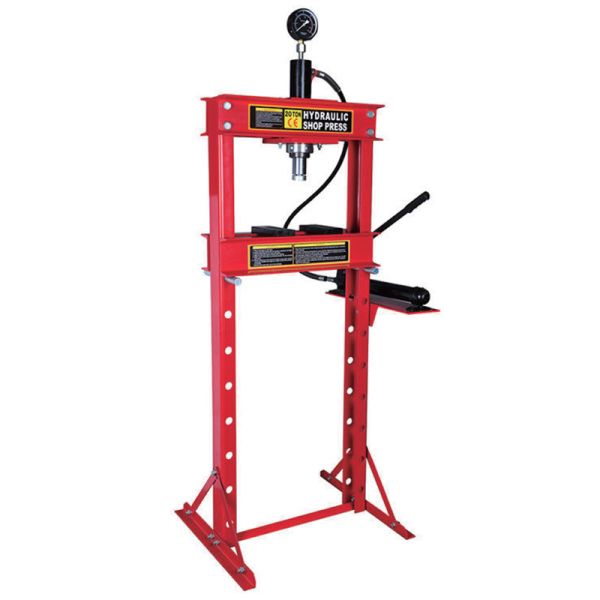
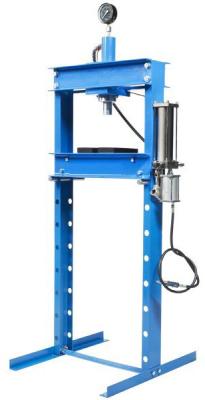
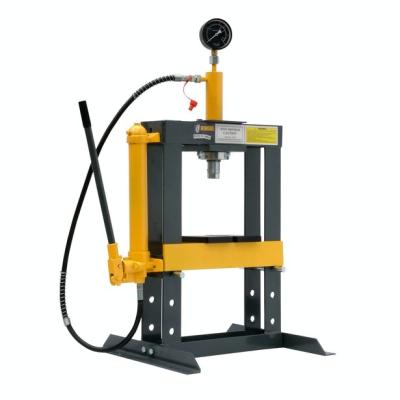
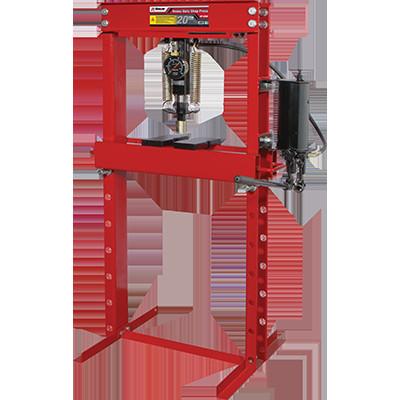
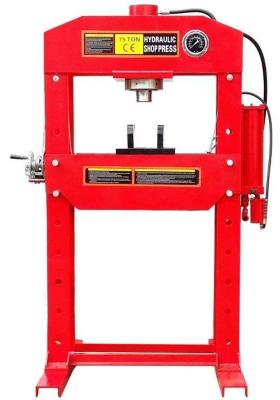
The YD06-010 20-Tonne Hydraulic & Air Floor Press is an industrial-grade high-pressure equipment that meets CE certification. Specifically designed for high-intensity and high-efficiency processing scenarios, it takes "hydraulic & air dual drive, high load-bearing capacity, and strong stability" as its core advantages. With a 20,000 kg rated holding capacity and a unique hydraulic & air linkage system, it balances fast operation and high-pressure output. It is suitable for heavy machinery factories, large maintenance stations, and other scenarios requiring both high pressure and high efficiency, and can efficiently complete heavy-duty operations such as pressing, assembly, and straightening.
In terms of core performance and power system, the equipment adopts a heavy-duty H-frame structure, which has strong body rigidity and excellent deformation resistance. It can withstand the impact force during 20-ton high-pressure operations, avoiding body deformation that affects processing accuracy. The hydraulic & air linkage power system is the core highlight: the pneumatic pump can quickly push the ram to the pressing position. Compared with pure manual hydraulic equipment, the efficiency in the early stage of operation is increased by 60%, greatly reducing waiting time. When full-load pressure output is required, supplementary pressure is applied through the manual handle to accurately control the maximum pressure, ensuring both efficiency and pressure accuracy, and avoiding the problem of large pressure fluctuations in pure pneumatic equipment.
In terms of structural and operational design, the minimum height from the ram to the table has two specifications: 1.77 inches (4.5 cm) and 35.82 inches (91 cm). Combined with a 5.12-inch (13 cm) ram stroke, it can adapt to the processing of multi-specification workpieces from ultra-thin precision parts to ultra-thick heavy parts. The 17.9-inch (45.5 cm) wide worktable has a spacious area and can stably place large workpieces (such as heavy machinery casings and automobile chassis components). The 4.13-inch (10.5 cm) table aperture facilitates the installation of fixing accessories or the discharge of processing waste. The overall height of 65.74 inches (167 cm) conforms to the operating habits of floor-standing equipment, allowing operators to complete operations while standing without frequent bending for adjustments.
In terms of weight and stability, the 90 kg gross weight makes the equipment more stable when placed, avoiding body shaking during high-pressure operations. Although the net weight and package size are not specified, it can be inferred from the gross weight that small lifting assistance is required during transportation, making it suitable for long-term use in fixed workstations, especially for heavy-duty processing scenarios with fixed production processes.
- Heavy Machinery Component Pressing Scenario: Suitable for press forming and shaping of thick steel plates and alloy components with a thickness of 25-40 mm. For example, in heavy machinery factories, 20-ton high pressure can be used to press thick steel plates into specific shapes of large equipment racks and mining machinery bases. The pneumatic pump quickly feeds materials to reduce processing waiting time, and manual pressure application ensures forming accuracy, improving the mass production efficiency of heavy components.
- Automotive Heavy Chassis Maintenance Scenario: Used for straightening and repairing heavy components such as automotive chassis and suspension systems. In auto repair shops, for deformed chassis longitudinal beams and suspension crossbeams caused by collisions, the pneumatic pump can quickly position the ram to the deformed position, and then manual pressure application outputs high pressure for straightening, avoiding the cost of component replacement and ensuring that the straightening accuracy meets safety standards.
- Large Bearing and Bushing Press-Fitting Scenario: For interference fit assembly of heavy bearings with a diameter of more than 100 mm, large bushings, and machine bodies. In construction machinery maintenance stations, the pneumatic pump can quickly push the bearing to the installation position, and then manual supplementary pressure completes the tight press-fitting, avoiding the time-consuming and labor-intensive nature of pure manual operation, and accurately controlling the pressure to prevent machine body damage.
- Precision Heavy Part Calibration Scenario: Used for calibration of large precision molds, machine tool guide rails, and other components. In mold manufacturing factories, high-pressure calibration can be performed on large stamping molds deformed after long-term use. The pneumatic pump quickly adjusts the ram position, and manual pressure application accurately controls the calibration force, ensuring the mold accuracy is restored and guaranteeing the quality of subsequent stamped parts.
- First, check if the air source pressure meets the standard. The equipment's pneumatic system requires a standard air pressure of 0.6-0.8 MPa. If the air pressure is too low, adjust the air compressor output pressure to the normal range—insufficient air pressure will lead to insufficient power of the pneumatic pump.
- Inspect the pneumatic pipeline for blockage or air leakage, focusing on the air pipe joints and pneumatic valve connections. If blocked, blow through the pipeline with compressed air; if there is air leakage, replace the air pipe or gasket to ensure stable air source delivery.
- If the air source and pipeline are normal, the piston inside the pneumatic pump may be worn. Disassemble the pneumatic pump to check the piston seal. After replacing the aged seal, apply special grease to restore the pushing capacity of the pneumatic pump.
- Check the oil level of the hydraulic oil tank. If the oil level is lower than the minimum scale line, add 46# anti-wear hydraulic oil to the normal level—insufficient oil will cause the pressure to fail to reach full load during manual pressure application.
- Check the hydraulic pipeline for leakage, focusing on the joints and seals of the manual pressure oil circuit. If there is oil leakage, replace the seal and tighten the joint to prevent hydraulic oil loss from affecting the pressure.
- If the above operations are ineffective, the valve core of the manual pressure valve may be worn. Disassemble the valve core and grind it for repair, or replace it with a valve core of the same model to ensure good sealing of the valve core and normal pressure transmission.
- Check the ram guide rail surface for wear or impurities. Wipe the guide rail with alcohol-soaked cotton, apply lithium-based grease after removing impurities. If there are slight scratches on the guide rail, polish it smooth with fine sandpaper to reduce friction resistance.
- Check the fit clearance between the ram and the oil cylinder. If the clearance is too small and causes jamming, slightly grind the outer wall of the ram with professional tools, and adjust the fit clearance to the range of 0.05-0.1 mm to ensure smooth movement of the ram.
- Inspect the hydraulic & air linkage system for air. Open the hydraulic oil tank cover, repeatedly operate the pneumatic pump and manual handle to discharge the air in the system—residual air will cause the ram to move stuck and uneven force.
- Check if the frame connecting bolts are loose. Use a torque wrench to tighten the bolts at all parts of the frame one by one—loose bolts will cause slight displacement of the frame during high-pressure operations, resulting in abnormal noise.
- Check if there is wear at the connection between the frame and the worktable. If wear causes excessive clearance, insert a thin metal gasket at the connection to reduce relative friction between the frame and the worktable.
- Confirm whether the equipment is placed horizontally. Use a level to detect the equipment base. If tilted, insert adjustment gaskets under the base to keep the equipment horizontal, avoiding abnormal noise caused by uneven force on the frame. Long-term tilting may also cause frame deformation, affecting the service life of the equipment.