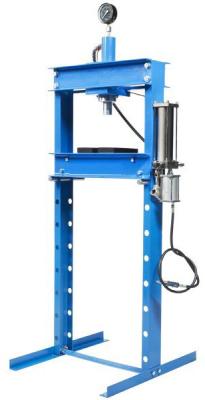
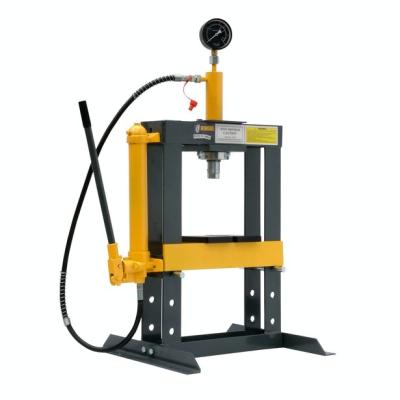
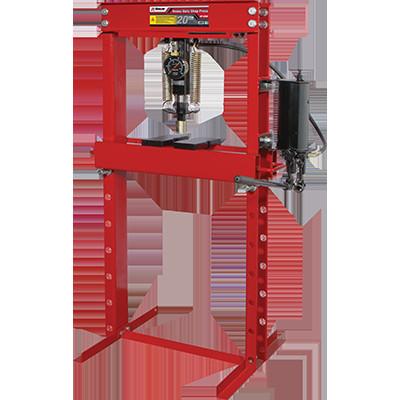
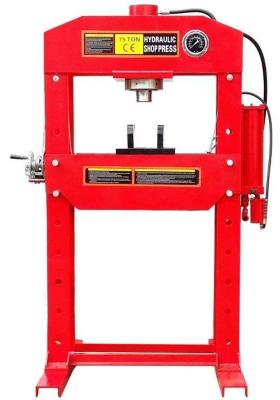
The YD06-004 10-Ton New Pump Shop Press is a lightweight industrial equipment that meets CE certification standards. Specifically designed for small and medium-sized workpiece processing scenarios, it features "efficient pump control, compact structure, and safe adaptation" as its core advantages. It not only meets the needs of precise processing but also fits scenarios with limited space such as small workshops and maintenance stations, balancing practicality and convenience.
In terms of core performance, the equipment is equipped with a new hydraulic pump unit. Compared with traditional presses, its pressure output response speed is increased by 20%, and the 10-ton rated capacity can act on workpieces stably, effectively avoiding processing deviations caused by pressure fluctuations. The CE certification strictly controls electrical safety, mechanical protection, and other aspects to ensure the equipment complies with EU industrial safety standards and reduces operational risks.
The structural design is highly ingenious: it adopts a double-column support structure. The outer width between the two columns is 590mm and the inner width is 510mm, which not only ensures the stability of the machine body support but also can accommodate most small workpieces such as bearings and bushings. The compact overall height of 810mm allows it to be flexibly placed in narrow workshop corners without occupying too much vertical space. The maximum working distance from the cylinder to the platform is 180mm, providing sufficient vertical movement range for operations such as stamping and press-fitting. Combined with the 690x500mm wide base, the equipment is not easy to tip over when placed, further enhancing operational safety.
In terms of operation, the new pump unit simplifies the pressure adjustment process. Operators can quickly set the required pressure via a knob without complex debugging. Although the shipping weight is not marked, it can be inferred from the size and tonnage that the machine body is lightweight, facilitating manual-assisted movement in the workshop. It is suitable for multi-station alternating operations and improves overall work efficiency.
- Small Machinery Maintenance Scenario: Suitable for press-fitting and disassembly of parts in automobile and motorcycle maintenance, such as precise press-fitting of bearings and bushings, and auxiliary disassembly of spark plugs. For example, in an automobile repair shop, the 10-ton stable capacity can be used to press out worn bearings, avoiding part deformation caused by manual knocking, while improving maintenance efficiency and the integrity rate of parts.
- Hardware Accessory Processing Scenario: For hardware such as hinges, hooks, and small metal brackets, it can complete bending and flanging of metal plates as well as straightening of deformed parts. In small hardware factories, it can bend thin steel plates into hinge accessories with specific angles, or straighten and repair metal hooks deformed during transportation to meet the needs of batch processing.
- Electronic Equipment Assembly Auxiliary Scenario: Used for press-fitting of internal metal connectors in electronic equipment such as small motors and distribution boxes, such as tight fitting of motor end covers and casings. With precise pressure control, it can prevent damage to electronic components due to excessive pressure, while ensuring firm fitting of connectors and improving the quality of equipment assembly.
- Teaching and Laboratory Scenario: Due to its small size, easy operation, and compliance with CE safety standards, it can be used as a teaching aid for mechanical majors in vocational colleges to demonstrate hydraulic transmission principles and press operation processes. It can also be used in small industrial laboratories to conduct pressure testing and processing experiments on small metal materials, supporting teaching and scientific research activities.
- Prioritize checking the power connection, confirm that the plug is tightly inserted and the voltage meets the equipment requirements (usually 220V or 380V, subject to the equipment nameplate). If the voltage is unstable or cut off, wait for the voltage to return to stable before powering on again.
- Check whether the hydraulic pump switch is damaged. A multimeter can be used to test the on-off status of the switch. If the switch is faulty, replace it with an original switch of the same model to avoid circuit compatibility issues caused by non-original accessories.
- If both the power supply and the switch are normal, the hydraulic pump motor may be faulty. Disconnect the power supply and contact professional maintenance personnel to check whether the motor coil is burned. Do not disassemble the motor by yourself to prevent expanding the fault range.
- First, check the oil level of the hydraulic oil tank. If the oil level is lower than the minimum scale line, supplement anti-wear hydraulic oil (46# hydraulic oil is recommended) that meets the specifications to the normal level. Insufficient oil will directly lead to insufficient pressure output.
- Inspect the hydraulic pipeline for leakage, focusing on the cylinder seals and oil pipe joints. If oil leakage is found, replace the aged seals or tighten the joints to prevent hydraulic oil loss from affecting the pressure.
- If the pressure still fails to meet the standard after the above operations, the pressure regulating valve of the hydraulic pump may be faulty. Contact after-sales personnel to re-calibrate the pressure of the regulating valve with professional tools or replace the faulty regulating valve.
- Check whether the column fixing bolts are loose. Use a wrench to tighten the bolts connecting the column to the base and the machine body one by one. Loose bolts will cause unstable support of the column, which in turn leads to shaking.
- Check the column surface for wear or deformation. If there are scratches or bends due to long-term use, slight wear can be polished smooth with sandpaper, slight deformation can be straightened with professional tools, and severe deformation requires column replacement.
- Confirm whether the base is placed flat. If the ground is uneven, insert adjustment gaskets under the base to ensure the equipment is placed horizontally, avoiding column shaking caused by uneven force.
- Check whether the viscosity of the hydraulic oil is too high. If the equipment operates in a low-temperature environment, the viscosity of the hydraulic oil will increase. You can replace it with hydraulic oil with better low-temperature adaptability (such as 32# hydraulic oil) or properly heat the oil tank (temperature not exceeding 40℃).
- Inspect the oil return pipeline of the cylinder for blockage, focusing on the oil return valve and oil pipe joints. If there is blockage by impurities, remove the oil pipe and blow it through with compressed air, or replace it with a new oil return filter.
- If the above operations are ineffective, the cylinder seal may be aged, causing internal leakage. Remove the cylinder and replace the sealing ring (nitrile rubber material is recommended). After replacement, apply hydraulic oil to lubricate the seal to avoid damage during installation.