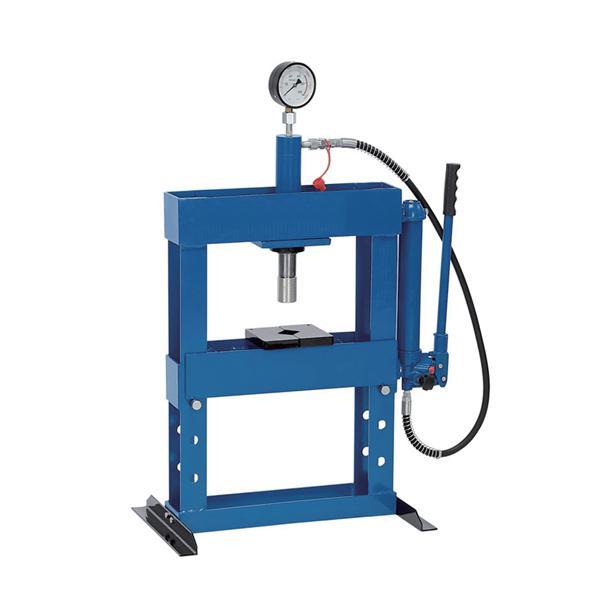
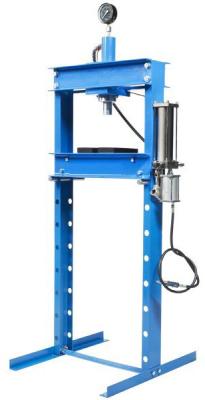
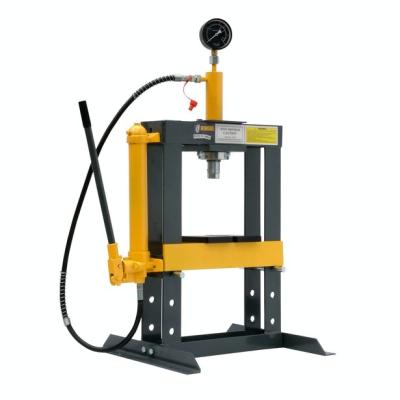
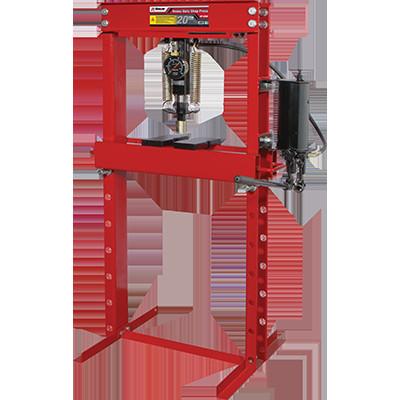
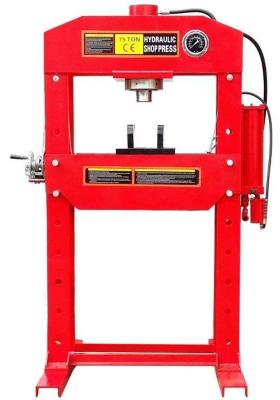
The YD06-006 10-Tonne Hydraulic Floor Press is a multi-functional hydraulic device specifically designed for small and medium-sized industrial processing and maintenance scenarios. With "high adaptability, precise pressure control, and easy operation" as its core advantages, it features a 10-tonne (10,000 kg) holding capacity and a range of practical configurations. It can efficiently perform alignment, bending, assembly, and straightening tasks, meeting the daily processing needs of workshops, maintenance stations, and similar settings.
In terms of core performance and configuration, the equipment is equipped with a high-pressure pump and a sliding head press, ensuring stable pressure output and rapid response. The 10-tonne holding capacity easily handles high-strength processing of metal parts and mechanical components. A standard pair of V-blocks securely fixes irregular workpieces such as cylindrical or tubular parts, preventing displacement during processing and improving operational safety and precision. The eye-level pressure gauge is designed to match the operator’s line of sight, enabling real-time monitoring and precise control of pressure output—avoiding workpiece damage from excessive pressure or processing defects from insufficient pressure.
The structural and dimensional design balances practicality and space adaptability: with an overall height of only 40.15 inches (102 cm), it is a compact floor-standing device that does not occupy excessive vertical space, making it suitable for small workshops with limited area. The 14.96-inch (38 cm) wide working table accommodates most small and medium-sized workpieces, while the 4.33-inch (11 cm) table aperture facilitates the installation of fixing accessories or the discharge of processing waste. The minimum height from the ram to the table is available in two specifications—5.7 inches (14.5 cm) and 12.2 inches (31 cm)—allowing flexible adjustment based on workpiece thickness without the need for additional accessory disassembly, simplifying the operation process.
In terms of weight and transportation, the equipment has a gross weight of 46 kg and a net weight of 44 kg, making it lightweight enough for 2-3 people to move within the workshop without relying on large hoisting equipment. Its compact structure also facilitates transportation and storage, reducing the costs of initial deployment and later storage.
- Metal Shaping & Processing Scenario: Suitable for bending and straightening metal materials such as steel plates and iron plates. For example, in small hardware factories, the device’s 10-tonne pressure can bend thin steel plates into brackets or connectors with specific angles, or straighten deformed metal components (e.g., angle steel, flat steel) that have been used for a long time. The V-blocks ensure secure fixation, guaranteeing shaping precision.
- Mechanical Component Assembly Scenario: Used for press-fitting assembly of parts such as bearings, bushings, and shafts. In agricultural machinery maintenance or small mechanical manufacturing plants, the high-pressure pump delivers stable pressure to accurately press bearings into bushings or machine body mounting positions—avoiding component damage from manual hammering. The eye-level pressure gauge controls pressure to prevent part deformation caused by interference fit.
- Workpiece Alignment & Finishing Scenario: Applied to align and finish welded parts and stamped parts. For instance, in small steel structure workshops, the device can align misaligned welded components and apply pressure to fix them for subsequent welding. It can also finish metal parts with uneven edges after stamping, improving workpiece appearance and assembly compatibility.
- Automotive Maintenance Auxiliary Scenario: Used for maintenance and processing of automotive chassis, suspension systems, and other components. In auto repair shops, it can straighten deformed chassis brackets or assist in disassembling and installing tightly fitted parts (e.g., half-shaft bearings). The V-blocks fix irregular components, enhancing the stability and efficiency of maintenance operations.
- First, check if the pressure gauge connection is loose. Gently tighten the joint between the pressure gauge and the hydraulic pipeline with a wrench—loose joints cause hydraulic oil leakage, leading to pressure fluctuations.
- Check if the hydraulic oil is clean. Impurities in the oil can block the internal channels of the pressure gauge, affecting reading accuracy. Replace the oil with qualified anti-wear hydraulic oil (46# hydraulic oil is recommended) and clean the hydraulic oil tank and pipelines.
- If the above operations are ineffective, the internal components of the pressure gauge may be faulty. Replace the gauge with an original one of the same range to avoid pressure detection deviations from non-original accessories.
- Check if the V-block surface is worn or oily. If wear reduces fit, lightly sand the surface for repair; if oily, wipe it clean with alcohol-soaked cotton to increase friction between the workpiece and the V-block.
- Ensure the V-block is installed correctly. The standard V-block must fit precisely with the table’s positioning holes. If misaligned, reposition and fix the V-block to ensure it is perpendicular to the table surface.
- For lightweight or irregularly shaped workpieces, place rubber gaskets between the V-block and the workpiece to increase friction and further prevent displacement.
- Check the hydraulic pump oil level. If the oil level is below the tank’s minimum scale, add hydraulic oil to the normal level—insufficient oil leads to weak ram lifting power.
- Inspect the hydraulic pipeline for blockages, focusing on the ram cylinder’s oil inlet and return pipelines. If blocked by impurities, remove the pipeline and blow it clear with compressed air, or replace the hydraulic oil filter.
- Check the lubrication of the ram’s sliding parts. Insufficient lubrication of the sliding rails increases friction resistance—apply special lithium-based grease to reduce component wear and jamming.
- First, check if the hydraulic pump is short of oil or if the oil inlet is blocked. Oil shortage causes the pump to run dry and generate noise—add oil; if the inlet is blocked, clean the oil inlet filter.
- Check the fit clearance between the ram and the guide rail. Excessive or insufficient clearance causes friction noise. If clearance is excessive, adjust the guide rail positioning bolts; if insufficient, grind the contact surfaces of the ram and guide rail to ensure smooth fit.
- Check if the device base is level. An uneven base causes machine vibration and noise—place adjustment gaskets under the base to keep the device horizontal.
-