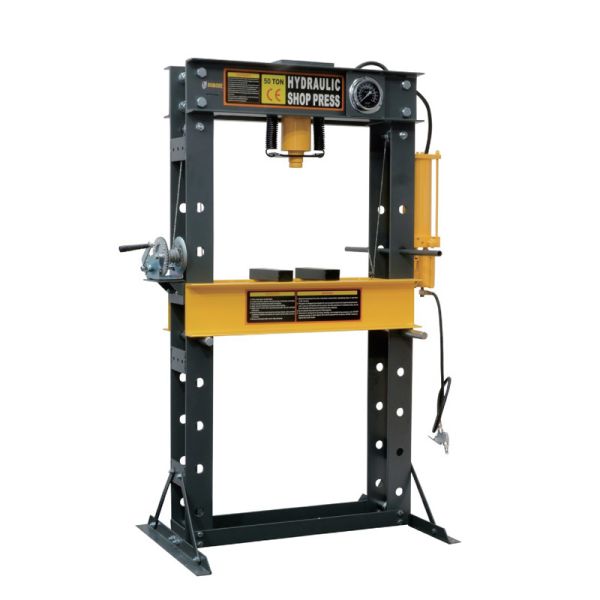
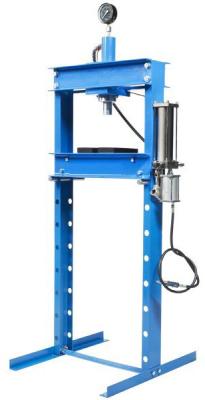
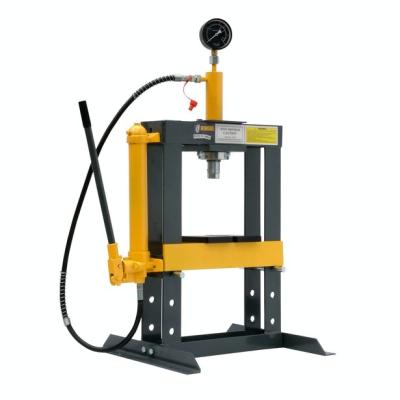
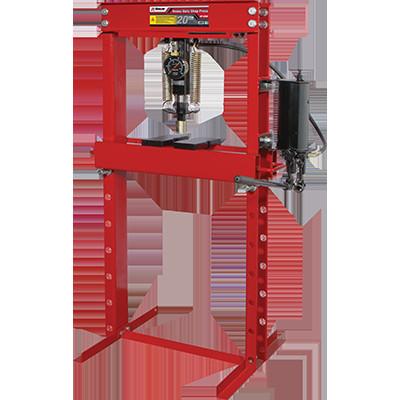
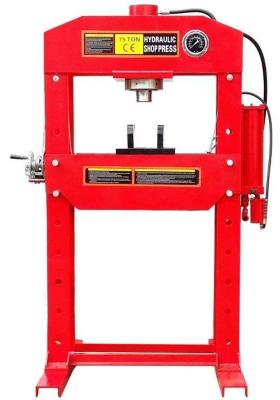
The YD06-017 50 Ton Hydraulic & Air Shop Press with Gauge is an industrial-grade equipment focusing on "heavy-duty load-bearing, efficient drive, and safety compliance". Specifically designed for heavy machinery processing and large-component maintenance scenarios, it integrates the advantages of fast pneumatic drive and stable hydraulic pressure boosting. Equipped with a high 50-ton rated capacity and an extra-wide worktable, it can efficiently complete operations such as heavy bearing press-fitting, thick steel plate shaping, and straightening of large mechanical components. It is suitable for heavy machinery factories, large auto repair shops, construction machinery maintenance points, and other scenarios. Moreover, it meets the EU CE safety standards, making it applicable for foreign trade export and domestic high-specification workshop needs.
Its core advantages are reflected in four dimensions:
- Heavy-Duty Performance: The 50-ton rated capacity combined with a 200mm long cylinder stroke can handle bending of 50-80mm thick steel plates and press-fitting of heavy bearings with a diameter of over 200mm. Compared with 30-ton presses, its load-bearing capacity is increased by 67%, adapting to larger and higher-strength processing needs.
- Hydraulic & Air Dual-Drive Efficiency: The pneumatic system drives the ram to move quickly, increasing positioning efficiency by 50% and reducing workpiece waiting time; the hydraulic system is responsible for stable pressure boosting, with a pressure output accuracy of ±2%, avoiding workpiece damage caused by sudden pressure surges, and achieving both "fast positioning" and "stable pressure application".
- Structural Stability: The machine frame is made of thick steel plates through welding and undergoes stress relief treatment, with no obvious deformation of the machine body during 50-ton pressure operation; the 690mm-wide worktable adopts an integrated forming process, with a load-bearing capacity of 800kg, which can stably place large workpieces (such as construction machinery drive axles and heavy motor housings) and reduce the risk of workpiece displacement during processing.
- Safety Compliance: It has passed the EU CE certification and is equipped with safety components such as an emergency stop button and an overload protection valve. When the pressure exceeds the rated value, it automatically relieves pressure to avoid equipment damage due to overload; the edge of the worktable is equipped with a protective fence to prevent splashing of processing debris and ensure the safety of operators.
In terms of detailed design, the standard-equipped pressure gauge adopts an anti-vibration dial, which can still clearly display pressure values in the high-frequency vibration environment of heavy-duty operations, facilitating real-time monitoring by operators; the bottom of the machine is equipped with adjustable feet, which can fine-tune the height according to the flatness of the workshop floor to ensure the worktable is level and improve processing accuracy; the surface adopts electrostatic spray coating treatment, which has strong oil resistance and rust resistance, adapting to the complex working conditions of heavy-duty workshops and extending the service life of the equipment.
- Straightening Scenario for Heavy Construction Machinery Components: Suitable for straightening deformed frames and large connecting rods of excavators and loaders. In heavy machinery factories, fix the deformed component on the 690mm-wide worktable, quickly position the ram to the deformed point through the hydraulic & air dual-drive system, then switch to hydraulic mode to output stable pressure (recommended straightening pressure: 35-45 tons). The 200mm cylinder stroke can cover the deformed area of the component, and the pressure gauge is used for precise pressure control to avoid component breakage and restore the mechanical properties of the component.
- Thick Steel Plate Shaping Scenario: Used for bending and shaping of 50-80mm thick steel plates and iron plates. In large hardware processing plants, 50 tons of pressure is used to bend thick steel plates into heavy structural parts such as construction machinery bases and large equipment brackets. The hydraulic & air dual-drive system quickly completes ram alignment, and the hydraulic system applies stable pressure to ensure the accuracy of the bending angle (such as 90° right angle, 120° obtuse angle). The 690mm worktable can accommodate the entire steel plate, eliminating the need for segmented processing and improving production efficiency.
- Heavy-Duty Auto Bearing Press-Fitting Scenario: For press-fitting of large wheel hub bearings (with a diameter of over 200mm) of trucks and engineering vehicles. In large auto repair shops, the pneumatic system is used to quickly push the bearing to the installation position, then the hydraulic system is activated to output 30-40 tons of stable pressure to complete the press-fitting. The pressure gauge displays the pressure value in real time to ensure tight fitting between the bearing and the bushing, avoiding potential driving safety hazards caused by improper press-fitting, and adapting to the maintenance needs of heavy-duty vehicles.
- Disassembly Scenario for Large Agricultural Machinery Components: Used for disassembling aging heavy components (such as large gearboxes and engine blocks) of tractors and harvesters. In agricultural machinery maintenance points, 50 tons of pressure is used with special tooling, and the disassembly speed is adjusted through hydraulic & air dual drive: the pneumatic system quickly approaches the component, and the hydraulic system applies stable pressure to separate the aging fitting surfaces, avoiding component damage caused by brute-force disassembly. It is especially suitable for emergency outdoor maintenance of agricultural machinery and fixed workshop operation scenarios.
- Check the pneumatic inlet pressure: Confirm whether the output pressure of the air compressor reaches 0.6-0.8MPa. If the pressure is lower than 0.6MPa, adjust the air compressor pressure to the standard range. Insufficient pneumatic pressure will result in insufficient driving force and failure to drive the ram to move.
- Inspect if the pneumatic pipeline is blocked or leaking: Turn off the air source, disassemble the pneumatic pipeline joint, and blow the pipeline with compressed air to remove impurities; if there is leakage at the joint, replace the sealing gasket and re-tighten to ensure the pneumatic pipeline is well-sealed without pressure loss.
- Check if the pneumatic solenoid valve is faulty: After power failure, disassemble the solenoid valve and clean the valve core impurities. If the valve core is worn or the coil is burned out, replace it with a solenoid valve of the same model to restore the control function of the pneumatic system and ensure the ram moves normally and quickly.
- Check if the worktable is level: Use a level to test the worktable surface. If the worktable is tilted, the pressure will be unevenly distributed. Insert adjustment gaskets under the machine feet to control the horizontal error of the worktable within 0.2mm, ensuring uniform pressure application on the steel plate.
- Confirm if the steel plate is fixed firmly: Thick steel plates are heavy. If not fixed with special fixtures, they are prone to displacement during processing. Install pressure plates or V-blocks according to the size of the steel plate, and fix the steel plate tightly on the worktable to avoid steel plate displacement during bending.
- Check the pressure stability of the hydraulic system: Start the hydraulic system and observe if the pressure gauge pointer fluctuates. If the pointer jumps violently, the hydraulic pump may be internally worn or the relief valve may be faulty. Contact the manufacturer for maintenance or replace the faulty parts to ensure stable hydraulic pressure output and guarantee the bending angle accuracy.
- First, confirm whether the workpiece weight and processing pressure exceed the rated value: The rated capacity of the machine is 50 tons. If the pressure required for workpiece processing exceeds 50 tons, a press with a higher tonnage should be replaced to avoid forced operation causing equipment damage.
- Check if the set value of the overload protection valve is offset: Turn off the machine power and re-calibrate the overload protection valve according to the manual, setting the protection pressure to 55 tons (slightly higher than the rated value to reserve a safety margin). After calibration, test the pressure output to ensure the protection valve is only triggered when the pressure exceeds the rated value.
- Inspect if the hydraulic oil has deteriorated: If the hydraulic oil has high viscosity, it will cause pressure fluctuations in the system and trigger false protection. Drain the old oil and replace it with 46# anti-wear hydraulic oil, and clean the hydraulic oil tank and filter element at the same time to ensure smooth circulation of hydraulic oil and reduce pressure fluctuations.
- Check if the installation ground is level: The machine should be placed on a level ground (horizontal error ≤0.1%). If the ground is uneven, place shock-absorbing pads of different thicknesses under the machine feet to fine-tune the overall level of the machine, reducing the perpendicularity deviation of the frame.
- Calibrate the perpendicularity between the worktable and the frame: Use a plumb bob to test the perpendicularity between the edge of the worktable and the frame column. If the deviation exceeds 0.5mm/m, loosen the connecting bolts between the worktable and the frame, and place thin copper sheets under the worktable for fine-tuning until the perpendicularity meets the standard, then re-tighten the bolts.
- If the deviation still cannot be corrected, contact the manufacturer's technical personnel: The frame may be deformed during transportation. Professional personnel are required to disassemble the frame, replace deformed parts (such as columns and beams), reassemble after repair, and test the perpendicularity to ensure the machine accuracy meets processing needs.