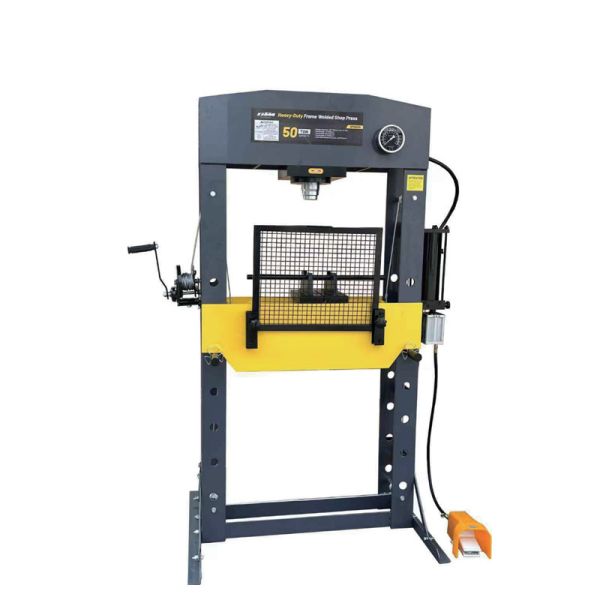
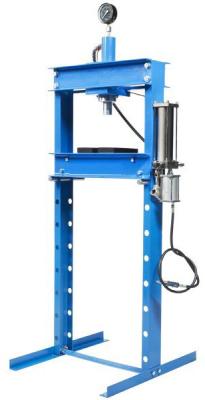
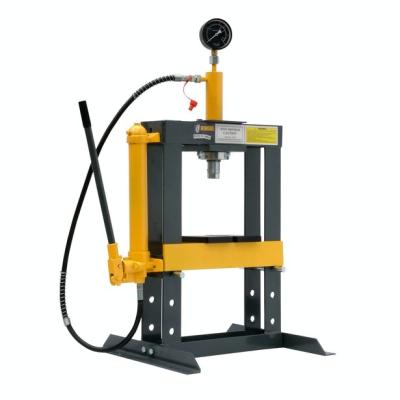
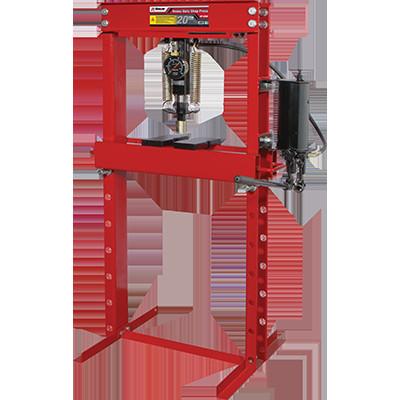
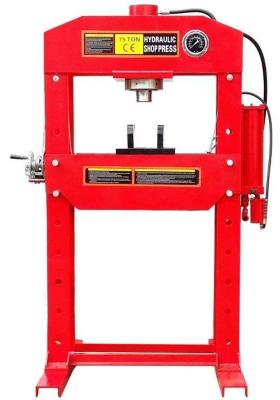
The YD06-018 50T Frame Welded Shop Press is a heavy-duty industrial equipment focusing on "ultra-stable structure, safety protection, and flexible operation". Specifically designed for heavy machinery maintenance, large-scale hardware processing, and other scenarios, it takes the welded reinforced frame as the core support, combined with a side-movable press head and multiple safety components. It can efficiently complete operations such as heavy bearing press-fitting, large-component straightening, and thick steel plate shaping. It is suitable for heavy machinery factories, engineering vehicle repair shops, large-scale steel structure processing plants, and other scenarios with high requirements for equipment strength and safety.
Its core advantages focus on four dimensions:
- Structural Strength: Adopting a fully welded frame design, the frame welds undergo X-ray flaw detection to ensure no false welding or missing welding. The overall anti-deformation capacity is 50% higher than that of bolted frames. There is no obvious shaking of the machine body during 50-ton pressure operation, and it can withstand high-frequency heavy-duty processing needs for a long time, extending the service life of the equipment.
- Safety Protection: Equipped with standard protective guards, combination blocks, and self-lock winches. The protective guard can block the splashing of processing debris to protect the safety of operators; the combination block is used to stably support workpieces and prevent workpiece displacement during operation; the self-lock winch can assist in handling heavy workpieces (maximum load-bearing 500kg), reducing the risk of manual handling and complying with industrial safety operation standards.
- Operational Flexibility: The press head supports 3.5-inch (89mm) horizontal movement, allowing press-fitting/straightening operations at different positions without frequent adjustment of the workpiece position. It is especially suitable for irregular large workpieces (such as engineering vehicle drive axles and heavy motor housings), improving operational efficiency by 40%.
- Pressure Control Precision: Equipped with a liquid-filled pressure gauge with a reading accuracy of ±1.2%, which can display pressure values in real time. Operators can accurately adjust the pressure according to the workpiece material (such as high-strength steel and cast iron) to avoid workpiece damage caused by overpressure or poor processing quality caused by insufficient pressure, ensuring the consistency of batch operations.
In terms of detailed design, the equipment surface adopts high-temperature spray coating treatment, which has strong oil resistance and rust resistance, adapting to the complex working conditions of heavy-duty workshops with high humidity and high dust; the press head guide rail is coated with long-acting grease to reduce friction resistance during horizontal movement and lower maintenance frequency; fixing holes are reserved at the bottom of the frame, and the equipment can be fixed to the ground with expansion bolts to further improve operational stability and prevent equipment displacement during heavy-duty operations.
- Engineering Vehicle Drive Axle Straightening Scenario: Suitable for straightening and maintenance of deformed drive axles of excavators and loaders. In engineering vehicle repair shops, use the self-lock winch to lift the drive axle (weight 300-400kg) to the worktable, fix it with combination blocks, move the press head horizontally to the deformed position, start the equipment to output 35-45 tons of stable pressure. The liquid-filled pressure gauge monitors the pressure value in real time to avoid drive axle breakage caused by overpressure. At the same time, the protective guard blocks metal debris to ensure the safety of operators, adapting to the maintenance needs of core components of heavy-duty vehicles.
- Thick Steel Plate Shaping Scenario: Used for bending and shaping of high-strength steel plates with a thickness of 60-100mm. In large-scale steel structure processing plants, 50 tons of pressure is used to bend steel plates into engineering steel structural parts (such as workshop load-bearing brackets and bridge connectors). The horizontal movement function of the press head enables continuous shaping of multiple positions on the steel plate without segmented processing; the combination block fixes the steel plate to ensure the accuracy of the bending angle (such as 90° right angle and 135° obtuse angle); the liquid-filled pressure gauge accurately controls the pressure to avoid cracks in the steel plate due to uneven pressure, improving product qualification rate.
- Heavy Bearing Press-Fitting Scenario: For press-fitting of heavy bearings with a diameter of more than 200mm (such as large motor bearings and engineering vehicle wheel hub bearings). In heavy machinery factories, use the self-lock winch to lift the bearing to the installation position, move the press head horizontally to align with the bearing center, and output 25-35 tons of stable pressure to complete the press-fitting. The liquid-filled pressure gauge feeds back the pressure in real time to ensure tight fitting between the bearing and the bushing, avoiding abnormal noise during equipment operation caused by improper press-fitting, and adapting to the assembly production line of heavy machinery.
- Large Agricultural Machinery Component Disassembly Scenario: Used for disassembling aging heavy components (such as large gearboxes and engine blocks) of tractors and harvesters. In agricultural machinery maintenance points, 50 tons of pressure is used with special tooling, and the press head moves horizontally to find the disassembly position, then applies pressure slowly to separate the aging fitting surfaces. The self-lock winch assists in handling the disassembled components to reduce labor consumption, and the protective guard prevents metal debris from splashing during disassembly, adapting to outdoor temporary maintenance and fixed workshop operation scenarios.
- Check if the press head guide rail is blocked by impurities: Turn off the equipment power, clean the dust and metal debris on the guide rail surface with a high-pressure air gun, then apply special lithium-based grease (thickness 2-3mm), and push the press head repeatedly to test the smoothness of movement. If the guide rail is scratched or deformed, contact the manufacturer to replace the guide rail assembly.
- Inspect if the press head drive mechanism is loose: Use a torque wrench to check the bolts of the press head horizontal movement connecting rod. If the bolts are loose, tighten them one by one in a diagonal order (torque reference value: 30-35N·m) to ensure the connecting rod is firmly connected to the press head, avoiding increased movement resistance caused by looseness.
- If the above operations are ineffective, check the hydraulic oil level: Open the oil tank cover. If the hydraulic oil level is below the minimum scale line, add 46# anti-wear hydraulic oil to the normal level. Insufficient hydraulic oil will lead to insufficient driving pressure and increased movement resistance. Test the press head movement function after replenishment.
- Check if the pressure gauge dial is contaminated by oil: Wipe the dial glass with a soft cloth dipped in alcohol to remove oil and dust. If oil enters the inside of the dial, disassemble the pressure gauge, clean the internal oil, and reassemble it to ensure clear readings.
- Confirm if the pressure gauge is affected by vibration: If the equipment vibrates violently during operation, it will cause the liquid inside the pressure gauge to become turbid. Place shock-absorbing pads under the equipment to reduce vibration transmission, let it stand for 30 minutes, and then observe the dial. If the liquid is still turbid, replace the liquid-filled pressure gauge with the same range (0-60 tons).
- Check if the pressure gauge connection interface is loose: If hydraulic oil leaks at the interface, it will cause oil to enter the dial. Gently tighten the interface bolts with a wrench and replace the aging gasket to ensure the interface is well-sealed and prevent oil from entering the dial again.
- Check if the winch wire rope is worn or loose: If the wire rope has broken wires or the wear exceeds 10% of the diameter, replace it with a new wire rope; if the wire rope is loose, adjust the winch tensioning device to tension the wire rope to avoid slipping.
- Inspect if the winch braking system is faulty: Turn off the winch power, check if the brake pads are severely worn. If the thickness of the brake pads is less than 3mm, replace them with brake pads of the same model; if the brake spring is loose, adjust the spring tension to ensure effective braking and prevent the workpiece from slipping and falling after lifting.
- Confirm if the workpiece weight exceeds the rated load of the winch: The maximum load-bearing capacity of the self-lock winch is 500kg. If the workpiece weight exceeds this value, replace the winch with a higher load-bearing capacity or use a forklift to assist in handling, avoiding equipment damage or safety accidents caused by forced use.
- First, check if the equipment is fixed firmly: If it is not fixed with expansion bolts, drill holes at the fixing hole positions at the bottom of the frame with a hammer drill, install M16 expansion bolts, and fix the equipment tightly to the ground to reduce vibration and abnormal noise.
- Check if the frame welds are cracked: Observe the frame welds with a magnifying glass. If slight cracks are found, stop using the equipment immediately and contact the manufacturer's professional personnel for welding repair. After repair, conduct flaw detection again to ensure the weld strength meets the standard.
- Inspect if the workpiece is placed evenly: If the workpiece center of gravity is offset, it will cause uneven stress on the frame and generate abnormal noise. Adjust the position of the combination block to align the workpiece center of gravity with the center of the worktable, ensuring uniform pressure on the frame and avoiding increased vibration caused by uneven local stress.