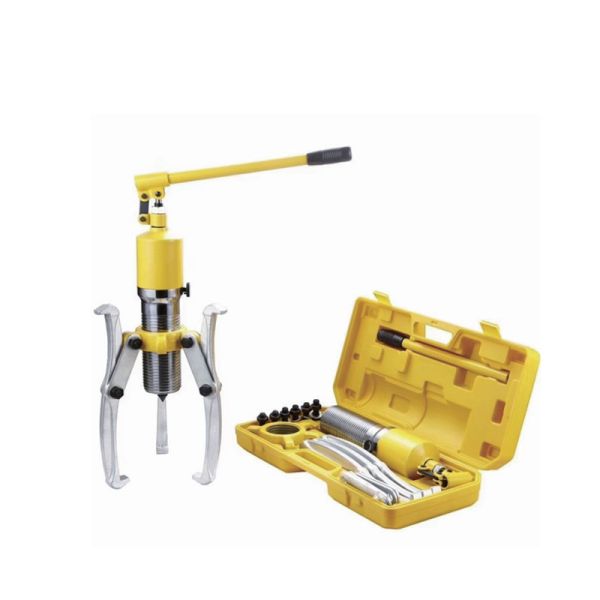
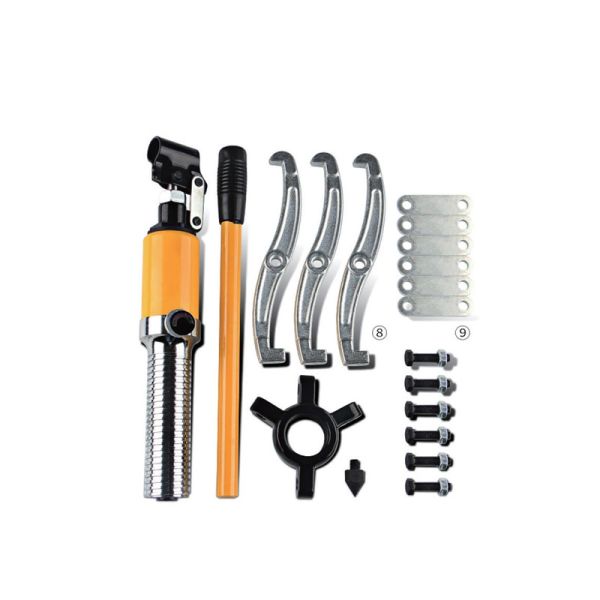
The table below details the core specifications of the 3-Jaws Hydraulic Gear Puller, covering load capacity, pull distances, stroke, weight, and package size for accurate selection and storage.
This 3-Jaws Hydraulic Gear Puller integrates high-strength materials and innovative design to handle heavy-duty disassembly tasks with safety and efficiency:
- Dual-Jaw Versatility: It supports both 2-jaw and 3-jaw configurations. The 3-jaw setup delivers balanced clamping force for round/cylindrical parts (e.g., gears, bearings), while the 2-jaw mode adapts to irregularly shaped components or tight spaces, meeting diverse work needs.
- Ergonomic & Space-Saving Design: Equipped with a removable handle and 360-degree pressure direction adjustment. The removable handle reduces storage space, and the adjustable pressure direction allows easy operation in restricted areas (e.g., narrow machine compartments) where traditional pullers are hard to maneuver.
- High-Safety Hydraulic Cylinder: The hydraulic cylinder features a one-piece solid steel molding design. This structure eliminates weak points from assembly, enhancing pressure resistance and preventing oil leakage or cylinder deformation under heavy loads, ensuring a high safety factor during use.
- CrV Steel Durability: Key components (including jaws and connecting parts) are made of CrV (Chrome-Vanadium) steel. CrV steel offers excellent toughness and wear resistance, and after precision processing, it ensures the puller can withstand long-term high-tension use without damage.
With its heavy-duty capacity and flexible design, this 3-Jaws Hydraulic Gear Puller is widely used in industrial and heavy-equipment maintenance scenarios:
- Heavy-Duty Machinery Maintenance: Ideal for factories maintaining large machinery (e.g., industrial motors, steel rolling machines, and mining equipment). It can pull out large gears, bearings, or hubs from machine shafts, even under high interference fits, minimizing equipment downtime.
- Automotive Heavy-Duty Repair: Suitable for repairing commercial vehicles (e.g., trucks, buses) or construction vehicles (e.g., excavators, loaders). It disassembles large components like transmission gears, axle bearings, and clutch hubs, which require high pulling force beyond manual tools.
- Marine Equipment Servicing: Used in shipyards or marine maintenance facilities to service ship engines, propeller shafts, or pump systems. The puller’s corrosion-resistant properties and high load capacity handle the harsh marine environment and heavy marine components.
- Power Generation Equipment Maintenance: Applied to maintain power plants (e.g., thermal power, hydropower) for disassembly tasks on turbine components, generator rotors, or large pump bearings. Its stable performance ensures safe and efficient maintenance of critical power equipment.
A1: Simply remove one jaw (using the provided release pin) to switch to 2-jaw mode. Ensure the remaining two jaws are symmetrically installed to maintain balanced force. For 3-jaw mode, reattach the removed jaw and align all three jaws evenly with the workpiece before use.
A2: First, check if the hydraulic oil level is sufficient (refer to the oil level window). If low, add the recommended hydraulic oil. If the oil level is normal, inspect for oil leakage at the cylinder connections—tighten loose fittings if needed. If the issue persists, contact customer service for professional repair to avoid damaging the cylinder.
A3: No. Exceeding the rated capacity will damage the hydraulic cylinder (e.g., oil leakage, cylinder deformation) or break the jaws, posing safety risks. Always select a model with a capacity matching or slightly higher than the workpiece’s estimated weight/tension.
A4: Every 6 months (or 50 uses), replace the hydraulic oil with the manufacturer-recommended type. After each use, wipe the cylinder rod clean to prevent dust from entering the system. Store the puller in a dry environment to avoid rust on the hydraulic components. Do not expose the cylinder to extreme temperatures (below -10°C or above 60°C) for extended periods.