This 1000kVA 20kV/0.4kV three-phase step-down distribution transformer is engineered to provide stable and efficient low-voltage power for three of the most demanding sectors: renewable energy generation, data center infrastructure, and electric vehicle charging networks. Acting as a reliability-focused link between the medium-voltage grid and 400V distribution systems, this transformer steps down 20kV to 0.4kV while maintaining excellent voltage regulation under variable load conditions.
Designed as a customizable platform, this step-down distribution transformer can be configured as an oil-immersed unit for outdoor pad-mounted installations or a dry-type cast-resin transformer for indoor, fire-sensitive environments. It integrates seamlessly with existing switchgear, containerized skids, and prefabricated substations. Every unit is built to IEC 60076 and backed by a dedicated engineering team that assists with design adaptations, prototype validation, and final commissioning support.
From core material and cooling method (ONAN, AN/AF) to enclosure rating (IP20 to IP54) and impedance, every parameter is adapted to your renewable, data center, or EV charging layout—no one-size-fits-all approach.

Low-loss cold-rolled grain-oriented silicon steel or amorphous metal cores reduce no-load and load losses significantly, helping operators cut operating costs and meet tight energy performance targets.
Winding configuration (standard Dyn11) with electrostatic shield and increased K-factor capability minimizes the adverse effects of harmonics generated by solar inverters, UPS systems, and fast EV chargers.
Reinforced insulation, proven short-circuit withstand capability, and thermal headroom for frequent overloads make this step-down transformer suitable for intensive cycling in solar farms and high-density charging plazas.
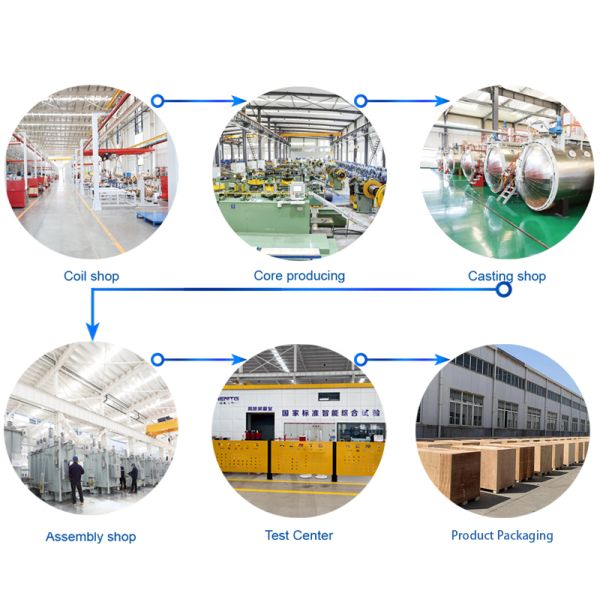
Our EPC-focused project team accelerates design review, drawing approval, and optional Factory Acceptance Testing (FAT), helping contractors maintain tight construction schedules.
| Specification | Detail |
|---|---|
| Rated Power | 1000 kVA continuous duty |
| Voltage Ratio | 20 kV (primary) ±2*2.5% taps / 0.4 kV (secondary) |
| Frequency | 50 Hz or 60 Hz (selectable) |
| Phases | Three-phase |
| Vector Group | Dyn11 (standard), Yyn0, or other upon request |
| Impedance | 4% to 6% (customizable) |
| Cooling & Type | Oil-immersed (ONAN, mineral oil or ester fluid) or dry-type cast-resin (AN/AF) |
| Insulation Class | F or H (dry-type); A (oil, with F‑rated design options) |
| No-Load / Load Losses | Compliant with IEC/EU Ecodesign Tier 2; typical no-load loss under 900 W, load loss ~10 500 W (specific values depend on configuration) |
| Enclosure Options | IP20 indoor, IP23 with drip shield, IP54 outdoor for pad‑mount or ground‑mount |
| Monitoring Preparedness | Prepared for oil level, oil temperature, winding temperature, Buchholz relay (oil units), and PTC thermistors; compatible with SCADA/remote monitoring gateways |
| Standards | Design, manufacture, and testing per IEC 60076; additional certifications available on project basis |
Insulation coordination accounts for overvoltage surges typical in grids with high penetration of inverter-based sources. The core is constructed with step-lap joints and low magnetostriction materials to reduce noise, while the windings are designed with adequate axial and radial support to withstand frequent thermal cycling.

Key Requirements: Fluctuating generation leads to wide load swings and exposure to harmonics from inverters. Transformers must maintain high efficiency during partial loading and withstand outdoor environmental stress.
Our Approach:
Key Requirements: Uninterrupted power, strict voltage stability, low electromagnetic emissions, fire safety, and capability to handle high inrush during cooling and backup transitions.
Our Approach:
Key Requirements: Heavy cyclic overloads during peak charging windows, harmonic currents from multiple power electronic converters, and compact footprint in urban or service station locations.
Our Approach:
Lead time depends on the configuration volume and current production schedule. A standard customized oil-immersed unit usually ships within 10–14 weeks; fast-track projects can be prioritized. We recommend contacting our project desk with the required specifications to receive a firm commitment.
Yes. We provide mechanical interface drawings, flange dimensions, and proposed busbar connection details during the design phase to ensure compatibility with major switchgear brands. Our engineering team can also attend interface coordination meetings.
The standard Dyn11 winding configuration isolates zero-sequence harmonics, and we can incorporate an electrostatic shield to reduce common-mode noise. For installations with very high THD, we can increase the transformer’s K-factor rating and advise on supplemental filtering strategies; the transformer itself will remain thermally stable under the specified harmonic spectrum.
We apply a multi-layer anti-corrosion coating (up to C5-M class) on the tank and cooling radiators. Sealed tank construction, stainless steel fasteners, and IP54 or higher enclosures are standard recommendations. For marine environments, we also offer ester-based biodegradable insulating fluid to prevent soil contamination in the event of a leak.
Efficiency varies by core material and design targets but typically exceeds 98.5%. We provide a routine test report that includes measured no-load losses, load losses, impedance, and insulation resistance. Type test or special test reports (e.g., sound level, partial discharge) can be provided on request to support grid operator submissions.
Absolutely. We supply or pre-integrate sensors for oil temperature, winding temperature, and optional dissolved gas (DGA) detection. Output protocols (4–20 mA, Modbus RTU/TCP) are configured according to your monitoring system requirements. The transformer is shipped ready for connection to the plant’s BMS or SCADA network.

Configure your 1000kVA 20kV/0.4kV step-down distribution transformer today—send us your project specifications and our engineering team will deliver a detailed technical proposal within 48 hours.