QCW Quasi-Continuous Laser Welder High Peak Power Precision Spot Weld for 3C Products
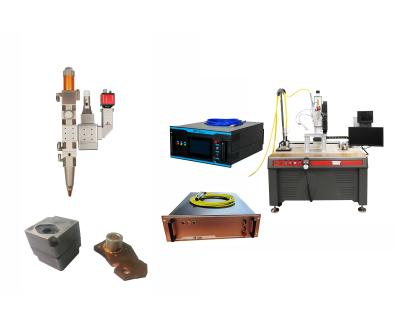
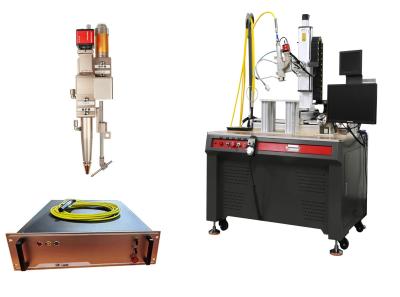
The QCW Quasi-Continuous Fiber Laser Welder is high-end equipment launched by Hanwei Laser for the precision welding field, adopting QCW quasi-continuous fiber laser technology that controls continuous fiber laser output through pulse modulation. It simultaneously possesses the high peak power of pulse lasers and the excellent beam quality of fiber lasers. The equipment is widely suitable for high-precision welding requirements in 3C electronics, new energy batteries, medical devices, precision hardware, and other industries.

Key Features
QCW quasi-continuous laser technology is the core competitive advantage of this equipment. Compared with traditional continuous wave laser welding, QCW technology achieves high peak power output through pulse modulation; single-pulse energy concentrates in extremely short time, effectively reducing heat conduction loss and significantly narrowing the heat-affected zone around weld spots.
The equipment supports one-button switching between pulse mode and continuous mode, allowing operators to flexibly select according to welding tasks. The intelligent pulse control module can preset multiple pulse parameter groups (frequency, width, energy curves) meeting welding needs of different materials and thicknesses. For high-reflectivity materials like copper and aluminum, QCW high peak power can effectively overcome material high-reflection characteristics achieving stable welding.

Technical Specifications
| Model |
HW-Q-150 |
HW-Q-300 |
| Input Voltage |
AC220V 50/60Hz |
AC220V 50/60Hz |
| Machine Size |
665*450*300 mm |
665*450*300 mm |
| Wavelength |
1070nm ± 10% |
1070nm ± 10% |
| Frequency |
100 Hz |
2 KHz |
| Machine Weight |
22 Kg |
28 Kg |
| Laser Power |
150 W |
300 W |
| Peak Power |
1500 W |
3000 W |
| Pulse Width |
0.5-50 |
0.5-50 |
| Pulse Energy |
15 J |
30 J |
| Power Stability |
≤ ± 1% |
≤ ± 1% |
| Power Consumption |
2 Kw |
2.5 Kw |
| Cooling Method |
Air Cooling |
Air Cooling |
Functions
The equipment features multiple welding modes and intelligent functions: Single-spot welding mode is suitable for precision spot welding; Continuous seam welding mode is suitable for seal welding with continuous and uniform weld seam formation; Multi-pulse sequence mode can preset pulse train parameters suitable for deep penetration welding and piercing welding. The 7-inch touch operation interface includes standard process packages for 3C electronics, new energy battery, medical device industries, supporting online parameter editing and USB data import. The equipment can be equipped with coaxial visual positioning systems, laser ranging sensors, and four-axis precision slides (optional) achieving high-precision automated welding.
About Shenzhen Hanwei Laser
In the laser welding field, every conquered technical challenge is a small step forward for manufacturing. Hanwei Laser deeply understands this. Our product development doesn't start in laboratories but begins at customer workshop sites. When customers reported zinc layer explosion during galvanized sheet welding, we developed composite preheating technology; when power battery enterprises suffered from low yield rates in aluminum alloy high-reflectivity material welding, we launched the AMB adjustable mode beam system; when metal processing manufacturers sought efficiency-quality balance, we created dual-wire handheld welding solutions. Every product iteration stems from deep understanding of actual customer needs.

Hanwei Laser's team doesn't pursue unlimited product line expansion but focuses on the vertical field of industrial laser welding. From precision spot welders to 6000W high-power welding systems, from handheld portable equipment to automated integration solutions, our product line, while focused, covers main industrial manufacturing welding scenarios. Specialization brings expertise—our technical team possesses profound understanding of material welding characteristics, capable of providing full-process technical support from equipment selection to process debugging.