Low Coupling Loss Edge FA 1550nm
1. Product Overview
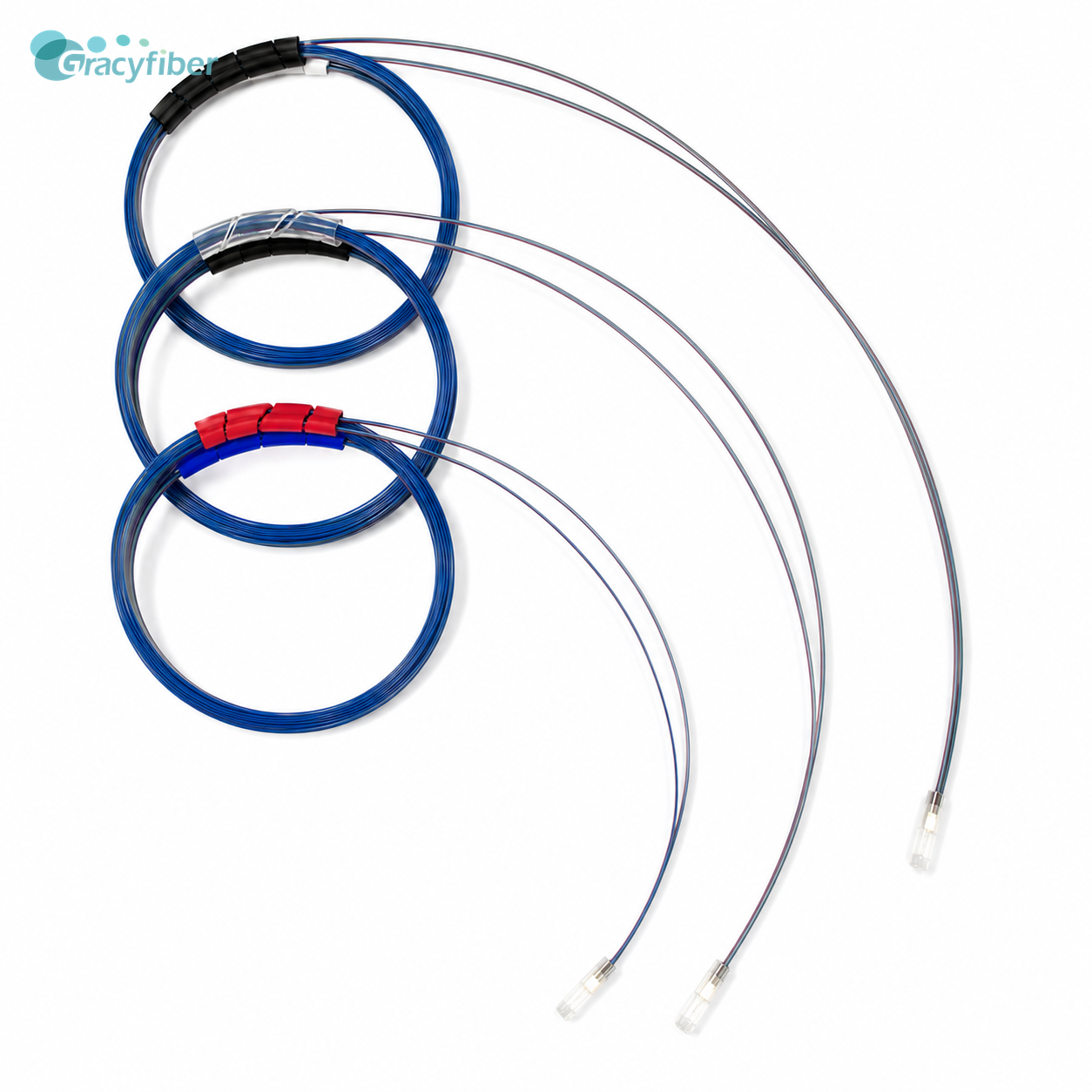
Gracyfiber’s Lensed Fiber Array (Lensed FA) is a highly specialized, precision optical interface engineered to maximize coupling efficiency between fiber arrays and Photonic Integrated Circuits (PICs). By directly integrating micro-lenses onto the fiber end-faces, this component provides superior mode matching and significantly expands the alignment tolerance for complex edge-coupling architectures. Manufactured with micron-level alignment control on precision glass substrates, our Lensed FAs deliver the scalable repeatability and stable optical performance required to drive advanced Silicon Photonics, AI/GPU optical interconnects, and next-generation high-bandwidth optical modules.
2. Product Features
| Parameter |
Unit |
1 |
2 |
4 |
8 |
12 |
16 |
24 |
32 |
48 |
| Wavelength |
nm |
980,1060,1260~1650 |
| Materials |
- |
Pyrex, Tempax, Quartz |
| Lid Option |
|
Lid |
| CorePitch |
- |
- |
250 |
127/350 |
127/250 |
127/250 |
127 |
127 |
127 |
127 |
| Core Pitch Tolerance |
μm |
+/-0.3 |
+/-0.5 |
+/-0.7 |
| Polish Angle |
Degree |
8°,90° or customized (12°, 21°,...) (±0.5°) |
| Beam Waist (Spot Size) |
μm |
2–5 (Customizable to match PIC MFD) |
| Working Distance |
μm |
10–30 |
| Mode Matching |
μm |
Optimized for PIC |
| Insertion Loss |
dB |
≤1.2(Typical 1.0) |
| Return Loss |
dB |
UPC≥40, APC≥50 |
| FA Dimension |
W |
mm |
2.5 |
2.5 |
2.5 |
2.5 |
3.5 |
3.5 |
5.7 |
5.7 |
9 |
| H |
mm |
2.5 |
2.5 |
2.5 |
2.5 |
2.5 |
2.5 |
2.5 |
2.5 |
2.5 |
| L |
mm |
10 |
10 |
10 |
10 |
10 |
12 |
12 |
12 |
12 |
| - |
- |
Standard or Customized |
| Fiber Type |
- |
OM1/OM2/OM3/OM4/OM5/G67A1/ A2/ B3 or Customized |
| Fiber Coating |
um |
250 µm / 900 µm loose tube / ribbon (optional) |
| Fiber Type Length |
cm |
100+/-10 or customized |
| Connector |
- |
.FC/LC/SC/E2000/MT/MPO/MMC |
| Operation Temperature |
°C |
-5~65 |
| Storage Temperature |
°C |
-40~85 |
(Designed to solve your edge coupling pain points and improve production line yield)
- Features: Customized Spot Size and Optimized Mode Matching
- Benefit: The beam waist can be precisely customized from 2 μm to 5 μm to perfectly match the mode field diameter (MFD) of a specific photonic integrated circuit (PIC). This fundamentally eliminates the severe mode mismatch problem common in standard flat-ended fibers, significantly reduces optical coupling loss, and ensures seamless injection of maximum optical power into the silicon waveguide.
-
- Features: Significantly Extended Alignment Tolerance and Working Distance
- Benefit: Designed to provide an extended working distance of 10 μm to 30 μm. This greatly widens the mechanical tolerance window in the active alignment process, reduces the reliance on extremely high precision assembly equipment, thereby accelerating production line throughput and comprehensively improving overall production yield.
-
- Features: Excellent low optical loss and high return loss
- Benefit: Strictly controlled insertion loss of ≤1.2 dB (typical 1.0 dB) while delivering excellent return loss performance (UPC ≥40 dB, APC ≥50 dB). This effectively protects critical system optical power budgets and minimizes back reflections, crucial for maintaining signal integrity in high-speed, long-distance data center networks.
-
- Features: High-precision pitch control and superior channel consistency
- Benefit: Maintains stringent fiber core pitch tolerances (±0.3 μm to ±0.7 μm) across array configurations of up to 48 channels. This ensures high consistency in performance across all channels in high-density parallel optical modules, effectively preventing channel skew and optical crosstalk in dense AI computing cluster environments.
-
- Features: Wide wavelength and fiber compatibility
- Benefit: Capable of efficient operation across a wide wavelength range of 980 nm, 1060 nm, and 1260–1650 nm, supporting standard single-mode, multimode (OM1–OM5), and custom fibers. This provides you with a highly adaptable, unified platform, streamlines the supply chain, and allows for seamless integration into various optical engine designs.
3. Applications
- AI / GPU Optical Interconnects: Delivering the massive bandwidth and low latency required for compute clusters.
- Silicon Photonics (SiPh): Serving as the optimal edge-coupling interface for integrated chips.
- Co-Packaged Optics (CPO)
- Optical Engines: Providing miniaturized, high-efficiency coupling for compact transceiver modules.
- LiNbO₃ Modulators: Ensuring stable, matched optical injection for high-speed modulation.
- High-Speed Data Center Networks: Supporting the backbone of 400G, 800G, and emerging 1.6T infrastructure.