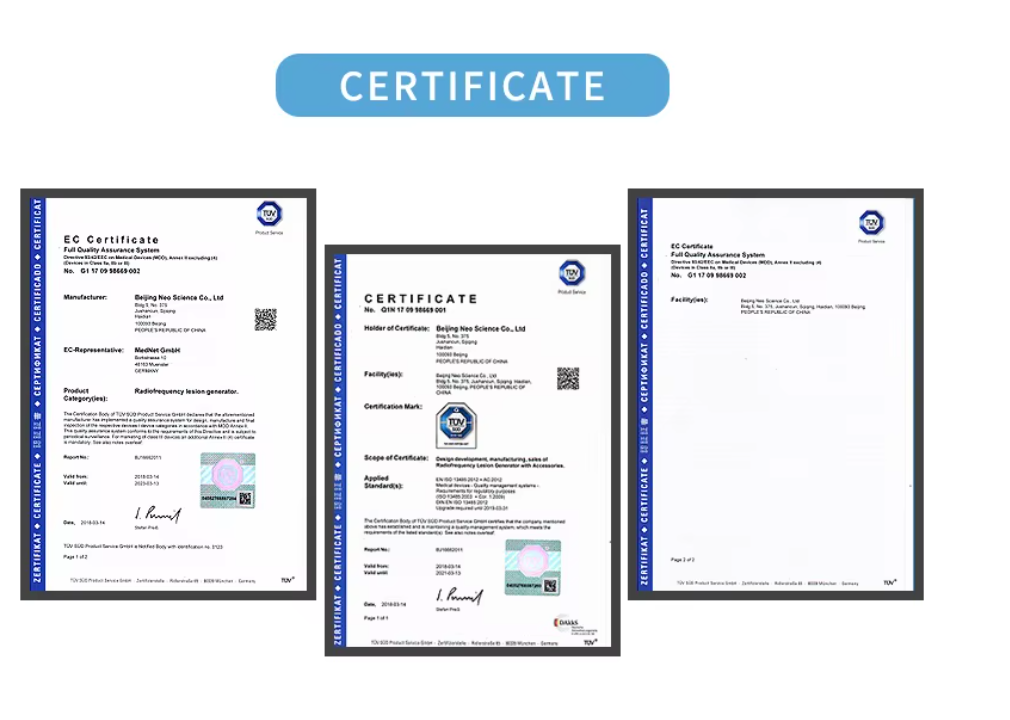
MDR CE Certified SEEG RF Lesion Generator for RF Thermocoagulation
Product Overview
The Golead SEEG RF Lesion Generator is a professional RF energy platform designed for compatible stereoelectroencephalography (SEEG)-guided radiofrequency thermocoagulation (RF-TC) systems.
SEEG-guided RF thermocoagulation uses implanted depth electrodes to deliver controlled RF energy between selected electrode contacts. Published technical literature describes RF-TC as a procedure performed through SEEG electrodes, with impedance changes used as an important indicator during thermocoagulation.
What Is SEEG RF Thermocoagulation?
Combining SEEG Mapping with RF Lesioning
Stereoelectroencephalography (SEEG) is an invasive method used to record electrical activity from implanted intracranial depth electrodes. In selected cases, the same implanted electrodes can subsequently be used to deliver RF energy for thermocoagulation.
Workflow Process:
SEEG Recording → Identify Relevant Electrode Contacts → Select RF-TC Contacts → Connect Compatible RF Generator → RF Thermocoagulation → Post-Procedure Assessment
Published reviews describe SEEG-guided RF-TC as a technique in which RF lesions are created through the implanted SEEG depth electrode, avoiding the need for a separate lesioning electrode insertion.
Key Features
- SEEG-Oriented RF Platform: Designed for integration into professional RF thermocoagulation workflows involving compatible SEEG electrode systems
- Controlled RF Energy Delivery: Provides controlled RF output according to the selected treatment configuration
- Impedance Monitoring: Provides impedance information for procedural monitoring where supported by the specific configuration
- Bipolar RF Capability: Supports RF energy delivery between selected electrode contacts for compatible bipolar RF-TC procedures
- Multi-Channel Configuration: Depending on the generator model, multiple RF channels can provide greater flexibility for electrode connection and procedural configuration
- Professional Neurosurgical Application: Designed for use in specialized medical environments and by appropriately trained healthcare professionals
Golead RF Generator Platform
RFE2-B - 2-Channel RF Lesion Generator
- 2 independent RF channels
- Continuous RF
- Pulsed RF
- Sensory stimulation
- Motor stimulation
- Real-time impedance monitoring
Suitable for selected RF lesion applications where a two-channel configuration is required.
RFE4-B - 4/8-Channel Multi-Mode RF Lesion Generator
- 4/8 RF channels
- Monopolar RF
- Bipolar RF
- Tripolar RF
- Thermal RF
- Pulsed RF
- Sensory stimulation
- Motor stimulation
- Real-time impedance monitoring
The multi-channel architecture provides a broader range of RF configurations for professional RF lesion procedures.
Technical Specifications
| Parameter | Specification |
|---|
| Product Category | SEEG RF Lesion Generator |
| Application | SEEG-Guided RF Thermocoagulation |
| RF Technology | Radiofrequency Thermocoagulation |
| RF Configuration | Model dependent |
| RF Channels | Model dependent |
| Bipolar RF | Model dependent |
| Impedance Monitoring | Supported configuration dependent |
| SEEG Interface | Required / model dependent |
| Electrode Compatibility | Model dependent |
| RF Output | Model dependent |
| Treatment Parameters | Model dependent |
| Application | Professional Neurosurgery |
| Quality System | ISO 13485 |
| Brand | Golead |
| OEM | Available |
Note: For exact RF output, impedance range, channel configuration, connector type, compatible SEEG electrodes and RF-TC parameters, please request the latest technical datasheet.
Frequently Asked Questions
What is a SEEG RF lesion generator?
A SEEG RF lesion generator is an RF energy system designed for use in compatible SEEG-guided radiofrequency thermocoagulation procedures.
What does SEEG RF thermocoagulation mean?
SEEG-guided RF thermocoagulation uses implanted stereoelectroencephalography electrodes to deliver RF energy between selected electrode contacts to create a localized thermal lesion.
Can SEEG electrodes be used for RF thermocoagulation?
Only SEEG electrodes specifically designed, validated or authorized for the intended RF-TC application should be used. Compatibility must be confirmed before the procedure.
Is SEEG RF-TC bipolar?
Many published SEEG RF-TC protocols use bipolar RF between selected electrode contacts, although monopolar approaches have also been described.
Why is impedance monitoring important?
Changes in impedance during RF-TC can provide information about the progression of thermocoagulation. Published technical guidance describes a sudden impedance change as an indicator associated with completion of thermocoagulation.