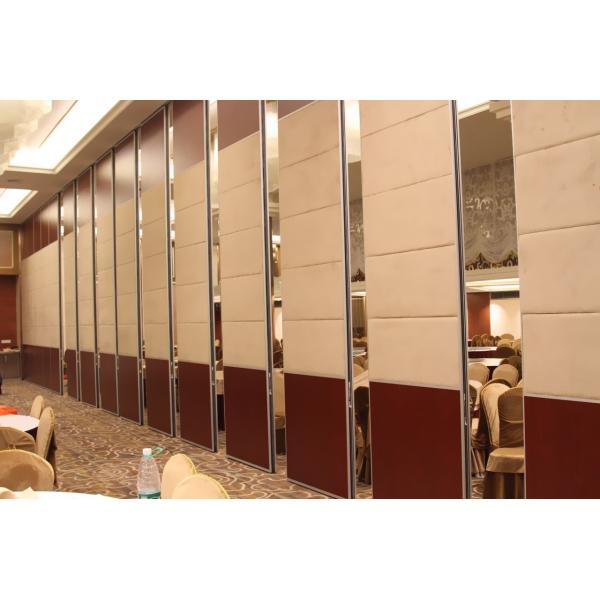
Extra-high movable partition walls (typically 4 meters or taller) are specialized architectural solutions designed to divide large spaces while maintaining flexibility, functionality, and aesthetic appeal. Their unique functions and special features cater to high-ceiling environments such as convention centers, hotels, auditoriums, and industrial facilities. Below is a detailed breakdown of their capabilities and distinguishing characteristics:
- Dynamic Reconfiguration: Enable rapid conversion of large open spaces into smaller, independent rooms (e.g., splitting a ballroom into multiple meeting rooms).
- Height Adaptability: Suitable for spaces with ceilings up to 10 meters or more, providing full vertical separation without permanent walls.
- Multi-Purpose Use: Ideal for venues requiring versatility, such as event halls that switch between banquet setups and exhibition layouts.
|
- Sound Isolation: High-density cores (e.g., mineral wool, laminated glass) and airtight seals reduce noise transmission, achieving STC ratings of 35–50+ (suitable for private meetings or sound-sensitive environments).
- Sound Absorption: Some models include acoustic panels to minimize echo in large spaces like gymnasiums or churches.
|
- Fire Resistance: Many systems meet fire ratings of 60–120 minutes (e.g., ASTM E119, EN 1364) using non-combustible materials and intumescent seals that expand during fires to block smoke and flames.
- Safety Sensors: Integrated infrared or pressure sensors stop panel movement if obstacles (e.g., people, objects) are detected, complying with safety standards like EN 16005.
|
- Thermal Insulation: Insulated cores reduce heat transfer, improving HVAC efficiency in large buildings.
- Light Control: Optional opaque or translucent panels regulate natural light, while glass inserts allow daylight diffusion without full openness.
|
- Customizable Finishes: Panels can be clad in materials like wood, fabric, metal, or glass to match interior design themes.
- Sleek Profile: Minimalist track systems and hidden hardware create a seamless, modern look, avoiding bulky permanent walls.
|

| 1. Heavy-Duty Structural Design | Reinforced Tracks | Made from aluminum or steel alloys to support panel weights of 50–150 kg per linear meter (far heavier than standard partitions). |
| Dual-Track Systems | Upper load-bearing tracks and lower guide rails stabilize tall panels, preventing sway or misalignment. |
| Counterbalance Mechanisms | Some models use weights or springs to offset panel mass, ensuring smooth manual operation even for 6+ meter heights. |
| | Modular Panel Construction | Panels are pre-fabricated in sections for easier transport and installation in high spaces, with interlocking mechanisms for structural integrity. |
| Wind Load Resistance | Engineered to withstand lateral forces (e.g., in atriums or outdoor-covered spaces), meeting structural codes for high-rise buildings. |
| Earthquake Compliance | Some systems include flexible connections to absorb seismic movement without collapsing. |
| | IoT Connectivity | Track usage data (e.g., opening/closing cycles, energy consumption) via smart sensors. |
| Audio-Visual Integration | Panels can incorporate built-in screens, projectors, or sound systems for conference or event spaces. |
| Access Control | Locking mechanisms (e.g., electromagnetic locks) secure panels for private events or restricted areas. |
| | Rigging Systems | Hoists or lifts are used to install panels at heights, with precision alignment tools (e.g., laser levels) ensuring vertical and horizontal accuracy. |
| Low Maintenance | Self-lubricating rollers and corrosion-resistant tracks reduce upkeep needs, while modular designs allow easy replacement of individual panels or components. |

- Hospitality: Ballrooms, conference centers, and hotels with high ceilings.
- Commercial/Industrial: Warehouses, showrooms, or factories needing flexible zoning.
- Cultural Institutions: Museums, galleries, or auditoriums requiring adaptable exhibition spaces.
- Transportation Hubs: Airports or train stations with large atriums needing temporary barriers.
| Feature | Extra-High Movable Partitions | Standard Partitions (≤3m) |
| Maximum Height | 4–10+ meters | 2–3 meters |
| Panel Weight | 50–150 kg/m linear | 20–50 kg/m linear |
| Structural Requirement | Reinforced ceilings/floors | Standard framing |
| Mobility | Motorized or heavy-duty manual systems | Manual or light-duty electric |
| Acoustic/Fire Ratings | Higher (STC 35+; fire rating 60+ mins) | Moderate (STC 25–35; fire rating 30 mins) |
- Structural Engineering: Ensure the building can support the load of tracks and panels (consult a structural engineer).
- Code Compliance: Meet local regulations for fire safety, accessibility (e.g., ADA), and seismic activity.
- Budget: Costs are 2–3x higher than standard partitions due to specialized materials and installation complexity.
Extra-high movable partition walls offer a blend of functionality, safety, and design flexibility for challenging architectural spaces, making them indispensable in modern commercial and public infrastructure.