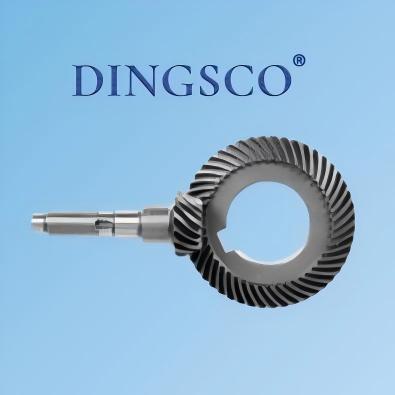
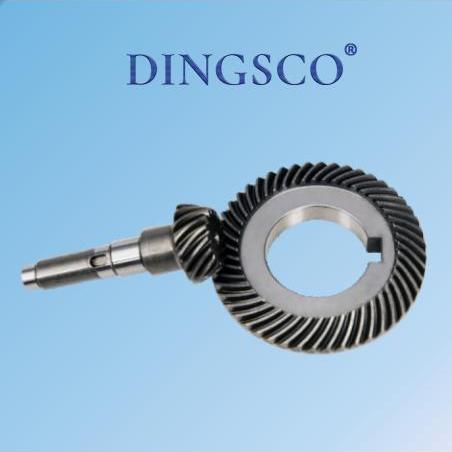
90° Spiral Conical Gear Progressive Meshing For Reducing Impact
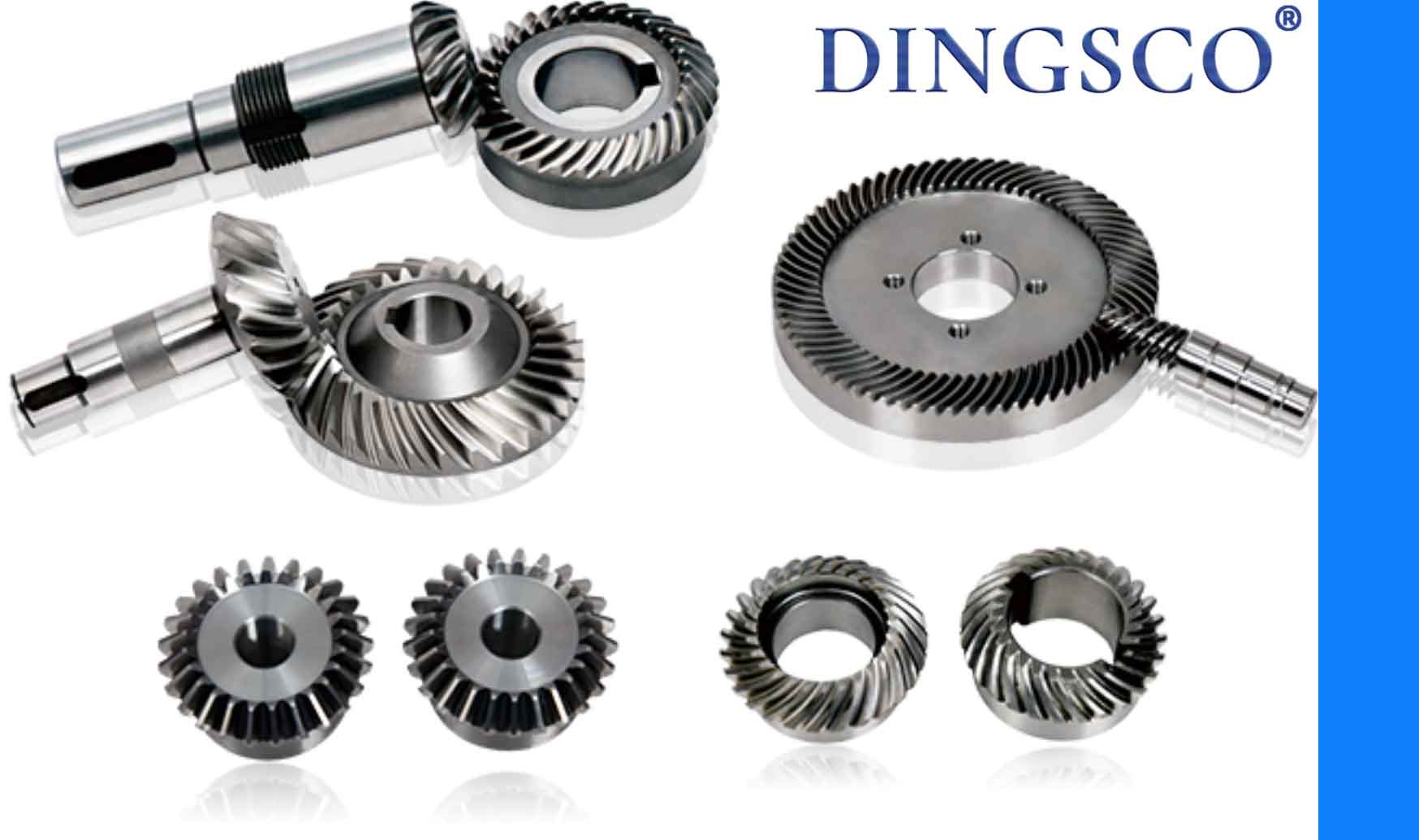
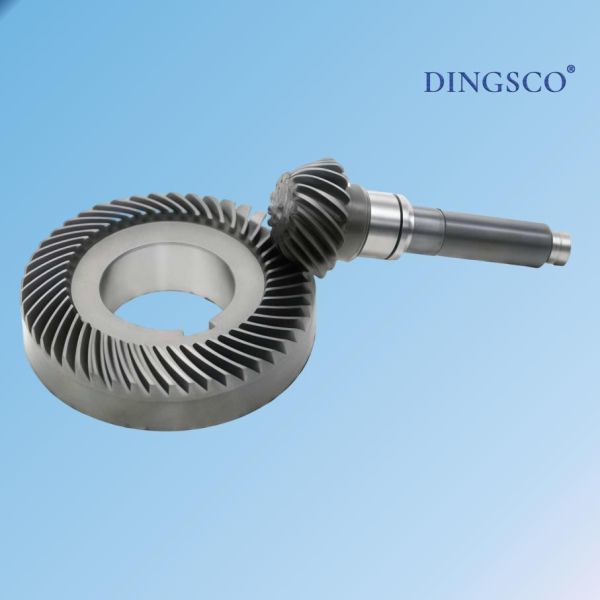
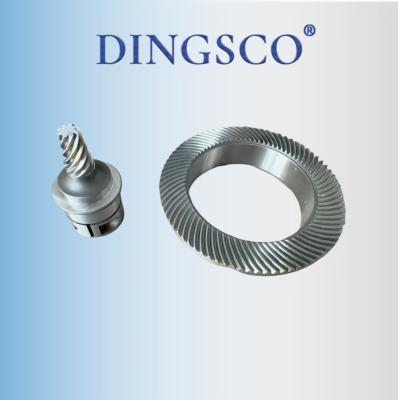
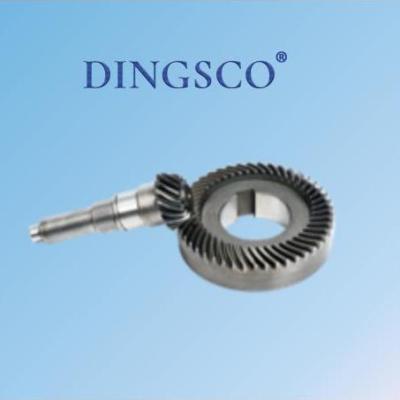
The set of Spiral Bevel Gears can be analyzed from dimensions such as structure, working principle, performance, and applications. Their design and characteristics are highly adapted to industrial transmission scenarios, including KF series bevel gear reducers.
Structural Features: Spiral Tooth Profile + Conical Base
- Tooth Profile Design: The tooth line is spiral around the conical generatrix, forming a curved tooth surface.
- Geometric Relationship: The pitch cone vertices of the two gears coincide, and the shaft angle is usually 90° for right-angle transmission.
- Processing Marks: Parameters like tooth surface helix angle and pressure angle determine meshing characteristics.
Transmission Principle: Progressive Meshing for Right-Angle Power Conversion
- Meshing Mode: The spiral tooth surfaces progressively contact during rotation, gradually meshing from the tooth end to the full tooth, then disengaging, significantly reducing impact compared to straight teeth.
- Power Direction Change: Through the meshing of conical tooth profiles, the horizontal/vertical rotation of the input shaft is converted into the vertical/horizontal rotation of the output shaft while achieving speed reduction/increase using the tooth ratio.
Performance Advantages: Core Competitiveness Surpassing Straight Teeth
| Comparison Dimension |
Spiral Bevel Gears |
Straight Bevel Gears |
| Stability |
Progressive meshing enables smooth operation with minimal vibration even at high speeds |
Instantaneous meshing causes significant impact and noise |
| Load-Carrying Capacity |
Tooth surfaces feature surface contact, increasing torque-bearing capacity by 30%-50% |
Tooth surfaces have line contact, making them prone to fatigue failure |
| Noise Control |
Smooth meshing reduces operating noise by 10-15 dB |
High meshing impact results in sharp noise |
| Transmission Efficiency |
Low sliding friction on tooth surfaces yields an efficiency of 95%-98% |
Efficiency is around 90%-93%, leading to higher energy consumption |
Application Scenarios: Covering from Industrial to Precision Equipment
- Industrial Reducers: Such as KF series bevel gear reducers, responsible for right-angle direction change, speed reduction and torque increase, adapted to heavy-load scenarios like machine tools, conveyor lines, and mining machinery.
- Automotive Field: Differentials for wheel differential speed and right-angle transmission, four-wheel drive transfer cases for distributing power to front and rear axles.
- High-End Equipment: Helicopter main reducers requiring high speed and high reliability, robot joints requiring low backlash and high stability.
- Precision Instruments: Medical devices, optical equipment relying on low vibration and high positioning accuracy.
Design and Processing: Technical Barriers Behind High Precision
- Processing Difficulty: Requires specialized machine tools to mill spiral tooth profiles, with tooth surface grinding accuracy reaching ±5μm level to ensure meshing stability.
- Installation Requirements: The pitch cone vertices of the two gears must be strictly aligned, and axial/radial clearances need precise adjustment (errors exceeding 0.1mm will exacerbate wear and noise).
- Materials and Heat Treatment: Alloy steels such as 20CrMnTi, 18CrNiMo7-6 are commonly used, with tooth surfaces hardened to HRC58~62 through carburizing and quenching while controlling heat treatment deformation.
Adaptability to KF Reducers
- Functional Matching: The 90° shaft angle perfectly fits the right-angle transmission requirement of KF series.
- Performance Compatibility: The high load capacity and low noise of spiral teeth directly meet industrial scenarios requiring heavy load and stable operation.
- Flexible Speed Ratio: By adjusting the tooth ratio, it covers the speed ratio range of i=3~50 for KF series.
In summary, spiral bevel gears with spiral tooth profile and conical base achieve efficient and stable right-angle power transmission through progressive meshing. They are core components of industrial equipment such as KF series bevel gear reducers, and their design and manufacturing level directly determine the performance ceiling of transmission systems.