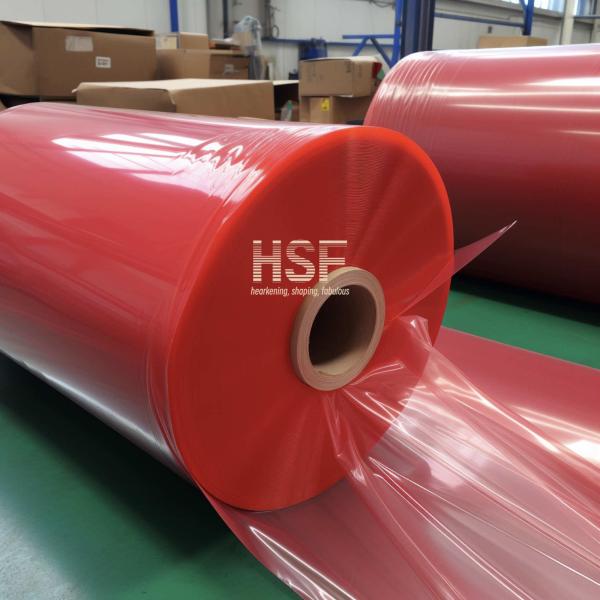
SGS Opaque Red Low Density Polyethylene Film For Packaging
120 μm red low density polyethylene film designed for packaging, agriculture, construction, medical, and various industrial applications.
About Low-Density Polyethylene (LDPE) Film
Low-density polyethylene film is a flexible, durable, and moisture-resistant plastic material widely used across multiple industries.
Primary Applications
- Packaging: Flexible packaging applications including bags, shrink wrap, and stretch film
- Agriculture: Greenhouse covers, mulch film, and silage bags
- Construction: Barrier protection material for construction sites, insulation, and roofing
- Medical: Disposable gloves and medical packaging
LDPE vs HDPE Comparison
LDPE film has lower density than HDPE film, making it softer, more flexible, and more transparent. HDPE film offers higher density, resulting in greater rigidity, opacity, tensile strength, and puncture resistance. LDPE provides superior conformability and heat sealing capabilities.
Technical Specifications
| No. |
Property |
Requirement |
Measured Data |
| 1 |
Appearance |
No air bubbles / stains / breakage / impurities |
OK |
| 2 |
Size |
Width: 1000 -0+6 mm Thickness: 0.120 ± 8% mm |
Width: 1004 mm Thickness: 0.116 mm |
| 3 |
Max. Tension (N/50mm) |
TD: ≥ 15 MD: ≥ 15 |
TD: 20 MD: 21 |
| 4 |
Color Difference |
Colorimeter △E < 3 |
OK |
| 5 |
Elongation @ Break (%) |
TD: ≥ 230 MD: ≥ 230 |
TD: 876 MD: 754 |
| 6 |
Surface Tension (Corona) |
≥42 dyne |
48 dyne |
Application Scenarios
- Construction: Protective sheeting for floors, walls, and surfaces during renovation
- Transportation: Shipment protection and color-coding for identification
- Agriculture: Greenhouse plastic protection from weather elements
- Marine Industry: Protection for boats and equipment during transport and storage
- Pond Liner: Water leakage prevention and environmental protection
- Roofing Industry: Weather-resistant layer against moisture and heat
Performance Enhancement Methods
- Blending: Combining with LLDPE or HDPE to improve strength and resistance
- Additives: Incorporating fillers, elastomers, and reinforcing agents
- Coating: Applying acrylic, urethane, or silicone coatings for enhanced properties
- Orienting: Stretching film to align polymer chains for improved strength
- Cross-linking: Modifying polymer chains for thermal stability and chemical resistance
- Process Control: Optimizing temperature, pressure, and extrusion parameters