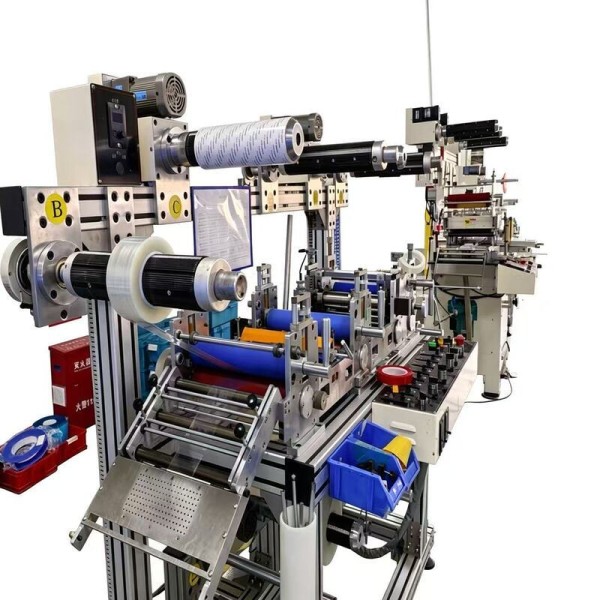
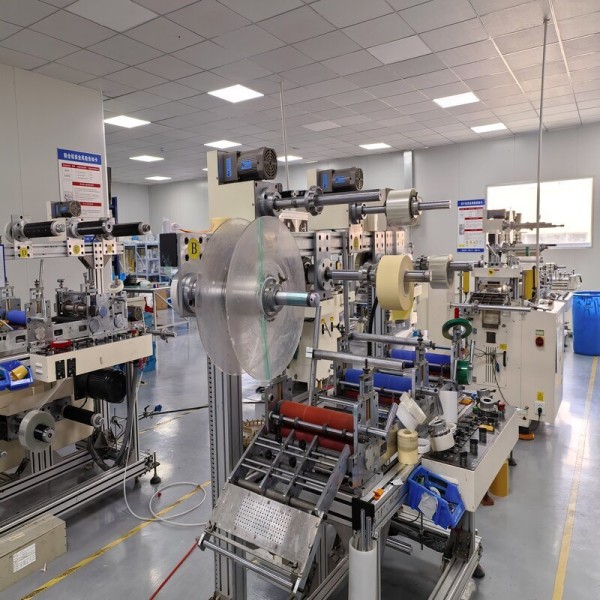
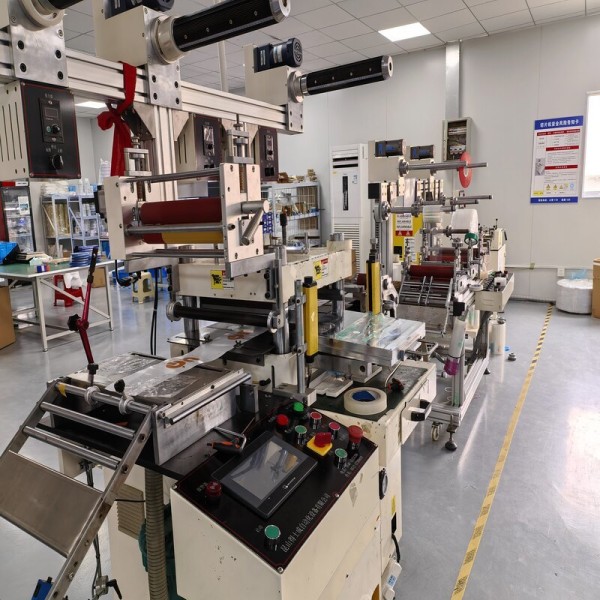
The rotary die cutting machine for high-volume adhesive vent and acoustic mesh production is an industrial-grade, high-speed converting system engineered for the continuous, cost-effective mass production of pressure-sensitive adhesive-backed vent patches, acoustic membranes, and microporous filter components. This machine employs a precision-ground rotary die cylinder that rotates against a hardened anvil roller, cutting through the material web as it passes continuously between the two rotating cylinders at speeds up to 60 meters per minute or more. It is the definitive production platform for the high-volume adhesive vent products used in smartphones, TWS earbuds, automotive sensors, and medical device packaging, where annual volumes can reach tens or hundreds of millions of parts. The machine integrates multi-station unwinding and laminating, precision rotary die cutting with automatic die pressure control, waste matrix stripping and re-winding, and finished product slitting and roll winding—all in a single, continuous in-line process. It delivers consistent part-to-part accuracy, minimal material waste, and the low per-part cost essential for competitive high-volume manufacturing.
The global market for adhesive-backed waterproof breathable vents is driven by the billions of consumer electronics, automotive components, and medical devices produced annually. Manufacturing these small, precision parts at competitive costs requires a converting process fundamentally different from batch-oriented flatbed cutting. A flatbed press, even a fast one, operates at intermittent strokes—the material stops, the platen descends, cuts, rises, and the material indexes forward. For parts as small as a 5mm diameter smartphone microphone vent, this stop-start process limits throughput and creates registration challenges. Rotary die cutting overcomes these limitations: the material web moves continuously at constant speed, the cylindrical die rotates in synchrony with the web, and cutting occurs on-the-fly. This continuous motion enables the high linear speeds and throughput that make parts economically viable. The primary challenges in rotary converting of vent products are maintaining precise kiss-cut depth on a rotating cylinder, managing the tension of thin, elastic ePTFE films without stretching, and rapidly stripping the complex, fragile waste matrix from around tiny parts at high speed without tearing the finished patches.
The rotary die cutting machine is purpose-designed for this continuous, high-speed production. The heart of the machine is a precision-ground, solid or magnetic rotary die cylinder. The die cylinder is mounted on precision bearings and driven by a servo motor synchronized with the web drive. The cutting depth—the kiss cut—is precisely set by a gap adjustment mechanism between the die cylinder and the hardened anvil roller. For magnetic cylinders, flexible engraved dies are wrapped around the cylinder, offering fast changeover and lower die cost. For ultra-high-volume solid dies, the entire cylinder is precision-machined from tool steel. The machine features multiple unwinding stations to laminate the ePTFE membrane, adhesive transfer tape, and release liner in-line, just prior to cutting, minimizing the handling of sensitive materials. A tension control system with dancer rollers and load cells maintains precise, low-tension control through each section of the machine. The rotary waste stripping system uses driven stripper rollers and vacuum hoods to continuously pull the skeletal waste matrix away from the cut parts and rewind it, while the finished parts remain on the liner and are re-wound into finished rolls. An integrated vision inspection system can be added to inspect every part on-the-fly at full production speed.
| Parameter | Specification |
|---|---|
| Machine Type | Servo-driven rotary die cutting line |
| Maximum Web Width | 300 mm – 800 mm |
| Maximum Production Speed | Up to 60 m/min (material and part dependent) |
| Die Cylinder Type | Solid engraved or magnetic with flexible die |
| Kiss Cut Accuracy | ±10 μm on release liner (consistent across web width) |
| Tension Control | Closed-loop servo with dancer and load cell feedback |
| Unwind Stations | Up to 4 independent unwinds with splicing table |
| Laminating Stations | Up to 3 precision heated or ambient nip stations |
| Waste Matrix Rewind | Torque-controlled with automatic tension taper |
| Finished Roll Rewind | Servo-driven with closed-loop tension control |
| Optional Features | Vision inspection, corona treatment, inkjet marking |
| Controls | PLC with full recipe management, Industry 4.0 ready |
The multi-layer material is built up in-line from individual rolls. The first unwind feeds the release liner. The first laminating nip applies the adhesive transfer tape. The second unwind and nip apply the ePTFE membrane. A third unwind may apply a top carrier or mask. The combined web then enters the rotary die cutting station. The servo-driven die cylinder rotates in precise synchrony with the web. As the web passes through the nip between the die cylinder and the anvil roller, the raised blades on the die cylinder press through the membrane and adhesive layers, cleanly cutting the desired part perimeter. The kiss-cut depth is maintained by the precisely set gap between the die cylinder and anvil. Immediately after cutting, the web passes through the stripping station. The waste matrix—the continuous web of membrane and adhesive surrounding the parts—is pulled away at an angle by a driven rewind roller and wound onto a waste roll. The finished parts remain on the liner and are re-wound onto the finished product roll.