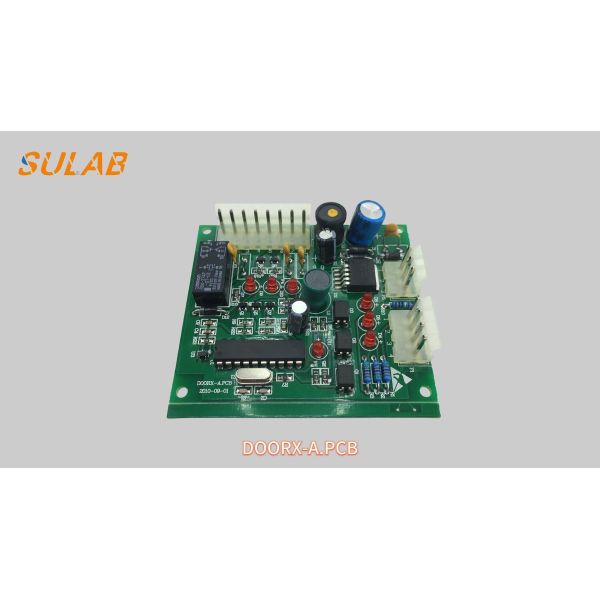
Otis Elevator SPBC-III PCB Board GDA26800KX1 Original Control Board For Gen2 Elevator Safety Protection & Brake Control System
The Otis GDA26800KX1 is an SPBC-III (Safe Protection & Brake Control III) elevator control circuit board (PCB), which is the core safety and logic control unit of Otis' Gen2, EFT, SkyRise and other series of elevator control systems.
| Brand | SULAB |
| Description | Elevator parts |
| Model | GDA26800KX1 |
| MOQ | 1PC |
| Transportion | TNT, UPS, DHL, Fedex, Air, Sea |
| Applicable | Elevator |
| Packages | Carton, Wooden case, Pallet etc |
| Delivery Time | Normally 2-3 working days after payment |
| Warranty | One year |
| Payment Method | Company Bank, Western union, Paypal etc |
Safety Circuit Monitoring and Protection: Real-time monitoring of the status of all safety switches, including elevator door lock circuits, safety circuits, emergency stop circuits, speed governors, safety brakes, and buffers.
Upon detection of any safety contact disconnection or malfunction, the system immediately cuts off the operation control signal, forcing the elevator to stop and lock, preventing the elevator from starting or running in an unsafe condition.
Brake Control and Monitoring: Receives commands from the main control system and precisely controls the opening and closing of the elevator's brake, ensuring braking safety during elevator start-up, operation, leveling, and stopping.
Provides real-time feedback on the brake switch's open/closed status, monitoring whether the brake is functioning properly and preventing risks such as slippage, overshooting, or bottoming out.
I/O Signal Processing and Logic Control: As an interface board, it is responsible for collecting digital input signals (such as inspection switches, limit switches, and leveling sensors) from the elevator machine room, hoistway, car, and landing doors.
Outputs control signals to drive relays, contactors, indicator lights, and other actuators, coordinating the logical actions of various elevator systems.
System Communication and Status Feedback
Communicates with the elevator main control board (such as GECB/TCBC) to transmit safety status, operating parameters, and fault codes.
When a fault is detected, the fault information is recorded and uploaded, facilitating troubleshooting by maintenance personnel via a server.
Drive and Protection Auxiliary Circuits
Some models integrate drive auxiliary circuits to provide stable power to external sensors and switches, and provide overcurrent and short-circuit protection.
Q1: How do I identify the correct replacement elevator PCB board?
To identify a replacement elevator PCB board, check the original part number, hardware revision, board markings, and elevator controller model. Clear photos of both sides of the PCB can help distinguish different versions.
Q2: Can elevator PCB boards with similar part numbers be interchangeable?
Not necessarily. Elevator PCB boards with similar part numbers may differ in hardware revisions, firmware, connector layouts, or communication protocols. Compatibility must be verified against the existing elevator system.
Q3: Does a replacement elevator PCB board require programming?
Some replacement PCB boards require firmware configuration, parameter settings, or system-specific programming. Others may already contain the required software. The correct procedure depends on the PCB model and its role in the elevator control system.
Q4: Can a faulty elevator PCB board be replaced without changing the complete control system?
In some cases, an individual PCB can be replaced if the replacement is compatible with the existing controller, firmware, wiring, and connected components. A qualified technician should confirm the fault before deciding on replacement.
Q5: What information should I provide when sourcing a replacement elevator PCB board?
Please provide the original PCB part number, hardware revision, elevator model, clear board photos, and required quantity. SULAB can help review these details and check available replacement options.