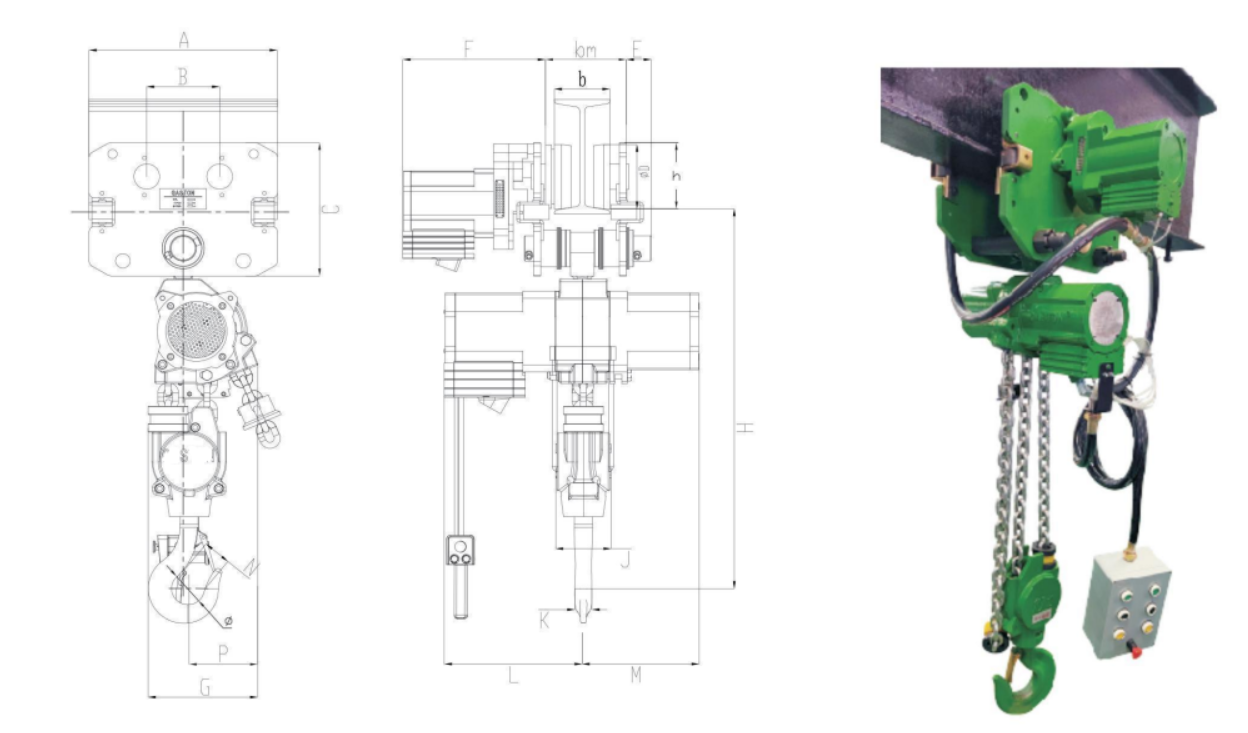
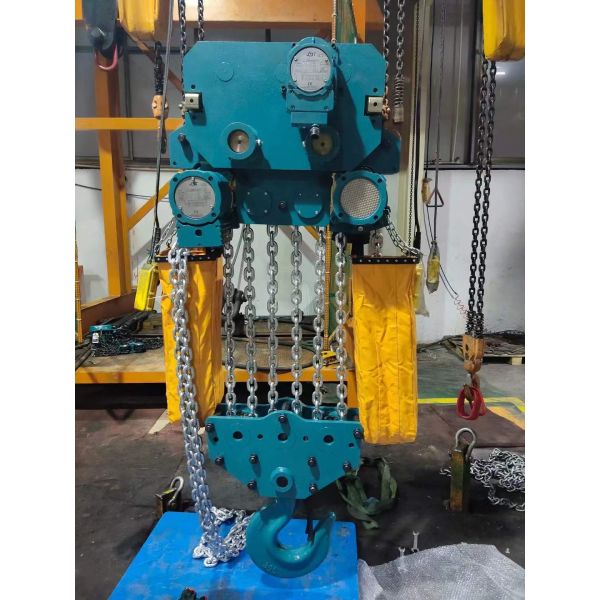
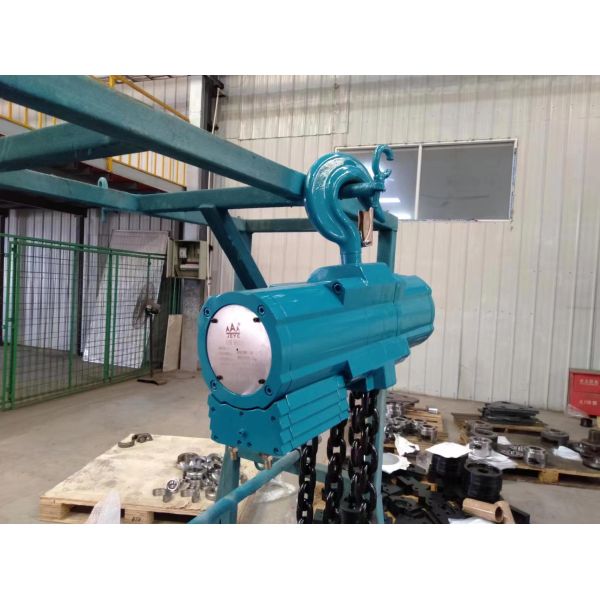
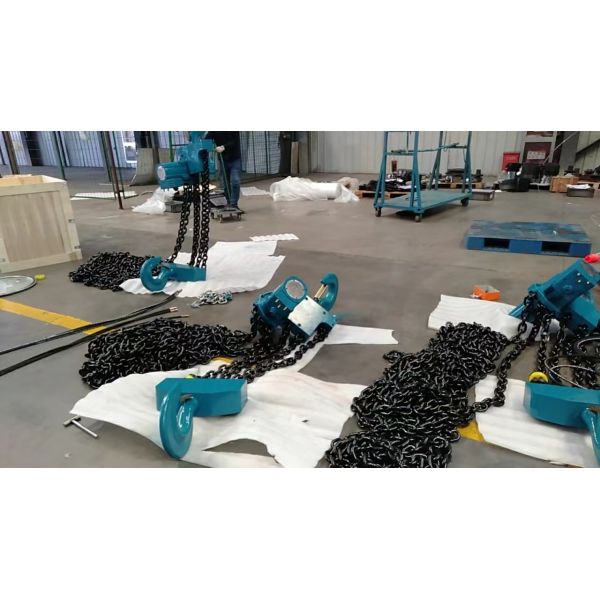
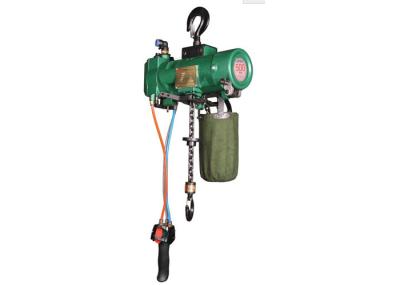
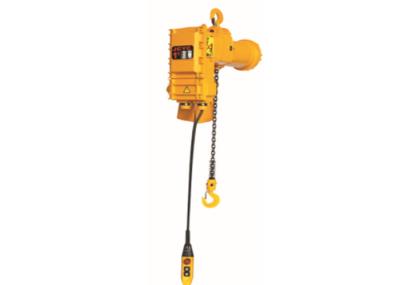
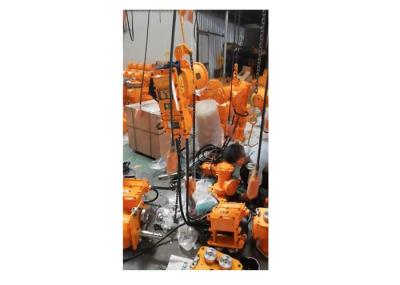
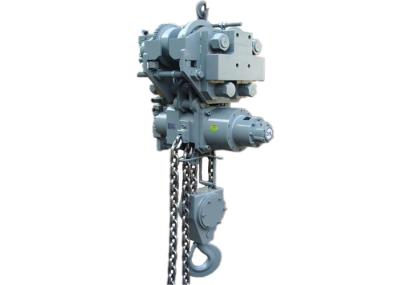
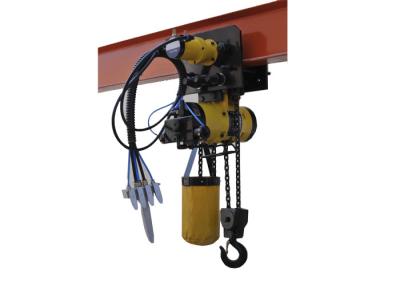
explosion-proof Chain Pneumatic air hoist
Air Hoist Introduction & Features
The air hoist is one of the most ideal lifting solutions in the world and has been widely used in industrially developed countries. It represents a new generation of lifting equipment designed to enhance safety, improve efficiency, and reduce operating costs.
The working principle of an air hoist is based on converting the pressure of compressed air into mechanical energy to lift loads. Compared with electric hoists, air hoists offer significant advantages, especially in hazardous and demanding environments.
Key Advantages of Air Hoists
- Explosion-proof and intrinsically safe
Air hoists do not generate electric sparks, completely eliminating explosion risks. They meet explosion-proof requirements for Hazardous Area Class I, including IIC gas group, T5 and below. - High efficiency & continuous operation
Small-capacity air hoists are suitable for continuous, high-efficiency operation with a 100% duty cycle, without overheating. - Excellent environmental resistance
Air hoists are highly resistant to acid, alkali, steam, high humidity, and heavy dust, making them ideal for harsh industrial environments. - Compact and lightweight design
Small in size and easy to operate, an air hoist weighs only 1/3 to 1/8 of an electric hoist with the same capacity. - Precise positioning
The pull-rod control responds quickly to operator commands, allowing centimeter-level positioning with zero impact, ensuring accurate load placement. - Clean, eco-friendly, and safe
The internal lubrication system prevents air pollution, supporting clean and environmentally friendly operation. - Reliable and low maintenance
Featuring a robust structural design, air hoists offer stable performance, high reliability, and low maintenance requirements. - Enhanced safety protection
Built-in air protection prevents sudden load drops in the event of air supply interruption, significantly improving operational safety.
Technical Specifications
| Mold | unit | HQ1-2 | HQ2-2 | HQ3-1 | HQ5-2 | HQ8-2 | HQ10-2 | HQ12-2 |
| Atmospheric pressure | Mpa | 0.6 | 0.6 | 0.4 | 0.6 | 0.4 | 0.6 | 0.4 | 0.6 | 0.4 | 0.6 | 0.4 | 0.6 |
| Capacity | (Tons) | 1 | 2 | 3 | 5 | 8 | 10 | 12 |
| chain numbers | (numbers) | 2 | 2 | 1 | 2 | 2 | 2 | 2 |
| Motor Power | (KW) | 1.0 | 1.0 | 1.8 | 3.5 | 1.5 | 2 | 1.8 | 3.5 | 1.8 | 3.5 | 1.8 | 3.5 |
| Lifting height | (M) | standard lifting height is 3m |
| Full load lifting speed | (m/min) | 3.6 | 2.7 | 2.5 | 5 | 1.2 | 1.5 | 1 | 1.7 | 0.8 | 1.5 | 0.5 | 1.1 |
| No load lifting speed | (m/min) | 7 | 5.5 | 6 | 10 | 1.2 | 2.8 | 1 | 1.7 | 0.8 | 1.5 | 0.5 | 1.1 |
| Full load descent speed | (m3/min) | 8 | 7 | 7.5 | 10.5 | 2.5 | 3.2 | 2.8 | 3.9 | 2.5 | 3.5 | 1.8 | 2.3 |
| Full load air consuption-Lifting | (m3/min) | 1.2 | 1.2 | 2 | 4 | 1.5 | 2.6 | 2 | 4 | 2 | 4 | 2 | 4 |
| Full load air consuption-Descent | (m3/min) | 1.5 | 1.5 | 3.5 | 5.5 | 2.2 | 3.6 | 2 | 4 | 2 | 4 | 2 | 4 |
| standard weight | (kg) | 32 | 38 | 86 | 79 | 115 | 115 | 119 |
| Noise at full load- Lifting | (dB) | 74 | 78 | 74 | 78 | 74 | 78 | 74 | 78 | 74 | 78 | 74 | 78 |
Manufacturer Profile
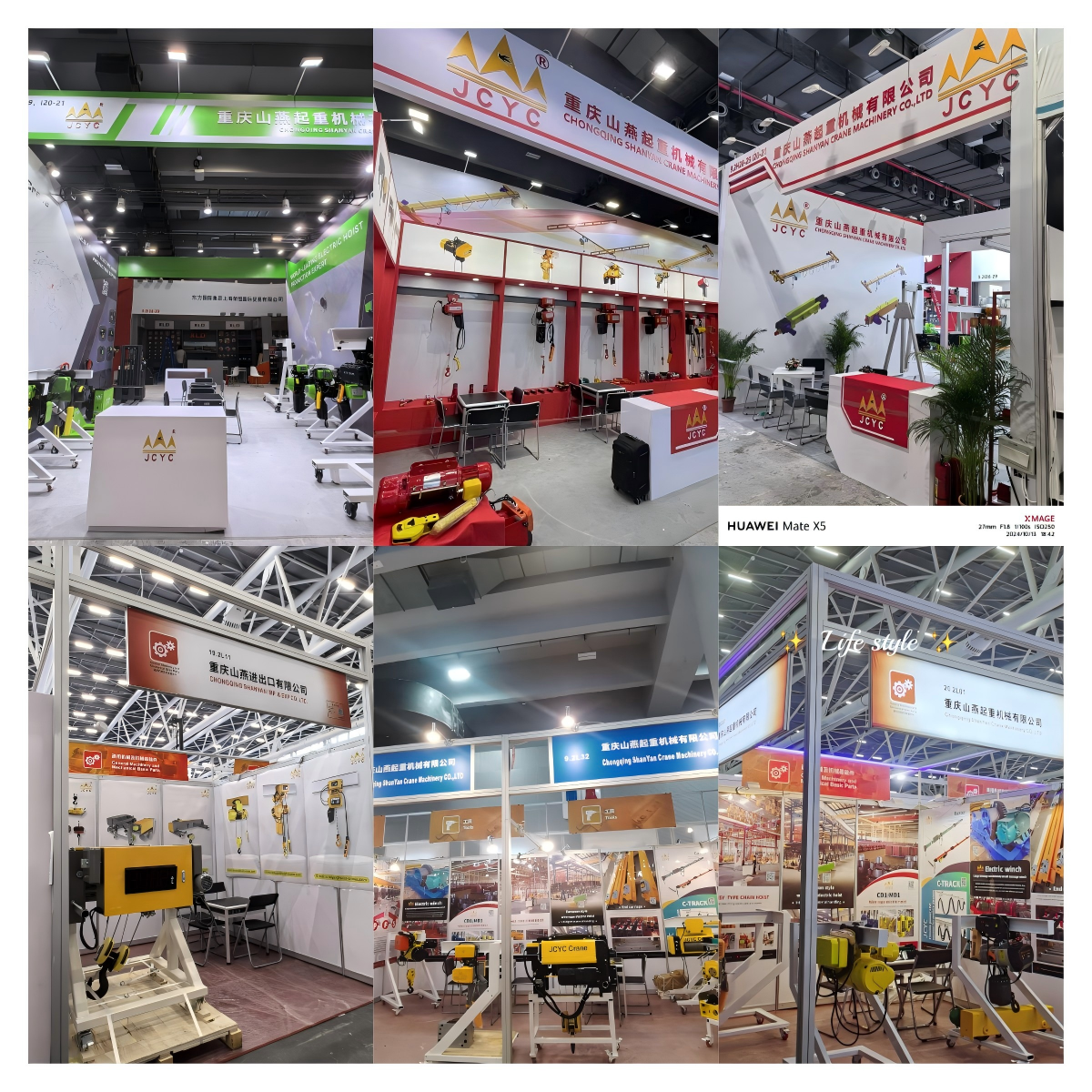
Industry Exhibitions