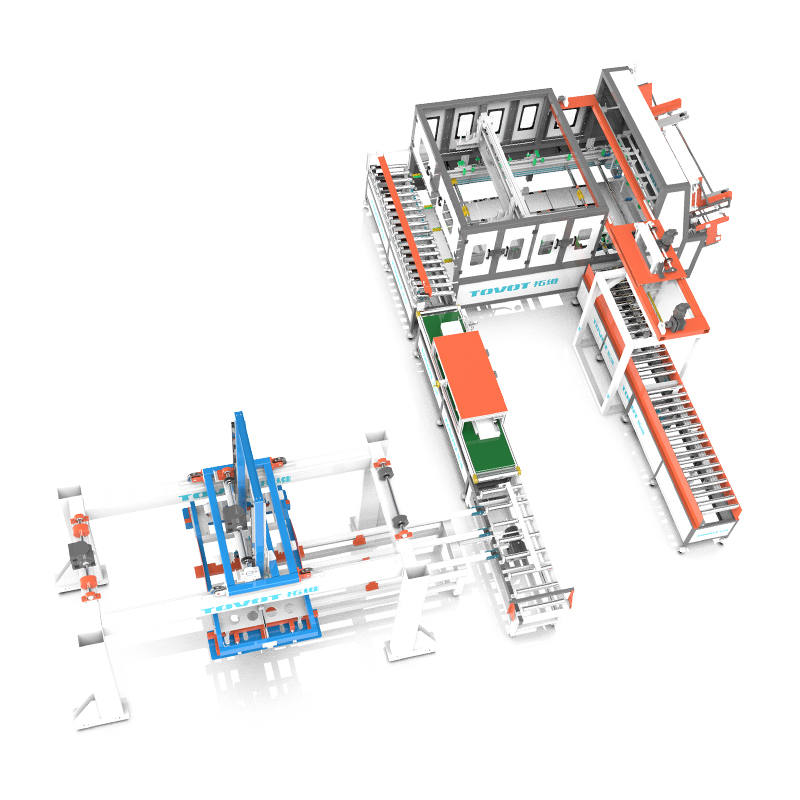
The End of Line Packaging System for Smart Flooring Factory Automation is developed for manufacturers that want to connect finished-product handling, packaging, identification, palletizing, and downstream logistics into one coordinated production process. Designed for products with lengths of 500–1000 mm, widths of 300–600 mm, and package heights of 25–80 mm, the system can achieve a production speed of approximately 8–12 boxes per minute.
With an installed power of around 28 kW and a standard electrical supply of 380V / 50Hz, this automated solution is suitable for flooring, panels, boards, and other regularly shaped industrial products. Instead of relying on separate manual stations, the line can automatically receive products, organize them, complete packaging operations, and transfer finished boxes to labeling or palletizing equipment. The modular design allows each project to be adapted according to product size, line speed, factory layout, and future automation requirements.
In many manufacturing plants, production equipment is already highly automated, but the operations after production are still completed manually.
Products may be cut, inspected, and stacked automatically, but workers are then required to move them to the packaging station, count the products, load cartons, apply labels, and prepare pallets.
This creates a mismatch between production capacity and packaging capacity.
Common problems include:
Finished products waiting between production and packaging
Manual counting errors
Irregular package quality
Too many operators concentrated at the end of the line
Slow transfer between different packaging stations
Incorrect labels or product identification
Repeated manual lifting and handling
Difficulty maintaining stable output during shift changes
Limited production traceability
Difficulty expanding production without adding more workers
When these processes are not connected, the entire factory may still be limited by end-of-line efficiency.
The purpose of an End of Line Packaging System is to create a continuous flow from finished production to warehouse-ready packages.
Products enter the system automatically after the upstream production or inspection process. Conveyors transfer them to the required packaging stations while sensors and the PLC coordinate each movement.
Depending on the project requirements, the system can perform several functions in sequence.
These may include:
Product receiving
Alignment and positioning
Automatic counting
Product grouping
Automatic stacking
Protective material insertion
Box loading
Carton closing
Product wrapping
Label printing
Barcode identification
Quality inspection
Robotic palletizing
Pallet stretch wrapping
Finished pallet transfer
This integrated approach reduces unnecessary manual transfer and allows different machines to operate as one complete production system.
|
Item |
Specification |
|---|---|
|
Product Name |
End of Line Packaging System |
|
Product Length Range |
500–1000 mm |
|
Product Width Range |
300–600 mm |
|
Package Height Range |
25–80 mm |
|
Production Speed |
8–12 boxes/min |
|
Installed Power |
Approx. 28 kW |
|
Standard Voltage |
380V / 50Hz |
|
Control System |
PLC + HMI |
|
Feeding Type |
Automatic |
|
Product Positioning |
Automatic |
|
Recipe Management |
Available |
|
Labeling Connection |
Optional |
|
Palletizing Connection |
Optional |
|
Wrapping Connection |
Optional |
|
Layout Customization |
Available |
Final specifications can be adjusted according to production speed, product size, carton dimensions, packaging format, destination electrical standard, and factory layout.
The End of Line Packaging System can be used in various manufacturing industries where finished products need to be packed automatically before storage or shipment.
For SPC flooring factories, the line can be installed after inspection or stacking and used to automate product grouping, box packaging, labeling, and palletizing.
LVT products can be transferred directly from upstream equipment into the end-of-line section, reducing unnecessary manual handling.
WPC flooring can be automatically counted, grouped, packaged, and prepared for palletizing.
The system can help laminate flooring manufacturers increase packaging consistency and maintain continuous production.
Rectangular decorative wall panels can be processed according to customized dimensions and packaging requirements.
The equipment can also be adapted for plastic boards, composite panels, industrial profiles, furniture components, and similar products.
Manufacturers of standardized building materials can use the line to reduce packaging labor and improve shipment preparation.
The complete workflow can be customized, but a typical system operates as follows.
Finished products arrive automatically from the previous production process.
The conveyor receives the products without requiring workers to move them manually between machines.
Sensors detect each incoming product.
Positioning devices align the product before it enters the next processing step.
The control system counts products according to the required quantity for each package.
This helps ensure consistent packaging quantities.
Products are combined into the required group or stack before packaging.
Depending on the application, this process may include automatic stacking, buffering, or alignment.
The grouped products enter the packaging station.
The packaging method can be customized according to carton structure, protective materials, and finished-product requirements.
A labeling or printing system can apply:
Product information
Barcode
QR code
Batch number
Production date
Shipping information
This helps improve product identification and traceability.
Packed products are transferred automatically to the next station through conveyors.
A robot can pick finished boxes and arrange them according to the required pallet pattern.
Completed pallets can be transferred to a pallet wrapping machine or directly to the finished-goods area.
One of the biggest advantages of an End of Line Packaging System is the reduction of repeated manual product movement.
Products can remain on an automated conveyor path from production to final palletizing.
Packaging capacity can be designed to match upstream production.
With a standard speed of 8–12 boxes/min, the system helps reduce product accumulation between processes.
Automatic positioning, counting, and packaging help produce more consistent finished packages.
Integrated printers, barcode systems, and labeling equipment can help connect product information with production and logistics.
Fewer manual packaging operations can help manufacturers manage labor more efficiently.
The finished boxes can be transferred directly to palletizers, stretch wrappers, or warehouse systems.
The modular system allows additional equipment to be added later as production capacity increases.
A successful end-of-line project depends on understanding the complete production process.
Provide detailed information about:
Minimum product length
Maximum product length
Product width
Product thickness
Package height
Package weight
This information determines conveyor size and handling structure.
Confirm how many pieces should be packed in each box.
Different quantities may require different grouping or stacking mechanisms.
The packaging line must be designed around the actual production output.
It is recommended to leave sufficient capacity margin so the packaging section does not become the bottleneck.
Provide:
Carton dimensions
Carton type
Carton photos
Carton drawings
Packing samples
This helps engineers design the correct packaging process.
Not every factory requires the same equipment.
You may select only the required modules, such as:
Packaging only
Packaging + labeling
Packaging + palletizing
Packaging + palletizing + wrapping
Complete production-to-warehouse automation
If automatic palletizing is required, confirm:
Pallet size
Box arrangement
Layers per pallet
Total pallet height
Maximum pallet load
Provide information about upstream and downstream machines.
This allows the system to match conveyor height, communication signals, speed, and product orientation.
A layout drawing is especially important for system engineering.
It helps determine machine arrangement, operator access, forklift routes, safety fencing, maintenance space, and pallet movement.
The standard configuration is 380V / 50Hz, but electrical components can be adjusted according to destination requirements.
End-of-line automation is not only about increasing packaging speed.
It is also about creating a more organized connection between manufacturing and logistics.
A well-designed system can help a factory move from isolated machines to a coordinated production environment.
The production line can finish manufacturing the product, automatically send it into packaging, identify the finished package, palletize it, and prepare it for storage without repeated manual handling.
This approach can help manufacturers improve:
Production continuity
Packaging standardization
Factory space utilization
Material flow
Product identification
Pallet preparation
Warehouse connection
Overall automation level
For factories planning long-term capacity expansion, this type of integrated system can provide a flexible foundation for future automation upgrades.
The standard system is suitable for products measuring approximately 500–1000 mm in length, 300–600 mm in width, and 25–80 mm in package height. Other sizes can be evaluated for customized projects.
The standard capacity is approximately 8–12 boxes per minute. Actual production speed depends on product size, carton structure, quantity per box, and required automation steps.
Robotic palletizing can be integrated as part of the complete system. The configuration depends on pallet size, box dimensions, pallet pattern, and required production capacity.
Yes. The system can be designed to connect with existing production machines and conveyors. A factory layout and information about the current equipment are recommended before final engineering.
Please provide product dimensions, production capacity, pieces per box, carton dimensions, packaging requirements, pallet information, factory voltage, and workshop layout. Videos of the current production process are also useful.
If your current production line still depends heavily on manual packaging, labeling, or palletizing, an integrated End of Line Packaging System can help connect these processes into one automated workflow.
Send us your product specifications, line speed, packaging method, carton dimensions, pallet requirements, electrical supply, and factory layout.
Our engineering team can develop a customized solution based on your actual production process and automation goals.